
How Dog Shoe Uppers Are Manufactured
author: Gigi
2026-10-26
Chapter 1: What Determines the Quality of a Dog Shoe Upper?
A dog shoe upper is more than a fabric covering a paw. It affects breathability, flexibility, abrasion resistance, fit stability, and overall durability. Unlike human footwear, dog shoes must accommodate different paw shapes and movement patterns. The dog shoe fabric upper needs to flex naturally while maintaining enough structure to prevent twisting or slipping. Its performance also depends on how well the fabric works with the lining, closure system, reinforcement, and sole.
Which Dog Shoe Upper Materials Are Best for Different Applications?
Nylon offers good strength-to-weight performance and abrasion resistance. It is suitable for outdoor dog boots, hiking footwear, and products exposed to repeated friction. However, nylon fabrics vary in weave density, thickness, and coating, all of which affect durability and flexibility.
Polyester provides good color retention, dimensional stability, and resistance to moisture-related stretching. It is commonly used in everyday dog shoes and product lines requiring consistent colors across production batches. Fabric construction and finishing still determine its final performance.
Mesh is lightweight and breathable, making it suitable for summer dog shoes and indoor footwear. However, thin mesh can snag or tear under concentrated stress. Buyers should evaluate yarn strength, mesh density, and reinforcement around seams rather than judge quality by appearance alone.
Thermoplastic polyurethane, or TPU, is often used for protective overlays and localized reinforcement. Depending on its formulation, it can improve abrasion resistance and provide a water-resistant surface. However, TPU does not automatically make a complete shoe waterproof or breathable.
When comparing dog shoe upper materials, buyers should start with the intended application. Summer footwear benefits from ventilation, while hiking boots need stronger textiles and reinforced areas. Combining materials can improve performance, but additional layers increase sewing, bonding, inspection, and material costs.
Chapter 2: How Does Dog Shoe Upper Manufacturing Work Step by Step?
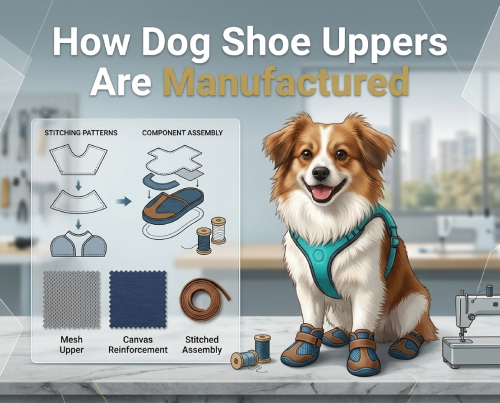
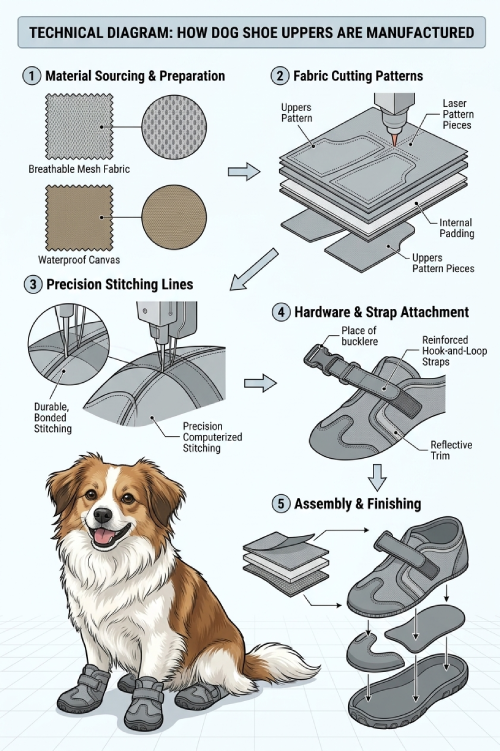
Professional dog shoe upper manufacturing typically includes fabric cutting, sewing, heat pressing, and trimming. Each stage affects the finished shoe's appearance, comfort, and durability. Consistent production depends on accurate patterns, suitable machinery, and clearly defined quality standards.
Step 1: How Does Fabric Cutting Affect Upper Fit and Material Waste?
Production begins with pattern development and fabric inspection. Manufacturers check for holes, color differences, coating defects, and inconsistent thickness before cutting.
Accurate patterns ensure that dog shoe fabric upper panels fit together correctly. Small cutting deviations can cause uneven openings, poor alignment, or excessive tension during assembly. For woven nylon and polyester, cutting direction matters because strength and stretch can vary with the weave. Mesh also requires careful handling to prevent distortion.
Computerized cutting can improve repeatability and material utilization for larger orders, while manual cutting may suit prototypes and small batches. In dog boot upper production, efficient pattern nesting reduces scrap, but manufacturers must preserve the correct fabric direction and component dimensions.
Step 2: What Sewing Techniques Improve Dog Shoe Upper Durability?
Sewing joins the dog shoe fabric upper panels, lining, gussets, and reinforcement components into a three-dimensional structure. Stitch type, thread strength, stitch density, and seam placement all influence durability.
Too many needle penetrations can weaken lightweight mesh, while insufficient stitching may cause seams to separate during use. High-stress areas, including the toe, heel, and closure attachment points, often need additional reinforcement. However, excessive reinforcement can increase weight and restrict flexibility.
For buyers evaluating a dog shoe fabric upper, inspect both the exterior stitching and internal seams. Loose threads, skipped stitches, uneven seam allowances, and rough edges may cause premature failure or discomfort. Production samples should also be checked for consistency across different sizes.
Step 3: How Does Heat Pressing Improve Dog Shoe Uppers?
Heat pressing is commonly used to attach TPU overlays, decorative films, logos, and reinforcement layers. It can create a cleaner finish than additional stitching and reduce exposed seam edges.
Temperature, pressure, and pressing time must match the materials being bonded. Excessive heat may deform synthetic fibers or damage coatings, while insufficient pressure can cause weak adhesion and peeling. Manufacturers should establish suitable process settings through trials rather than apply one standard setting to every fabric.
Bonded samples should be inspected after cooling and, where appropriate, after repeated flexing and abrasion. In dog boot upper production, reinforcement must improve protection without making the dog shoe fabric upper unnecessarily stiff or uncomfortable.
Step 4: Why Are Trimming and Finishing Essential?
Trimming removes excess threads, uneven edges, and surplus bonding materials. Manufacturers also inspect opening symmetry, seam consistency, surface cleanliness, and component alignment before the dog shoe fabric upper moves to sole attachment.
Poor finishing can cause fraying, peeling, and assembly problems. This stage is particularly important for mesh and coated textiles, where exposed edges may deteriorate during repeated use. In a controlled dog shoe upper manufacturing process, final inspection helps identify defects before they become more expensive to correct.
Chapter 3: How Can Buyers Evaluate Quality and Control Manufacturing Costs?
1. Which Quality Tests Matter Most for Dog Shoe Upper Materials?
Testing should reflect the product's intended environment. Summer dog shoes require attention to breathability and flexibility, while outdoor boots need stronger abrasion and tear resistance. Waterproof designs require additional checks on coatings, seams, openings, and closures.
Important quality checks include:
- Dimensional accuracy, fabric thickness, and visual consistency
- Seam strength and stitching quality
- Abrasion resistance and repeated-flex performance
- TPU overlay adhesion and peeling resistance
- Colorfastness and cleaning resistance where relevant
For dog shoe upper materials, buyers should establish measurable acceptance standards before mass production. General descriptions such as "durable" or "waterproof" are not sufficient. Suppliers should provide relevant specifications and test results, and production materials should match the approved sample.
2. How Can Importers Reduce Dog Shoe Upper Manufacturing Costs Without Sacrificing Quality?
The cheapest fabric does not always deliver the lowest overall cost. Low-quality materials can increase cutting waste, sewing defects, and customer returns. Similarly, complicated patterns and excessive reinforcement may increase labor time without improving performance for the intended application.
Buyers can improve cost efficiency by simplifying patterns, standardizing components across product sizes, and selecting materials according to actual use conditions. For example, using nylon or polyester for the main dog shoe fabric upper with limited TPU reinforcement may be more economical than applying heavy protective materials throughout the shoe.
Purchasing teams should also compare minimum order quantities, material availability, sampling costs, and production lead times. Changes to fabric thickness, coating, or reinforcement after sample approval can affect both quality and delivery schedules. A detailed specification reduces misunderstandings between buyers and manufacturers.
Guangzhou Petsun, established in China in 1999, specializes in high-quality pet shoes, with its main business focused on dog shoe design, production, and wholesale. Its emphasis on quality, innovation, customer satisfaction, and environmental responsibility reflects the importance of balancing product performance with manufacturing efficiency. For wholesale buyers, discussing material requirements and end-use conditions early can help manufacturers develop more suitable dog shoe fabric upper constructions.
Chapter 4: Industry FAQ and Practical Sourcing Recommendations
Can Nylon and Polyester Be Used Interchangeably for Dog Shoe Uppers?
Not automatically. Nylon is often selected for strength and abrasion resistance, while polyester offers good color retention and dimensional stability. Actual performance depends on yarn quality, weave, coating, and finishing. Buyers should compare specifications and test results rather than select materials by fiber name alone.
Does TPU Make a Dog Shoe Upper Fully Waterproof?
No. TPU overlays can improve surface protection, but water may still enter through seams, openings, and closures. Buyers should define the required level of water resistance and evaluate the complete shoe under representative conditions.
Why Do Dog Shoe Uppers Peel or Separate After Use?
Peeling may result from incompatible materials, poor surface preparation, incorrect heat-press settings, or insufficient bonding pressure. Repeated flexing can also expose weaknesses in the bond. Quality control should therefore assess adhesion after cooling and repeated movement, not just immediately after pressing.
How Should Buyers Approve Dog Shoe Upper Samples Before Bulk Production?
Request a pre-production sample using the intended fabric, thread, reinforcement, and bonding process. Check dimensions, seam strength, flexibility, edge finishing, and compatibility with the sole. Confirm color standards, defect tolerances, testing requirements, and material substitution policies in writing before approving mass production.
What Information Should Be Included in a Dog Shoe Upper RFQ?
A complete request for quotation should specify the intended application, material composition, fabric thickness or weight, color, reinforcement locations, seam construction, size range, order quantity, testing requirements, and packaging needs. Reference images or physical samples can reduce interpretation errors and help suppliers quote comparable specifications.
Choosing suitable dog shoe upper materials requires evaluating the entire construction rather than focusing only on fabric price. Accurate cutting, reliable sewing, controlled heat bonding, and consistent finishing all contribute to product quality. When these factors are defined before bulk production, buyers can reduce avoidable defects and improve consistency across orders.
For businesses developing a new dog footwear range or expanding wholesale product lines, Guangzhou Petsun can discuss material selection, design requirements, and production options. A clear product brief helps establish an upper construction that balances comfort, durability, and manufacturing efficiency.