
How Rubber Soles Are Made for Dog Shoes
author: Gigi
2026-10-23
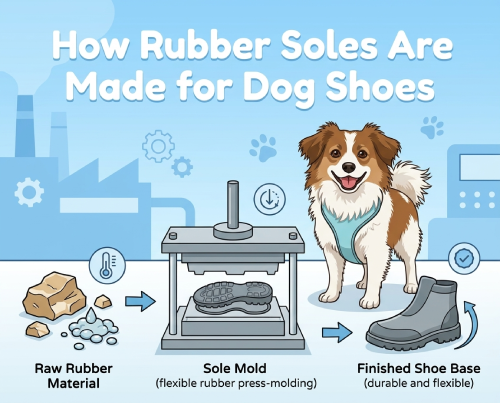
Rubber soles play a critical role in dog footwear performance. They influence traction, abrasion resistance, flexibility, water resistance, and walking comfort.
The manufacturing process involves more than molding rubber into a particular shape. Raw material selection, compounding, mixing, molding, vulcanization, and finishing must work together to achieve consistent performance. Small variations in formulation or processing conditions can affect hardness, elasticity, bonding strength, and production yield.
Chapter 1. What Materials Are Used to Manufacture a Dog Shoe Rubber Sole?
1.1 Which Rubber Materials Offer the Best Balance of Grip, Flexibility, and Durability?
The first step in rubber sole manufacturing is selecting a compound that matches the shoe's intended application. Different elastomers offer different balances of flexibility, wear resistance, weather performance, and cost.
Natural rubber provides high elasticity and good tear resistance, making it useful for flexible soles that experience repeated bending. However, its resistance to oils, ozone, and long-term weathering may require improvement through formulation.
Styrene-butadiene rubber, commonly known as SBR, offers useful abrasion resistance and is widely used in cost-sensitive rubber products. Its performance depends on the formulation, and it may require modification when high flexibility or specialized environmental resistance is needed.
Nitrile rubber is particularly useful where oil resistance matters, although it is not automatically the best choice for ordinary dog footwear. Its material cost and other performance characteristics must justify its inclusion.
Ethylene propylene diene monomer, or EPDM, offers strong resistance to weathering and ozone. It may be considered for products exposed to outdoor conditions, although compound design still determines the final grip and wear characteristics.
Thermoplastic elastomers, or TPE, are also relevant to dog shoe sole production. They can combine rubber-like flexibility with thermoplastic processing, potentially allowing efficient molding and material reuse in suitable manufacturing systems. However, TPE is not identical to vulcanized rubber, and its heat resistance, abrasion performance, and environmental suitability depend on the specific grade.
1.2 How Do Rubber Formulations Affect Sole Cost?
The price of a dog shoe rubber sole depends on more than the base elastomer. Fillers, processing oils, curing agents, pigments, and performance additives all influence material cost and final properties.
Carbon black and silica can reinforce rubber and improve selected mechanical characteristics. Their effects depend on particle properties, loading levels, and compatibility with the compound. Excessive filler loading may increase stiffness or complicate processing, while insufficient reinforcement can reduce durability.
Plasticizing oils can improve processability and flexibility, but the wrong type or concentration may affect aging, strength, or surface characteristics. Curing agents and accelerators determine how the rubber develops its final network structure during vulcanization.
Chapter 2. Rubber Sole Manufacturing: From Raw Materials to a Finished Compound
2.1 How Are Rubber Ingredients Formulated and Mixed?
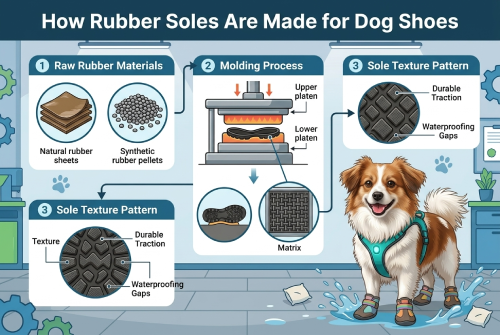
The first stage of rubber sole manufacturing is compounding. Technicians weigh the selected elastomers, reinforcing fillers, processing aids, pigments, and curing ingredients according to a defined formulation.
The ingredients are then processed in an internal mixer or other suitable mixing equipment. During this stage, shear forces distribute the fillers and additives throughout the rubber. Mixing time, temperature, rotor speed, and loading sequence influence dispersion and batch consistency.
Poor dispersion can create weak spots, uneven color, and inconsistent mechanical properties. Excessive heat may also cause premature curing, known as scorch, which reduces the material's ability to flow during subsequent molding.
For better process control, manufacturers monitor batch temperature, mixing energy, and compound uniformity. Curing ingredients may be incorporated during a separate, cooler mixing stage to reduce premature reactions.
A consistent compound is essential for dog shoe sole production because even a well-designed mold cannot compensate for unstable raw material properties.
2.2 How Are Rubber Compounds Shaped Before Vulcanization?
After mixing, the compound is prepared for molding. Two common approaches are compression molding and injection molding, although extrusion and calendering may also be used in particular production systems.
In compression molding, a measured rubber blank is placed into a heated mold. The mold closes under pressure, forcing the compound into the cavity. This method is suitable for many shaped rubber components and can be economical for selected production volumes.
In injection molding, a suitable rubber compound is injected into a closed mold. The molded rubber dog soles process can improve material dosing and support repeatable production, but equipment compatibility, mold complexity, and process requirements affect investment costs.
Calendering passes rubber through rollers to produce sheets of controlled thickness. These sheets can then be cut into sole blanks or used in layered constructions. Calendering is therefore a material preparation method rather than a complete substitute for molding when the molded rubber dog soles requires a three-dimensional tread pattern.
The choice of process depends on sole geometry, compound behavior, production volume, dimensional tolerances, and equipment availability. For molded rubber dog soles, mold design must also account for material flow, air evacuation, shrinkage, and tread details.
2.3 Why Is Vulcanization Critical to Rubber Sole Quality?
Vulcanization uses heat and a curing system to create crosslinks between rubber polymer chains. These crosslinks help the material maintain its shape and recover after deformation.
Insufficient curing may produce weak, tacky, or mechanically unstable soles. Excessive curing can damage the compound's properties, depending on the rubber system and processing conditions.
Cure time and temperature must be established through compound-specific testing, such as rheometer analysis. Mold temperature, sole thickness, and heat transfer also affect the time required for the material to cure throughout its cross-section.
For rubber sole manufacturing, controlling vulcanization is particularly important when soles have thick sections or complex tread patterns. Inconsistent curing can cause differences in hardness, elasticity, wear resistance, and dimensional stability between production batches.
Chapter 3. How Are Dog Shoe Rubber Soles Finished and Quality-Tested?
3.1 How Do Trimming and Surface Finishing Affect Performance?
After molding and curing, the sole is removed from the mold and allowed to cool under appropriate conditions. Excess material around the mold parting line, known as flash, is trimmed away.
Manufacturers then inspect the sole for incomplete filling, surface defects, cracks, dimensional deviations, and visible contamination. Depending on the construction, the surface may require additional preparation before bonding to the shoe upper.
A dog shoe rubber sole must not only meet dimensional requirements but also maintain reliable attachment to the upper. Inadequate surface preparation, incompatible adhesives, contamination, or unsuitable bonding conditions can lead to separation during repeated flexing.
3.2 What Tests Should Buyers Request Before Ordering?
A useful quality program evaluates the properties relevant to the intended application. Common checks include:
- Hardness testing to confirm that the compound falls within the agreed specification.
- Abrasion testing to assess material loss under defined test conditions.
- Flexing or repeated-bending tests to identify cracking and structural weaknesses.
- Tensile and tear testing where applicable to the sole design.
- Bond-strength testing to assess the connection between the sole and upper.
- Slip-resistance testing under relevant surface and environmental conditions.
Test results must be interpreted according to the method used. A hardness value alone does not establish traction, and a laboratory abrasion result does not guarantee a particular service life in every environment.
Chapter 4. Rubber Sole Supply Chain Costs, Purchasing Decisions, and FAQ
4.1 How Can Buyers Reduce Dog Shoe Sole Production Costs Without Sacrificing Quality?
The main cost drivers include elastomer selection, compound formulation, mold investment, cycle time, labor, energy consumption, scrap rate, and secondary finishing.
Standardized molded rubber dog soles designs can reduce tooling complexity and simplify inventory management. Larger production runs may distribute mold costs across more units, but excessive purchasing can increase inventory risk. Custom tread patterns and specialized compounds may improve product differentiation while raising development costs.
When evaluating dog shoe sole production, buyers should compare total cost per accepted component, not simply the quoted price per sole. A cheaper process may generate more rejects, trimming waste, or bonding failures, ultimately increasing the cost of finished footwear.
4.2 FAQ: What Common Manufacturing Problems Should B2B Buyers Watch For?
Why do rubber soles crack after repeated use?
Potential causes include unsuitable compound selection, inadequate curing, excessive stiffness, poor design geometry, or environmental aging. Buyers should request flexing and aging tests appropriate to the intended application.
Why does a sole separate from the shoe upper?
Possible causes include contamination, incompatible materials, inadequate surface preparation, and incorrect bonding conditions. Testing the complete shoe under repeated flexing can help identify weaknesses that isolated sole tests miss.
Are softer rubber soles always better for dog shoes?
No. Softer compounds may improve flexibility but can wear faster or provide insufficient structural support. The ideal molded rubber dog soles hardness depends on the shoe's purpose, outsole thickness, tread design, and expected surface conditions.
Should buyers choose natural rubber, synthetic rubber, or TPE?
There is no universal winner. Natural rubber may suit flexible designs, SBR can support cost-conscious applications, EPDM offers weathering advantages, and TPE may provide processing efficiencies. The final decision should follow performance requirements, production constraints, and verified sample results.
Understanding rubber sole manufacturing helps procurement teams assess materials, production methods, quality risks, and cost trade-offs. For a reliable supply chain, define the required performance, approve samples, verify manufacturing controls, and compare quotations against consistent specifications.
Contact Guangzhou Petsun to discuss your dog shoe requirements and request a wholesale quotation for bulk purchasing or customized products.