Dog Shoe Stitching and Assembly Process
author: Gigi
2026-11-27
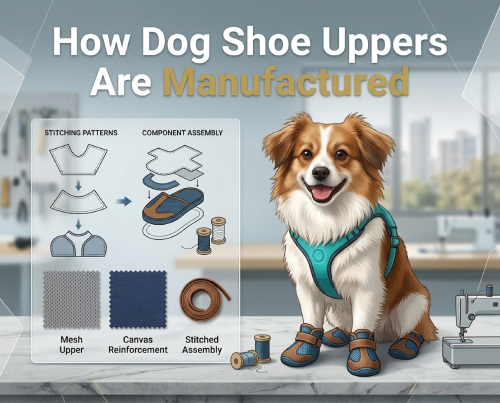
The durability and comfort of dog shoes depend not only on material selection but also on how individual components are stitched and assembled. Uneven seams, weak thread connections, poorly attached soles, and inconsistent construction can lead to product returns and customer complaints. To achieve consistent quality across bulk orders, a reliable factory must coordinate cutting, sewing, component joining, sole attachment, and quality inspection.
1. What Stitching Methods Are Used in Dog Shoe Manufacturing?
Stitching is a critical stage in upper construction. It connects fabric panels, linings, reinforcements, and functional components into a complete shoe upper. Different materials and structural requirements call for different joining methods.
1.1 How Does Flat Stitching Improve Dog Shoe Construction?
Flat stitching, commonly performed with a lockstitch machine, joins two or more material layers along a defined seam line. It is widely used for fabric uppers, lining connections, decorative panels, and reinforcement attachments.
In dog shoe stitching, the quality of a flat seam depends on several technical parameters:
- Stitch density: Determines how closely the needle penetrates the material.
- Thread tension: Excessive tension can cause puckering, while insufficient tension creates loose stitches.
- Seam allowance: Provides sufficient material beyond the stitch line to prevent edge failure.
- Needle selection: Must match material thickness and structure to minimize fabric damage.
For lightweight mesh uppers, an excessively dense stitch pattern may weaken the fabric through repeated needle perforations. For thicker synthetic leather, needle size and thread strength must be adjusted to prevent skipped stitches and thread breakage.
1.2 When Should Overlock Stitching Be Used for Dog Boots?
Overlock stitching wraps thread around the raw edges of fabric to prevent fraying and improve seam stability. It is particularly useful for knitted fabrics, mesh linings, and textile components with exposed edges.
In the dog boot stitching process, overlocking is often applied to internal seams or selected edge-finishing areas. It can reduce loose fibers and create a cleaner internal construction.
However, overlocking is not suitable for every structural connection. High-stress areas around adjustable straps or sole attachment points may require additional reinforcement or a separate lockstitch seam.
1.3 Is Heat Bonding Better Than Traditional Sewing?
Heat bonding uses controlled temperature, pressure, and sometimes adhesive films to join compatible materials without relying entirely on needle-and-thread connections.
It is useful for decorative overlays, seam reinforcement tapes, waterproofing details, and selected synthetic material combinations.
Unlike conventional dog shoe sewing, heat bonding requires careful control of temperature, pressure, and processing time. Excessive heat can deform mesh, damage coatings, or reduce material flexibility.
So, heat bonding should be treated as a complementary joining technology rather than a universal replacement for stitching.
2. How Does the Dog Shoe Assembly Process Work Step by Step?
A well-organized dog shoe assembly process follows a defined sequence. The order matters because incorrectly positioned components can become difficult to adjust after subsequent seams or bonding operations are completed.
2.1 What Happens Before the Upper Sewing Process Begins?
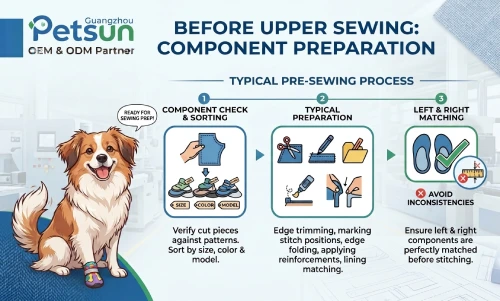
Before dog shoe sewing, cut components should be checked against approved patterns and sorted by size, color, and product model.
Typical preparation operations include edge trimming, marking stitch positions, folding fabric edges, applying reinforcement materials, and matching lining components.
During dog shoe stitching, operators must ensure that corresponding left and right components are correctly matched. Small cutting or alignment differences can produce noticeable inconsistencies in finished pairs.
2.2 What Is the Correct Assembly Sequence for Dog Footwear?
Although construction varies between summer mesh shoes, waterproof boots, and rubber-soled outdoor footwear, a typical production sequence includes:
1. Upper panel preparation: Inspect cut fabrics and prepare reinforcement pieces.
2. Upper stitching: Join front, side, rear, and other structural panels.
3. Lining installation: Attach the inner lining while avoiding wrinkles and excessive bulk.
4. Closure installation: Sew or attach hook-and-loop straps, elastic sections, zippers, or other fastening components.
5. Upper shaping: Form the upper into its intended three-dimensional structure.
6. Outsole attachment: Apply the specified bonding, stitching, or molding method.
7. Finishing: Remove loose threads, clean surfaces, and check the completed footwear.
The dog shoe assembly sequence should be documented in production instructions so that different operators follow the same construction requirements.
2.3 How Are the Upper and Outsole Connected?
Sole attachment is one of the most important operations because the connection must withstand repeated bending, friction, and contact with different surfaces.
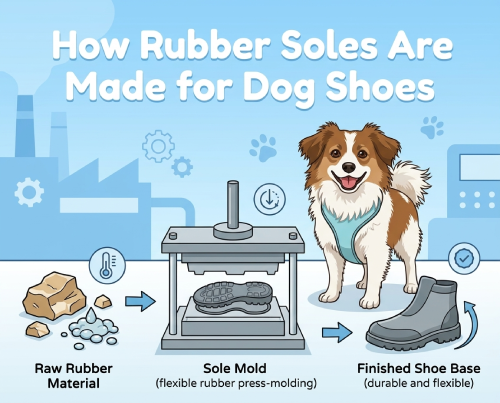
Depending on the product design, manufacturers may use adhesive bonding, direct injection, vulcanization, or mechanical stitching.
For adhesive bonding, the contact surfaces may require cleaning, roughing, primer application, and controlled adhesive coating. Heat activation may also be necessary depending on the adhesive system.
The components are then aligned and pressed under controlled conditions. Incorrect positioning or insufficient bonding pressure can result in uneven edges and premature sole separation.
A reliable dog footwear assembly system must therefore control both upper construction and bottom attachment rather than treating them as unrelated operations.
3. What Quality Control Points Determine Dog Shoe Stitching Performance?
A visually attractive sample does not guarantee stable bulk production. Quality inspection must evaluate construction strength, dimensional consistency, and functional performance.
3.1 Which Defects Should Manufacturers Inspect During Sewing?
The following table summarizes common production defects and their control measures.
| Quality Control Point | Common Defects | Recommended Inspection |
| Stitch formation | Skipped stitches, loose threads, broken seams | Check stitch continuity and thread tension |
| Seam alignment | Uneven seam allowance, puckering | Compare with approved patterns |
| Edge finishing | Fraying, exposed raw edges | Inspect trimming and overlock coverage |
| Component joining | Misaligned panels, folded lining | Check symmetry and internal construction |
| Strap attachment | Weak reinforcement, incorrect positioning | Conduct repeated fastening checks |
| Sole attachment | Open edges, adhesive failure | Inspect bonding and perform peel or flex tests |
The dog boot stitching process should include in-line inspection rather than relying exclusively on final product checks. Early detection prevents defective components from moving into more expensive dog footwear assembly stages.
3.2 How Can Factories Prevent Stitching Problems in Bulk Orders?
Production consistency depends on standardized operating procedures.
Factories should establish specifications for thread type, needle size, stitch density, seam allowance, and reinforcement positioning. Operators should also receive model-specific instructions before production begins.
For the dog boot stitching process, machine settings should be verified whenever the production line changes material thickness or construction type.
Another important factor is operator training. Dog shoe sewing curved openings, narrow straps, and multiple material layers requires different handling techniques. Experienced operators can reduce material distortion and improve seam consistency.
3.3 How Does Production Capacity Affect Assembly Quality?
Production capacity is not simply the number of dog shoe sewing machines or workers in a factory. It also depends on how efficiently cutting, sewing, sole attachment, finishing, and inspection are coordinated.
A bottleneck in upper dog shoe sewing can delay the entire order, even when other departments have sufficient capacity.
A structured dog shoe assembly operation should therefore consider:
- Standardized workstation procedures.
- Balanced workloads between dog shoe sewing and dog footwear assembly stations.
- Material availability and component preparation.
- In-process defect tracking and rework management.
- Production scheduling based on model complexity and order quantity.
4. How Should B2B Buyers Evaluate a Dog Shoe Manufacturing Factory?
When selecting a manufacturing partner, buyers should examine more than the finished sample. They should understand how the factory translates an approved design into repeatable production standards.
What Questions Should Importers Ask About the Dog Shoe Sewing Process?
Q1: Why do dog shoes sometimes develop loose seams after repeated use?
Possible causes include unsuitable thread strength, insufficient seam allowance, excessive needle perforation, poor thread tension, or inadequate reinforcement at stress points. Buyers should request construction details and test samples under realistic use conditions.
Q2: Can heat bonding completely replace traditional stitching?
No. Heat bonding works well for selected materials and applications, but it may not provide sufficient mechanical strength for every structural connection. Hybrid construction often offers a more practical solution.
Q3: Why are some dog shoes asymmetrical even when they use the same size pattern?
Inconsistent cutting, incorrect component matching, uneven dog shoe sewing tension, and inaccurate positioning can affect the final shape. Pair matching and dimensional inspection should be included in production QC.
Q4: How can buyers evaluate whether a factory can handle large orders?
Ask about production workflow, dog shoe sewing operator allocation, daily output by product model, defect tracking, inspection procedures, and previous experience with repeat orders. Requesting a pilot batch can help verify actual production consistency.
Q5: What is the most important quality test after dog footwear assembly?
There is no single test that covers every failure risk. Buyers should consider seam integrity, closure retention, sole bonding strength, repeated flexing, dimensional consistency, and material-specific performance.
High quality pet footwear requires precise coordination between stitching techniques, component preparation, assembly sequencing, and quality inspection. For B2B buyers, understanding these processes makes it easier to assess supplier capabilities, identify production risks, and establish realistic product specifications.
Guangzhou Petsun has specialized in good quality dog footwear assembly shoes since 1999, if brands and wholesalers planning new collections or repeat orders, just discussing construction details, sample requirements, and quality standards with the experienced dog footwear assembly manufacturer Guangzhou Petsun is a practical first step toward consistent bulk production.