How to Choose Wholesale Dog Shoes
author: Gigi
2026-10-26
Chapter 1: How Should Retailers Evaluate Wholesale Dog Shoes?
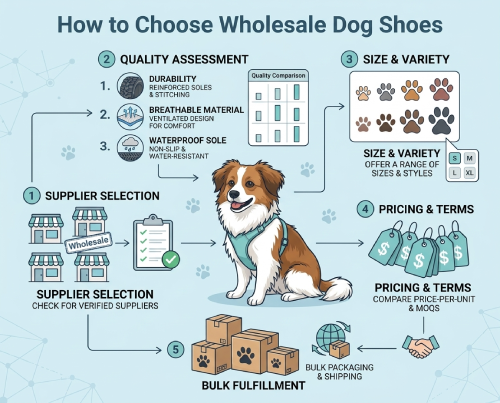
Choosing wholesale dog shoes involves more than comparing unit prices. It’s important to choose dog shoe wholesaler, too. The buyers must consider material performance, product positioning, size coverage, minimum order quantities, customization, and wholesale dog boots supplier reliability. A low-cost product may create higher expenses if sizing problems, weak closures, or poor durability lead to customer complaints and returns.
1. Which Dog Shoe Materials Are Best for Different Markets?
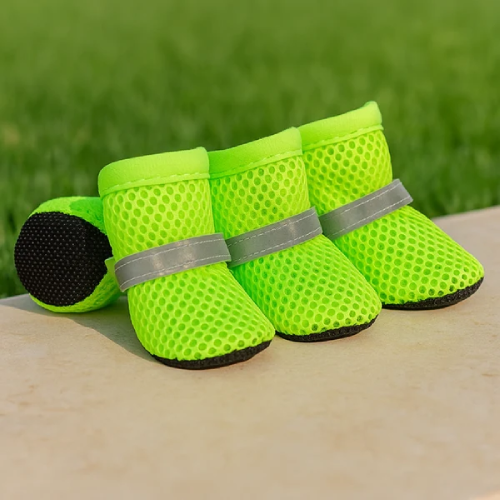
Material selection should match the customer's needs and the conditions in which the shoes will be used. Lightweight mesh and breathable polyester are suitable for summer footwear, where ventilation and flexibility are priorities. Nylon offers useful abrasion resistance for outdoor products, while coated fabrics and TPU reinforcement can improve surface protection in demanding environments.
Rubber and other flexible sole materials influence grip, wear resistance, and walking comfort. A thick, rigid sole may offer protection on rough ground but can restrict paw movement if the upper is poorly designed. Conversely, a soft sole can feel comfortable but may wear quickly on abrasive surfaces.
When evaluating a wholesale dog shoe supplier, buyers should request material specifications rather than relying on descriptions such as "premium," "waterproof," or "heavy-duty." Ask how the upper is constructed, how the sole is attached, and whether closures remain secure during repeated movement. These details help determine whether a product suits everyday walking, hot pavement, rain, snow, or outdoor adventures.
2. How Can Buyers Choose the Right Product Mix?
Retailers should avoid purchasing a broad assortment without understanding local demand. A practical product range can begin with everyday walking shoes, breathable summer styles, and protective outdoor boots. Seasonal or specialized products can be added after sales data reveals demand.
Size coverage is equally important. Dogs vary considerably in paw width, length, shape, and weight, so a product range should not assume that one size system works for every breed. Buyers should review the wholesale dog shoe supplier's measurement guide, test representative sizes, and assess how easily customers can select the correct fit.
To choose dog shoe wholesaler options effectively, compare the entire assortment rather than individual products. A wholesale dog shoe supplier with consistent sizing, repeatable quality, and several compatible designs may be more useful than one offering a lower price on a single style.
Chapter 2: How Do Wholesale Prices, MOQ, and Order Quantities Affect Profitability?
1. What Is a Reasonable Wholesale Dog Shoe Price?
Wholesale prices vary according to material quality, construction complexity, order volume, customization, packaging, and destination market. Simple fabric shoes generally cost less to produce than reinforced waterproof boots or products with specialized closures and molded soles.
Buyers should compare quotations at equivalent specifications. A low-priced shoe made with thin mesh and basic stitching is not directly comparable to a reinforced outdoor boot. When evaluating a wholesale dog boots supplier, request pricing for the same size range, materials, packaging, and quality requirements.
Calculate landed cost rather than focusing only on the factory price. Freight, import duties, inspection, packaging, warehousing, platform commissions, and expected return rates all affect profitability. A slightly higher purchase price may be commercially preferable if it reduces defects and customer complaints.
For e-commerce sellers, product weight and package dimensions also influence fulfillment costs. Lightweight shoes may be easier to ship, but excessive packaging or bulky presentation boxes can reduce margins. Retailers should model expected profit using realistic selling prices and operating expenses before committing to a large order.
2. How Should Buyers Compare MOQ and Bulk Purchasing Options?
Minimum order quantity (MOQ) depends on whether the product is an existing stock design or a newly developed item. Standard products may be available in smaller quantities, while customized colors, logos, packaging, or new patterns can require larger commitments.
For first-time dog shoe bulk buying, a small trial order is often safer than purchasing a large volume immediately. It allows buyers to test sizing, product durability, customer feedback, and sales conversion before replenishing inventory.
However, small orders can have higher unit costs and may not qualify for the best production pricing. Buyers should ask suppliers for several quantity-based quotations, including sample orders, initial stock orders, and repeat-order volumes. Compare the savings against inventory risk rather than assuming that the largest order is always the most economical.
Size allocation deserves special attention. A dog shoe bulk buying order can become difficult to sell if popular sizes sell out while less common sizes remain in stock. Review historical sales where available, or use a limited launch to establish a more reliable size distribution.
3. Which Customization Options Are Worth Paying For?
Customization may include logo printing, branded labels, packaging, fabric colors, closure changes, material combinations, and adjustments to sole design. Each option serves a different business objective.
For new brands, packaging and logo customization can strengthen brand recognition without requiring a completely new shoe structure. More substantial changes, such as developing a proprietary upper pattern or specialized waterproof construction, may require additional sampling, tooling, testing, and development time.
Before placing a customized order, confirm artwork requirements, sample approval procedures, production lead times, ownership of custom designs, and the policy for defective goods. Buyers should also clarify whether the quoted MOQ applies per style, color, size, or total order. These distinctions can substantially change the actual purchasing commitment.
A reliable wholesale dog shoe supplier or choose dog shoe wholesaler should explain which changes can be made to existing products and which require new development. This helps buyers prioritize customization that creates measurable value rather than adding complexity without proven demand.
Chapter 3: How Can Buyers Evaluate a Wholesale Dog Shoe Supplier?
1. What Should Retailers Check Before Choosing a Supplier?
A wholesale dog shoe supplier's reliability depends on more than its catalogue. Buyers should evaluate production capability, quality-control procedures, communication, order consistency, and its ability to handle repeat orders.
Ask how incoming materials are inspected, how finished shoes are checked, and how sizing consistency is maintained across production batches. Request samples from the intended product range and inspect stitching, sole attachment, closure strength, edge finishing, and comfort. For specialized products, confirm that performance claims are supported by appropriate testing.
When you choose dog shoe wholesaler partners, also assess their response to problems. Clear defect-handling procedures, documented specifications, and realistic delivery commitments are valuable indicators of a workable long-term relationship.
2. Should Buyers Work With a Factory or a Trading Company?
Factories may offer closer control over production processes, material selection, and customization. Trading companies may provide access to multiple manufacturers, broader product selection, and consolidated purchasing. Neither model is automatically better; the right choice depends on order size, product complexity, and sourcing requirements.
A wholesale dog boots supplier with direct manufacturing capabilities may be particularly useful when buyers need customized materials, consistent specifications, or product development support. Regardless of the supplier model, confirm who is responsible for quality inspection, production scheduling, and resolving defects.
Guangzhou Petsun, established in China in 1999, specializes in high-quality pet shoes, with its main business focused on design, production, and wholesale. Its emphasis on quality, innovation, customer satisfaction, and environmental responsibility reflects several considerations relevant to buyers evaluating long-term manufacturing partnerships.
Chapter 4: Wholesale Dog Shoe Buying FAQ and Practical Recommendations
How Can Buyers Avoid Unsold Inventory?
Start with a focused assortment based on customer demand, climate, and selling channel. Test a limited range of sizes and styles before expanding. Review sell-through rates, return reasons, and customer feedback before increasing order quantities. This approach makes dog shoe bulk buying more data-driven and reduces the risk of excess inventory.
What Is the Biggest Risk When Buying Cheap Wholesale Dog Shoes?
The main risk is that low initial prices conceal weaknesses in fit, construction, or material durability. Poorly attached soles, unreliable closures, and inconsistent sizing can increase returns and damage customer trust. Compare total landed cost and expected return rates, not just the quoted unit price.
Can Buyers Mix Sizes and Colors Within One MOQ?
Sometimes, but policies differ by supplier and product. Some dog shoe bulk buying manufacturers calculate MOQ per style or color, while others permit mixed sizes within a production run. Ask for written confirmation before placing an order, including any additional charges for smaller color quantities or special packaging.
How Can Importers Verify Product Quality Before Shipment?
Approve a reference sample and establish written inspection criteria covering dimensions, materials, stitching, closures, sole attachment, packaging, and acceptable defect levels. For larger orders, consider pre-shipment inspection based on a mutually agreed sampling plan. Keep production records so repeat orders can be compared with the original specifications.
What Should a Wholesale Dog Shoe RFQ Include?
A complete request for quotation should identify the target market, intended use, materials, size range, quantity, customization requirements, packaging, delivery destination, and expected lead time. Request sample costs, MOQ rules, production pricing tiers, and defect-handling terms. This allows buyers to compare dog shoe bulk buying suppliers on consistent criteria.
The best dog shoe bulk buying decision balances product suitability, landed cost, order flexibility, and supplier reliability. Start with materials and functions that match customer needs, test samples before scaling, and calculate MOQ against realistic sales forecasts. Careful supplier evaluation is especially important when moving from standard products to customized designs.
Guangzhou Petsun can be a starting point for discussing product specifications, customization, and sourcing requirements. A clearly defined purchasing brief helps both parties assess whether the proposed products fit the target market and commercial objectives. Just contact us!