Quality Testing Dog Shoe Material Inspection
author: Gigi
2026-11-28
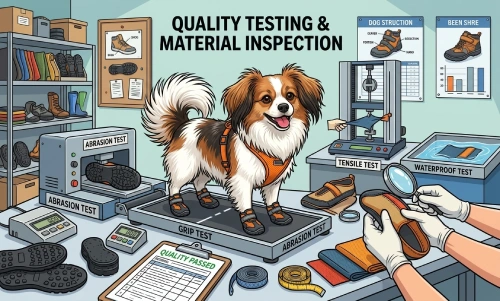
Material quality is one of the most important factors determining the durability, comfort, and safety of dog shoes. Weak fabric, unstable coatings, defective fasteners, or excessive chemical residues can lead to product failures, customer complaints, and costly returns.
A systematic dog shoe material inspection program should begin before materials enter the production workshop. Incoming Quality Control (IQC) helps manufacturers identify defects at the source, verify supplier consistency, and prevent unsuitable components from moving into production.
1. Why Is Dog Shoe Material Inspection Essential for Incoming Quality Control?
Dog shoes combine multiple materials, including textile uppers, rubber or PVC outsoles, linings, cushioning materials, adhesives, sewing threads, and fastening accessories. Each component has different performance requirements and potential failure modes.
1.1 What Should B2B Buyers Check Before Accepting Raw Materials?
An effective dog shoe material inspection process should cover four basic areas:
- Specification verification: Confirm material composition, thickness, weight, dimensions, color, and supplier identification against approved samples and purchase specifications.
- Visual dog shoe material inspection: Identify stains, holes, scratches, uneven coatings, color differences, and surface contamination.
- Physical performance: Evaluate tensile strength, tear resistance, abrasion resistance, flexibility, and dimensional stability.
- Batch consistency: Compare incoming materials with previously approved batches to identify unexpected changes in texture, hardness, color, or construction.
One common procurement problem is that suppliers replace materials with visually similar alternatives without informing the buyer. For example, a different textile backing or rubber formulation may change flexibility and durability even when the surface appearance remains almost identical.
1.2 How Can Buyers Establish a Practical Inspection Standard?
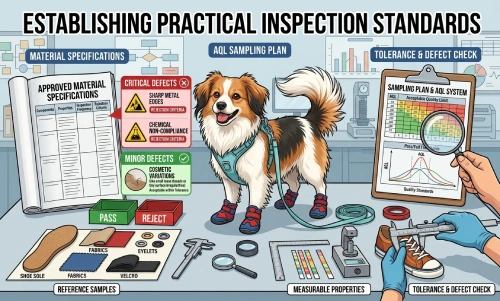
Create an approved material specification for every component. It should include reference samples, measurable properties, acceptable tolerances, dog shoe material inspection frequency, and rejection criteria.
For large orders, buyers can also apply an agreed sampling plan and AQL system. Critical dog shoe material defects, such as sharp metal edges or chemical non-compliance, should have stricter acceptance requirements than minor cosmetic variations.
2. How to Inspect Dog Shoe Fabric Quality and Identify Textile Defects?
The upper and lining directly contact the dog's paws or surrounding skin. Their properties influence breathability, flexibility, friction, moisture management, and wearing comfort.
1.3 Which Fabric Properties Should Be Included in Dog Shoe Fabric Quality Testing?
Common upper materials include polyester mesh, nylon fabric, Oxford cloth, knitted textiles, and synthetic leather.
A professional dog shoe fabric quality evaluation should include the following tests:
1. Fiber composition and fabric weight
Check whether the actual fiber composition matches the supplier's declaration. Fabric weight can be measured using ASTM D3776, while fiber composition can be examined using appropriate textile identification methods.
Unexpected weight variations may indicate a change in yarn density or fabric construction.
2. Tensile and tear strength
Tensile testing evaluates the force required to break a fabric specimen, while tear testing measures its resistance to an expanding cut.
ASTM D5034 and ISO 17706 are examples of relevant textile and footwear material test methods.
3. Abrasion resistance
Martindale abrasion testing helps determine whether mesh, lining, or coated fabric can withstand repeated rubbing. Weak abrasion resistance may cause thinning, pilling, or holes around high-contact areas.
4. Colorfastness
Use ISO 105-X12 or AATCC 8 to evaluate color transfer during dry and wet rubbing. Water and perspiration colorfastness should also be considered for materials exposed to moisture.
5. Flexibility and coating adhesion
Repeated bending can reveal cracking, peeling, or delamination in coated textiles and synthetic leather.
1.4 What Are the Most Common Dog Shoe Material Defects in Fabric?
Typical dog shoe material defects include uneven mesh density, broken yarns, inconsistent dyeing, coating bubbles, excessive stiffness, and weak bonding between fabric layers.
For visual identification, inspectors should examine materials under consistent lighting and compare them against approved color and texture samples. A simple stretch-and-release check can reveal poor elasticity or permanent deformation, while rubbing tests can expose unstable surface dyes.
3. How Should Accessories, Hardware and Outsole Materials Be Inspected?
Beyond the upper fabric, fastening accessories and sole materials determine whether dog shoes remain secure and withstand repeated movement.
3.1 How to Perform Dog Boot Material Testing on Accessories and Hardware?
Common accessories include hook-and-loop fasteners, elastic bands, zippers, plastic buckles, metal eyelets, and sewing threads.
Inspectors should focus on:
- Hook-and-loop fasteners: Check engagement strength, adhesive or stitching quality, edge fraying, and repeated opening performance.
- Elastic materials: Measure extension and recovery to identify excessive permanent deformation.
- Zippers: Check smooth operation, tooth alignment, slider movement, and seam attachment.
- Metal eyelets and buckles: Inspect plating, corrosion, sharp edges, dimensional accuracy, and attachment strength.
- Sewing threads: Verify thickness, color consistency, tensile strength, and resistance to abrasion.
3.2 How Can Buyers Identify Outsole and Adhesive Defects?
Rubber, TPR, PVC, and other polymer-based materials are commonly used in dog shoe soles.
Important dog shoe material inspection items include hardness, thickness, density, flexibility, abrasion resistance, and surface uniformity.
Typical dog shoe material defects in outsole materials include:
- Surface bubbles caused by molding or processing problems.
- Uneven thickness resulting in inconsistent ground contact.
- Brittle edges or cracks caused by unsuitable formulations or aging.
- Poor bonding caused by contamination, inadequate surface treatment, or incompatible adhesives.
- Color variation caused by inconsistent pigment dispersion.
Relevant footwear test methods include SATRA TM 174 for outsole abrasion, SATRA TM 205 for hardness, and SATRA TM 161 for flex resistance. Sole bonding can be evaluated using SATRA TM 411 or ISO 17708.
The selected test method should match the actual sole material and product construction.
| Component | Main dog shoe material inspection items | Common dog shoe material defects | Relevant test methods |
| Upper fabric | Weight, tensile, tear, abrasion | Holes, weak yarns, coating peeling | ASTM D3776, ISO 17706, ISO 17704 |
| Lining | Abrasion, colorfastness, flexibility | Pilling, dye transfer, rough surface | ISO 17704, ISO 105-X12 |
| Hook-and-loop | Engagement and attachment strength | Weak fastening, fraying | In-house repeated-cycle and pull tests |
| Zippers and buckles | Operation, strength, corrosion | Jamming, breakage, rust | EN 16732, SATRA TM 141 |
| Outsole | Hardness, abrasion, flex resistance | Cracking, bubbles, deformation | SATRA TM 174, TM 205, TM 161 |
| Adhesives | Bonding and aging resistance | Delamination, loss of adhesion | SATRA TM 411, ISO 17708 |
4. How to Verify Environmental Compliance and Prevent Material Safety Risks?
Physical durability alone cannot guarantee that dog shoe materials are suitable for their intended market. Chemical safety is another essential part of supplier qualification and incoming inspection.
4.1 Which Chemical Substances Should Be Checked in Dog Shoe Materials?
Depending on material composition, manufacturing processes, and destination-market requirements, relevant restricted substances may include:
- Azo dyes: Certain aromatic amines may be released from unsuitable dyed textiles.
- Phthalates: Potentially present in some PVC and plasticized components.
- Heavy metals: Lead, cadmium, and nickel may be associated with pigments, coatings, or metal accessories.
- Formaldehyde: May be associated with certain textile finishes, adhesives, or chemical treatments.
- PAHs: May be relevant to certain rubber and polymer components.
- PFAS: May require investigation in water-repellent coatings and treatments.
For EU-bound products, applicable REACH restrictions and current substance requirements should be reviewed. Other destinations may have different chemical safety obligations.
4.2 How Can Manufacturers Verify Environmental Compliance?
A reliable compliance process combines supplier declarations, material safety documentation, risk based laboratory testing, and batch traceability.
For higher risk materials, third-party dog boot material testing can verify restricted substances. Methods such as EN 14362 for certain azo colorants and ISO 14184-1 for formaldehyde are useful references.
Certificates should also be checked for validity, dog boot material testing scope, material identity, and supplier information.
4.3 How Does Guangzhou Petsun Approach Material Quality Management?
As a specialist in pet shoe design, production, and wholesale since 1999, Guangzhou Petsun operates in a product category where fabric selection, sole performance, fastening reliability, dog shoe fabric quality and safety all influence the final product.
4.4 FAQ: Common Questions About Dog Shoe Material Inspection
Q1: Can visual dog shoe material inspection alone determine whether dog shoe materials are qualified?
No. Visual dog shoe material inspection identifies surface defects, but it cannot reliably measure tensile strength, abrasion resistance, chemical residues, or long-term flexibility. Laboratory and mechanical tests are necessary for performance-critical properties.
Q2: Why do materials that pass incoming inspection sometimes fail during production?
Incoming materials may pass individual tests but perform differently after cutting, sewing, molding, or bonding. For example, a fabric may have adequate tensile strength but tear around needle holes. Dog boot material testing should therefore be supplemented by process trials and finished-product evaluation.
Q3: How can buyers prevent inconsistent dog shoe fabric quality between orders?
Use approved reference samples, fixed material specifications, batch identification, supplier change control procedures, and periodic verification dog boot material testing. Any change in composition, coating, factory, or material source should require prior approval.
Q4: Are supplier test reports sufficient for chemical compliance?
Not always. Buyers should verify the dog boot material testing laboratory, report date, tested material, analytical methods, and applicable substance limits.
Q5: Which dog shoe material defects should be treated as critical during incoming inspection?
Sharp metal edges, detachable small components, serious chemical non-compliance, and structural defects that could cause injury or loss of shoe retention deserve immediate attention.
Effective material inspection is not simply a rejection procedure. It is a preventive dog shoe fabric quality management system that connects supplier qualification, material verification, production consistency, and finished-product performance.
Guangzhou Petsun welcomes B2B inquiries about dog shoe manufacturing, product customization, and wholesale cooperation.