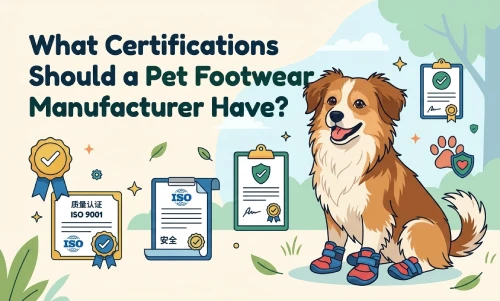
What Certifications Should a Pet Footwear Manufacturer Have?
author: Gigi
2026-11-23
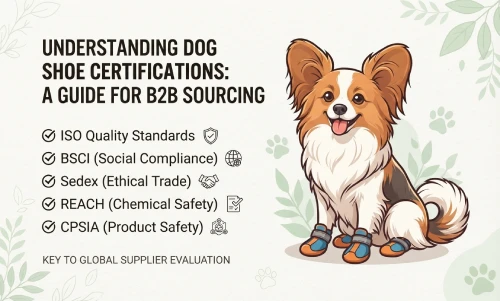
When sourcing dog shoes internationally, buyers need to evaluate more than product quality and manufacturing prices. So, dog shoe certifications are important for buyers to understand. Understanding dog shoe certifications is therefore an important part of B2B supplier evaluation. ISO, BSCI, Sedex, REACH, and CPSIA serve different purposes, and not every requirement applies to every pet footwear manufacturer or destination market.
1. What Quality Management and Social Compliance Certifications Should Dog Shoe Manufacturers Have?
A reliable manufacturer should demonstrate that its production processes are controlled and that its workplace meets relevant ethical requirements.
1.1 Is ISO 9001 Important When Choosing an ISO Dog Shoe Manufacturer?
ISO 9001 is an internationally recognized quality management system pet footwear safety standards. The ISO dog shoe manufacturer can establish documented procedures for production control, supplier management, inspection, corrective actions, and continuous improvement.
For dog footwear production, these ISO dog shoe manufacturer procedures are particularly important because different materials, sizes, and construction methods can create inconsistencies between production batches.
When evaluating an ISO dog shoe manufacturer, buyers should check:
- Whether the ISO 9001 certificate is valid and issued by a credible certification body.
- Whether the certified legal entity matches the actual supplier.
- Whether the production site and certification scope cover relevant manufacturing activities.
- Whether quality inspection and corrective-action procedures are documented.
ISO 9001 is not a product safety certificate. An ISO dog shoe manufacturer proves operational consistency, not automatic product compliance.
When comparing different dog shoe certifications, buyers should distinguish between factory management qualifications and product compliance documents. An ISO dog shoe manufacturer may have a certified quality management system without having tested every material used in its dog boots.
Therefore, evaluating ISO dog shoe manufacturer certifications should involve checking both factory-level documentation and product-specific testing records.
1.2 What Do BSCI and Sedex Mean for Pet Footwear Suppliers?
Social compliance is increasingly important for international retailers and private-label brands.
BSCI evaluates suppliers against social responsibility requirements, including working conditions, occupational health and safety, working hours, remuneration, and workers' rights.
Sedex/SMETA provides a framework for ethical trade audits. Depending on the audit scope, assessments may cover labor standards, health and safety, environmental management, and business ethics.
An important distinction is that BSCI and SMETA are social compliance audit systems, not product quality dog shoe certifications.
When reviewing dog boot factory certifications, buyers should request current audit reports, facility information, findings, and corrective-action plans rather than simply asking whether a supplier has a certificate.
2. What Chemical Regulations and Pet Footwear Safety Standards Apply to Dog Shoes?
Chemical compliance deserves particular attention because dog footwear may contain synthetic fabrics, rubber soles, adhesives, dyes, coatings, and metal accessories.
2.1 Does REACH Apply to Dog Shoes Sold in Europe?
REACH is the EU's Regulation on Registration, Evaluation, Authorisation and Restriction of Chemicals.
It regulates chemical substances and establishes responsibilities for manufacturers and importers to manage chemical risks.
For dog shoes, relevant material assessments may include:
- Phthalates in certain plasticized materials.
- Restricted azo dyes in dyed textiles and leather.
- Chromium VI in applicable leather materials.
- Lead and cadmium in certain components.
- Restricted substances in rubber, coatings, and adhesives.
Buyers should request material declarations and relevant laboratory test reports based on the actual product composition.
A general REACH statement is not sufficient evidence that every component complies. The test scope should identify the tested materials, restricted substances, applicable limits, and report date.
2.2 Does CPSIA Apply to Pet Footwear Sold in the United States?
CPSIA is the US Consumer Product Safety Improvement Act. It establishes requirements for certain consumer products, particularly products designed primarily for children aged 12 or younger.
Ordinary dog shoes intended for animal use are not automatically children's products simply because children may handle them.
However, if a product is designed, marketed, or represented primarily for children's use, its legal classification must be assessed separately. Applicable children's product requirements may include third-party testing, a Children's Product Certificate (CPC), and tracking labels.
2.3 Which Pet Footwear Safety Standards Should Buyers Evaluate?
There is no single universal international pet footwear safety standards covering every type of dog shoe. Buyers should develop product-specific testing requirements according to materials, construction, intended use, and destination market.
| Compliance Area | Relevant Standard or Assessment | What Buyers Should Verify |
| Quality management | ISO 9001 | Production control and quality procedures |
| Environmental management | ISO 14001 | Environmental management practices |
| Social responsibility | BSCI / Sedex SMETA | Workplace conditions and audit findings |
| Chemical compliance | EU REACH | Restricted substances and material test reports |
| US children's products | CPSIA, when applicable | Required testing and certification |
| Physical performance | Laboratory testing | Sole bonding, abrasion, flexibility, and seam strength |
These pet footwear safety standards should be selected according to actual product risks rather than treated as a universal checklist.
3. How Can Buyers Verify Dog Boot Factory Certifications and Testing Reports?
Possessing documents does not automatically mean a manufacturer is compliant. Buyers must verify whether documentation is genuine, current, and relevant to the products being purchased.
3.1 What Documents Should You Request from a Dog Shoe Manufacturer?
Company and management documents: Business registration, ISO certificates, manufacturing-site details, and quality management procedures.
Social compliance documents: BSCI audit reports, Sedex membership information, SMETA reports, and corrective-action records where applicable.
Material compliance documents: REACH test reports, material declarations, chemical safety information, and supplier documentation.
Product testing reports: Tests covering sole adhesion, abrasion resistance, flex resistance, stitching strength, colorfastness, and fastening durability.
When evaluating dog shoe certifications, buyers should pay attention to the relationship between the report and the actual product.
3.2 How Can Buyers Identify Invalid or Misleading Factory Certificates?
A complete dog boot factory certifications review should examine the relationship between the certificate holder, manufacturing location, and actual production processes.
Some suppliers operate through multiple facilities or outsource certain components. Buyers should verify whether documents cover the relevant production sites and activities.
Check the following details:
1. Certificate holder and legal company name.
2. Manufacturing site and certification scope.
3. Issuing organization and verification information.
4. Issue date, expiry date, and current validity.
5. Product model, material, or batch covered by test reports.
6. Laboratory identity and testing methods.
For higher-risk materials or important export markets, consider independent laboratory testing before shipment.
An ISO dog shoe manufacturer should also be able to explain how its quality system controls incoming materials, production inspections, finished-product testing, and nonconforming products.
Procurement teams should request evidence of internal inspections, supplier evaluation procedures, corrective actions, and material traceability. These procedures help determine whether pet footwear safety standards are integrated into daily manufacturing operations or merely mentioned in marketing materials.
4. Common Compliance Problems: Expert FAQ for B2B Buyers
Q1: Must Every Dog Shoe Manufacturer Have ISO 9001?
Not necessarily. ISO 9001 is valuable evidence of a structured quality management system, but it is not universally mandatory for dog footwear manufacturers.
Buyers should evaluate actual production controls and customer-specific requirements rather than automatically reject every supplier without the certificate.
Q2: Are BSCI and Sedex Mandatory for Exporting Dog Shoes?
They are not universal legal requirements for exporting dog shoes. However, some international retailers and sourcing programs require suppliers to undergo specific social compliance audits.
Confirm the buyer's requirements and accepted audit schemes before supplier selection. Reviewing actual dog boot factory certifications and audit findings is more useful than relying on a supplier's general compliance claims.
Q3: Can One REACH Test Report Cover an Entire Dog Shoe Collection?
Not automatically. Different fabrics, rubber compounds, coatings, adhesives, and accessories may have different chemical compositions.
Buyers should confirm whether tested samples represent the materials used in the actual production order. A material change may require additional assessment.
Q4: Should Pet Footwear Manufacturers Provide CPSIA Certificates?
Ordinary dog shoes intended for pets are generally outside the children's product classification. CPSIA requirements become relevant when a product is legally classified as a children's product.
Importers should assess intended use, marketing, packaging, and product presentation before determining applicable obligations.
Q5: What Is More Important: Factory Certification or Product Testing?
Both serve different purposes. Factory certifications and audits help evaluate management systems and workplace practices, while product testing provides evidence about specific material or performance characteristics.
Q6: How Often Should Buyers Verify Dog Shoe Manufacturer Certifications?
Buyers should verify certification validity before starting a new supplier relationship and periodically during long-term cooperation.
Evaluating a pet footwear manufacturing partner? Contact ISO dog shoe manufacturer Guangzhou Petsun to discuss dog shoe product specifications, manufacturing capabilities, and documentation relevant to your wholesale or OEM/ODM requirements.
What Should You Ask a Dog Shoe Manufacturer Before Ordering?
Related Article
Learn what to ask a dog shoe manufacturer before ordering. Compare MOQ, lead times, OEM options, samples, pricing, payment terms, and quality guarantees. - Guangzhou Petsun
What Should You Ask a Dog Shoe Manufacturer Before Ordering?
How to Build a Profitable Retail Category - Guangzhou Petsun
Wholesale Dog Shoes for Pet Stores