What Should You Ask a Dog Shoe Manufacturer Before Ordering?
author: Gigi
2026-11-20
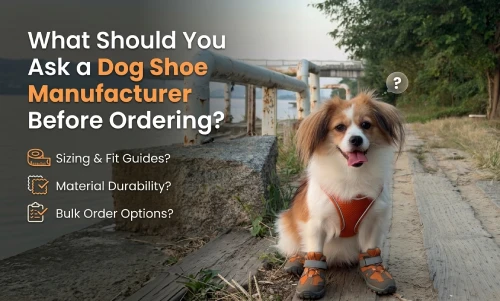
Choosing a dog shoe manufacturer is not simply about finding an attractive product at a competitive price. For importers, wholesalers, and private-label brands, the success of a bulk order depends on production capacity, material consistency, delivery schedules, customization capabilities, and clearly defined commercial terms.
Before placing an order, buyers should ask specific dog shoe manufacturer questions about minimum order quantities (MOQs), lead times, pricing, samples, quality guarantees, and payment conditions. These details help prevent unexpected expenses, production delays, and disputes after delivery.
1. What Should You Ask About MOQ, Pricing, and Production Lead Times?
The first stage of a dog boot factory inquiry should establish whether the manufacturer can meet your purchasing dog shoe OEM requirements and deliver within your expected timeframe.
1.1 How Is the Dog Shoe Manufacturer MOQ Calculated?
Ask the supplier:
- What is your minimum order quantity per style?
- Is dog shoe manufacturer MOQ calculated separately by color and size?
- Can different sizes be combined within one order?
- Are lower quantities available for trial orders?
- Does customization increase the minimum quantity?
Understanding the dog shoe manufacturer MOQ is particularly important because dog footwear involves multiple sizes, colors, and materials.
For example, a factory may accept a mixed-size order but require a separate minimum quantity for each color. Custom rubber soles, specialized fabrics, and printed packaging may also have independent material minimums.
Buyers should therefore distinguish between the finished-product dog shoe manufacturer MOQ and the minimum dog shoe OEM requirements of individual components.
1.2 What Production Lead Time Should Buyers Confirm?
Ask the manufacturer to separate the following timelines:
1. Sample development and approval.
2. Raw material procurement.
3. Mass production.
4. Quality inspection and rework, if necessary.
5. Packaging and shipment preparation.
A supplier's quoted lead time should begin from a clearly defined milestone, such as deposit receipt, final specification approval, or material confirmation.
During a dog boot factory inquiry, also ask whether peak-season orders affect production schedules and how unexpected material shortages are handled.
1.3 How Should You Compare Prices and Trade Terms?
A professional quotation should specify unit price, currency, dog shoe manufacturer MOQ, packaging, sample charges, tooling costs, and quotation validity.
| Commercial Item | Questions Buyers Should Ask | Risk to Avoid |
| Unit price | What materials and processes are included | Hidden production costs |
| Dog Shoe Manufacturer MOQ | Is it per style, color, or size? | Unexpected inventory commitments |
| Incoterms | Is the quotation EXW, FOB, CIF, or DDP? | Unclear freight and customs responsibilities |
| Sample fees | Are development and courier costs included? | Unexpected sample expenses |
| Payment | When is the deposit and balance due? | Excessive upfront exposure |
| Warranty | How are defective products handled? | Unresolved quality claims |
Compare quotations using the same specifications and delivery terms. The lowest unit price does not necessarily represent the lowest landed cost.
2. What Should You Confirm About Dog Shoe OEM Requirements and Samples?
Customization can differentiate a pet footwear brand, but unclear specifications often create expensive revisions and inconsistent bulk production.
2.1 What Customization Options Can a Dog Shoe Manufacturer Provide?
When discussing dog shoe OEM requirements, ask:
- Can you customize shoe designs, colors, and materials?
- Are different upper fabrics and outsole materials available?
- Can you develop customized sizing and size labels?
- Do you support logo printing, embroidery, and private-label packaging?
- Can you modify existing designs or develop completely new products?
- Who owns customized molds, patterns, and artwork?
For dog shoes, buyers should pay particular attention to construction details.
The upper material affects breathability and flexibility, while outsole thickness, rubber hardness, and tread patterns influence grip and durability. Closure systems such as Velcro straps and zippers also affect fitting convenience and product performance.
A detailed specification sheet should document material types, dimensions, color standards, stitching dog shoe OEM requirements, sole construction, and acceptable tolerances.
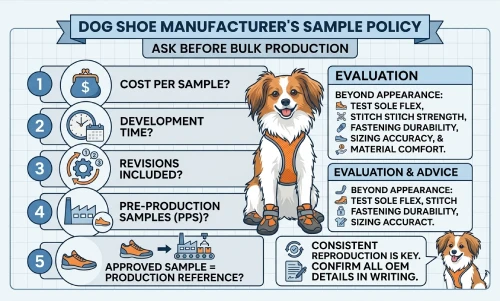
2.2 What Is the Manufacturer's Sample Policy?
Before bulk production, ask:
1. How much does each sample cost?
2. How long does sample development take?
3. How many sample revisions are included?
4. Can you provide pre-production samples?
5. Will the approved sample become the reference for mass production?
Sample evaluation should go beyond appearance. Buyers should test sole flexibility, stitching strength, fastening durability, sizing accuracy, and material comfort.
A common procurement mistake is approving a sample without ensuring that the factory can reproduce it consistently at scale.
Therefore, all dog shoe OEM requirements should be confirmed in writing before production begins.
3. How Should Buyers Negotiate Quality Guarantees, Payment Terms, and Delivery Responsibilities?
Commercial negotiations should define not only what the manufacturer promises but also what happens when the order fails to meet agreed specifications.
2.1 What Quality Control and Warranty Terms Should Be Included?
Ask the supplier:
- Do you inspect incoming materials and finished products?
- Are in-line and pre-shipment inspections available?
- Can you provide product testing records?
- What happens if bulk products differ from approved samples?
- What is your policy for defective products?
- Can defective products be repaired, replaced, or refunded?
For dog footwear, quality inspection should cover:
- Sole bonding: Check for separation between the outsole and upper.
- Stitching: Inspect loose threads, uneven seams, and weak reinforcement.
- Material consistency: Verify fabric thickness, flexibility, and color.
- Sizing: Compare finished dimensions against approved tolerances.
- Fastening systems: Test Velcro adhesion, zipper operation, and strap strength.
Buyers should establish an inspection standard, sampling method, defect classification, and corrective-action procedure before production.
Warranty agreements should also specify the claim submission period, required evidence, responsibility for inspection costs, and remedies for confirmed manufacturing defects.
A warranty should not be confused with unlimited coverage for normal wear, misuse, or incorrect sizing.
2.2 Which Payment Methods and Terms Are Appropriate?
During a dog boot factory inquiry, confirm the accepted payment methods, deposit percentage, balance payment trigger, and bank account details.
A common international trade arrangement is a 30% deposit and 70% balance, although the actual terms depend on supplier credibility and order circumstances.
More importantly, buyers should clarify whether the remaining balance is due before inspection, after inspection approval, or before shipment.
The purchase agreement should identify the legal contracting entity, payment currency, beneficiary account, and procedures for handling disputes.
Avoid transferring money to unrelated personal accounts without independently verifying the supplier's identity.
2.3 How Can Buyers Protect Themselves Against Delivery Delays?
Ask the manufacturer to confirm the production completion date, inspection schedule, shipment window, and responsibility for supplier-caused delays.
For larger dog boot factory inquiry orders, consider milestone reporting and third-party inspection before shipment release.
These arrangements make dog shoe manufacturer questions part of an enforceable purchasing process rather than informal conversations.
4. Common Dog Shoe Procurement Risks: Expert FAQ
Q1: Should Buyers Choose a Low-MOQ Manufacturer or a Large Factory?
Neither option is automatically better. Small buyers may benefit from flexible trial dog boot factory inquiry orders, while established brands may prioritize production capacity and repeat-order consistency.
Evaluate the dog shoe manufacturer MOQ alongside unit pricing, material minimums, customization costs, and replenishment capabilities.
Q2: What If the Bulk Products Are Different from the Approved Samples?
The purchase agreement should identify the approved reference sample and final technical specifications.
If the factory changes materials, sole construction, dimensions, or other critical components without authorization, buyers should have a documented basis for requesting corrective action.
Keep signed sample records, photographs, material specifications, and inspection reports.
Q3: How Can Buyers Identify Unrealistic Factory Quotations?
Be cautious when suppliers offer unusually low prices or extremely short lead times without reviewing product specifications.
Ask for a cost breakdown, production schedule, and explanation of material availability. A credible manufacturer should explain the assumptions behind its quotation.
Q4: What Should Buyers Do Before Paying a Deposit?
Verify the supplier's legal identity, production location, banking information, and manufacturing capabilities.
Confirm the final quotation, proforma invoice, approved sample, payment conditions, and quality agreement. Never rely exclusively on verbal promises.
Q5: Can OEM Customization Increase the Risk of Production Delays?
Yes. New molds, special fabrics, custom sizing, logo development, and packaging artwork can introduce additional approval and procurement stages.
For dog shoe OEM requirements, buyers should approve design files, material specifications, and pre-production samples early. Any design revision should be assessed for its impact on cost and delivery.
5. Building a Reliable Dog Shoe Manufacturing Partnership
Asking the right dog shoe manufacturer questions before ordering helps buyers control costs, reduce manufacturing risks, and establish more predictable supply chains.
Guangzhou Petsun, with its main business covering product design, production, and wholesale. Its mission is to simplify pet parenting through product quality, innovation, customer satisfaction, and environmental responsibility.
Planning your next wholesale dog shoe order? Have any dog shoe manufacturer questions? Prepare your product specifications, expected quantities, customization dog shoe OEM requirements, and target delivery schedule before contacting Guangzhou Petsun to discuss potential manufacturing cooperation.
Wholesale Dog Shoes for Pet Stores
Related Article
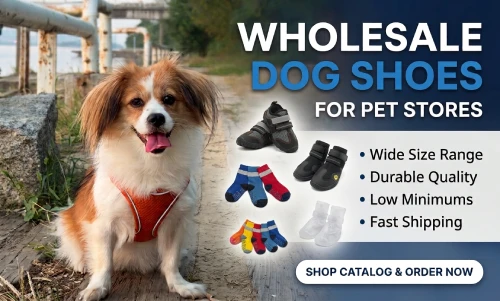
How to Build a Profitable Retail Category - Guangzhou Petsun
Wholesale Dog Shoes for Pet Stores
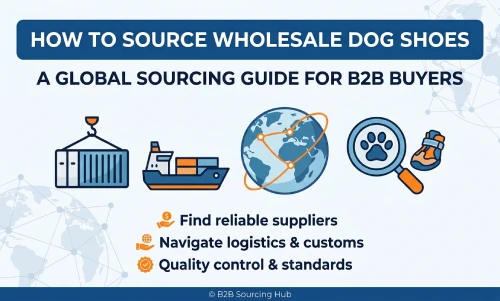
Discover how to source wholesale dog shoes worldwide. Compare China, Vietnam, and Turkey, evaluate suppliers, negotiate MOQs, and ensure consistent product quality. - Guangzhou Petsun
How to Source Wholesale Dog Shoes: A Global Sourcing Guide for B2B Buyers