Custom Dog Shoes: OEM vs. ODM
author: Gigi
2026-11-25
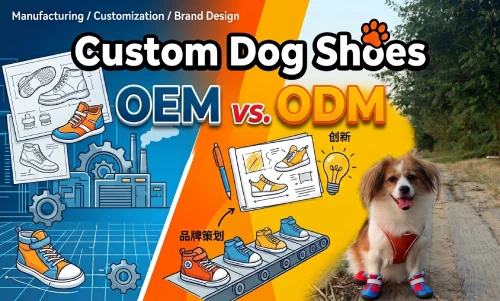
For pet brands, wholesalers, and distributors, developing a custom dog shoe collection involves more than adding a logo to an existing product. Buyers must decide who controls product design, material selection, construction, and manufacturing.
OEM (Original Equipment Manufacturing) and ODM (Original Design Manufacturing) are two common cooperation models. Understanding their differences helps businesses control development costs, protect product differentiation, and select the right manufacturing partner.
1. What Are the Differences Between OEM and ODM Dog Shoe Manufacturing?
1.1 What Does OEM Mean for Custom Dog Shoes?
OEM means the buyer provides the design or technical specifications, while the factory manufactures products according to those requirements.
A custom dog shoes OEM project may involve:
- Customized shoe patterns, dimensions, and size specifications.
- Upper materials such as mesh, nylon, polyester, and waterproof fabrics.
- Outsole materials, tread patterns, thickness, and flexibility.
- Closure systems, including Velcro, zippers, and elastic openings.
- Logo placement, dog shoe private label, and retail packaging.
The main advantage is design control. Brands can develop distinctive products based on their target customers and market positioning.
However, OEM requires a clear product brief. Incomplete specifications can lead to repeated sampling, inconsistent expectations, and additional costs. An experienced custom dog shoe manufacturer should evaluate technical feasibility before confirming the quotation.
1.2 What Does ODM Mean in Dog Shoe Development?
ODM means the manufacturer provides existing designs or product-development solutions that buyers can select and customize.
For example, a distributor may choose an existing dog boot design and request a different upper fabric, color, logo, or packaging. This dog shoe ODM approach reduces the need to develop every component from scratch.
Its main advantages are lower development complexity and potentially shorter time to market. It is particularly suitable for startups, wholesalers, and brands without an internal footwear design team.
However, buyers should confirm which modifications are possible. Changes to sole structure, shoe dimensions, or fastening positions may require additional tooling and testing.
1.3 Is Dog Shoe Private Label the Same as OEM or ODM?
Not exactly. Dog shoe private label describes the branding arrangement rather than the product development method.
With dog shoe private label services, buyers sell products under their own brand by adding logos, labels, and customized packaging to existing products.
Private label can use an ODM product platform or an OEM-developed design. Buyers should clarify who owns the original design and whether exclusivity is available.
2. OEM vs. ODM vs. Private Label: Which Model Should Buyers Choose?
The right model depends on design resources, investment capacity, product differentiation, and sales expectations.
| Evaluation Factor | OEM | ODM | Private Label |
| Design source | Buyer | Manufacturer | Existing product |
| Customization | Extensive | Platform-dependent | Usually limited |
| Development cost | Generally higher | Moderate | Generally lower |
| Development complexity | High | Medium | Low |
| Product differentiation | High | Medium | Limited |
| Design ownership | Contract-dependent | Usually manufacturer-owned base design | Usually manufacturer-owned |
| Suitable buyers | Established brands | Growing brands and distributors | Retailers and startups |
2.1 When Should Brands Choose OEM Dog Boots?
OEM dog boots are suitable for businesses with distinctive product concepts, internal design resources, or specific technical requirements.
For example, a brand targeting small-breed dogs may find that standard footwear does not provide sufficient retention. It may need customized patterns, opening dimensions, and adjustable fastening positions.
OEM allows the buyer to specify these details and develop a product around its own market research.
Before starting custom dog shoes OEM production, buyers should confirm whether new molds, lasts, cutting dies, or patterns are required. These can significantly affect development costs and lead times.
2.2 When Is ODM More Practical for Pet Brands?
A dog shoe ODM arrangement is often better for businesses that want to launch quickly without investing in complete product development.
A retailer entering the winter footwear market, for example, might select an existing boot and customize its lining, upper material, color, and branding.
This approach helps businesses test market demand before investing in proprietary designs. However, buyers should not assume an ODM design is exclusive. Any exclusivity requirements should be negotiated in writing.
2.3 When Should Buyers Use Private Label?
Dog shoe private label is appropriate when speed and initial investment matter more than product uniqueness.
Retailers can introduce existing footwear under their own brand, collect customer feedback, and later move toward deeper ODM or OEM development.
3. How Can Buyers Evaluate a Custom Dog Shoe Manufacturer?
Choosing a cooperation model is only the beginning. The custom dog shoe manufacturer factory must also be capable of turning specifications into consistent mass production.
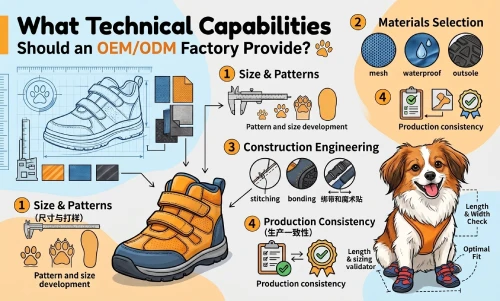
3.1 What Technical Capabilities Should an OEM/ODM Factory Provide?
A professional custom dog shoe manufacturer should understand the relationship between materials, patterns, sole construction, and fit.
Key capabilities include:
Pattern and size development: Dog paws vary in length and width, and front and rear paws may require different sizing. Buyers should ask how the custom dog shoe manufacturer factory validates size charts and sample fit.
Material selection: Mesh improves ventilation, while waterproof fabrics suit wet-weather applications. Outsole materials must balance flexibility, grip, and abrasion resistance.
Construction engineering: Stitching, sole bonding, reinforcement, and fastening positions influence durability and fit. These details should be evaluated through physical samples.
Production consistency: Approved samples should become the reference standard for bulk production. Material specifications, size tolerances, inspection checkpoints, and defect-handling procedures should be documented.
These requirements apply to both OEM dog boots and ODM products. Even small material changes can affect product performance.
3.2 What Should Buyers Confirm Before Sampling and Mass Production?
Before placing an order, clarify:
1. Customization scope: Which components can be modified?
2. Sampling: How many revisions are included, and who approves the final sample?
3. MOQ: Is the minimum order calculated per style, color, or size?
4. Tooling: Who owns molds, lasts, and cutting dies?
5. Intellectual property: Who owns original designs and customized components?
6. Quality control: What specifications and inspection standards apply to bulk production?
A reliable custom dog shoe manufacturer should explain these details before mass production begins.
4. OEM and ODM Dog Shoe Manufacturing: Common B2B Questions
Q1: Is OEM More Expensive Than ODM?
Generally, OEM requires more upfront investment because new patterns, molds, and sample revisions may be necessary. ODM can reuse existing product structures and reduce development complexity.
However, actual costs depend on materials, customization depth, order quantity, and testing requirements.
Q2: Can Buyers Own the Design in an ODM Project?
Not automatically. Manufacturers usually retain ownership of their original designs, while buyers may own separately commissioned elements.
Contracts should distinguish existing designs from newly developed designs and specify licensing, exclusivity, and future usage rights.
Q3: Can a Brand Start with ODM and Later Switch to OEM?
Yes. A practical strategy is to use dog shoe ODM to test demand, identify popular styles, and collect customer feedback. Once sales justify further investment, the brand can develop proprietary products through custom dog shoes OEM.
However, using an existing ODM design does not automatically transfer its ownership to the buyer.
Q4: What Information Should Buyers Provide for OEM Dog Boots?
OEM dog boots provide reference images or drawings, target dog sizes, material preferences, sole requirements, closure details, branding specifications, packaging requirements, and estimated order quantities.
Clear specifications help the factory assess feasibility and provide a more accurate quotation.
Q5: Can Existing Dog Shoes Be Customized Without New Molds?
Often, yes. Fabric, color, dog shoe private label, and packaging may be changed using existing product structures. However, modifying sole geometry, dimensions, or fundamental construction may require new tooling.
Q6: How Can Buyers Prevent Differences Between Samples and Bulk Orders?
Approve a reference sample and document its materials, dimensions, stitching, sole hardness, fastening strength, and acceptable tolerances. For larger orders, consider pre-production samples and in-process inspections. Material substitutions should require buyer approval.
Q7: Which Model Is Best for a New Pet Footwear Brand?
Startups with limited development resources may prefer ODM or dog shoe private label to test market demand. Brands with unique product concepts and sufficient development budgets may benefit more from OEM.
5. Choosing the Right Manufacturing Partnership
OEM offers greater control over product design, ODM provides access to manufacturer-developed designs, and dog shoe private label makes branded product launches more straightforward.
The right approach depends on how much customization your business needs, how much development investment it can support, and how distinct the final product must be.
Guangzhou Petsun a custom dog shoe manufacturer, combines experience in dog shoe design, production, and wholesale with customization options for different business requirements.
Planning a custom dog footwear collection? Contact custom dog shoe manufacturer Guangzhou Petsun to discuss your product concept, customization scope, MOQ, and suitable OEM or ODM cooperation model.
What Certifications Should a Pet Footwear Manufacturer Have?
Related Article
Learn which certifications pet footwear manufacturers need, including ISO, BSCI, Sedex, REACH, and CPSIA, to evaluate suppliers and manage compliance risks. - Guangzhou Petsun
What Certifications Should a Pet Footwear Manufacturer Have?
Learn what to ask a dog shoe manufacturer before ordering. Compare MOQ, lead times, OEM options, samples, pricing, payment terms, and quality guarantees. - Guangzhou Petsun
What Should You Ask a Dog Shoe Manufacturer Before Ordering?