Common Quality Problems in Dog Shoes
In the competitive pet industry, dog shoe quality problems are not just minor inconveniences; they are direct threats to your bottom line. At Guangzhou Petsun, we have spent over two decades observing, analyzing, and ultimately eradicating these issues from the production floor. To help you make informed, strategic sourcing decisions, let’s pull back the curtain on the most common dog shoe issues, deeply analyze why they happen, and explore the rigorous dog shoe quality control mechanisms required to prevent them.
What Are the Most Common Dog Shoe Quality Problems in Manufacturing?
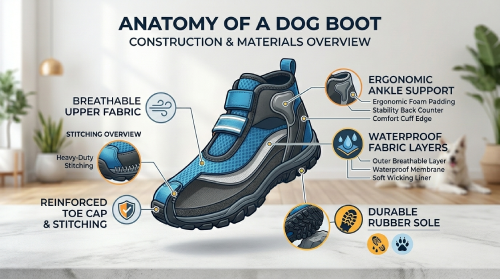
When auditing pet footwear production, certain dog boot defects consistently rise to the top of the failure list. These are rarely random accidents; they are usually the result of compromised processes, subpar materials, or inadequate oversight. The most frequent offenders include sole delamination (glue failure), broken threads and seam blowouts, noticeable color deviation between batches, sizing discrepancies that render the boot unwearable, and hidden material flaws like micro-tears in the upper fabric. Understanding the root cause of each is the first step toward eliminating them.
Why Does Sole Delamination Occur in Dog Footwear, and How Can It Be Prevented?
Sole delamination—where the outsole peels away from the upper—is arguably the most catastrophic of all dog footwear problems. It instantly renders the product useless and destroys consumer trust. To understand how to prevent it, we must deeply examine the bonding process.
The Science of Adhesive Failure
Delamination rarely happens because the glue is inherently "bad." More often, it occurs because the wrong type of adhesive was chosen for the specific materials being bonded, or the adhesive was applied outside its optimal temperature window. For example, using a standard cold cement on a highly porous, untreated fabric upper will result in the glue soaking into the fabric rather than forming a strong surface bond. When the dog flexes its paw, the weak internal bond snaps.
Surface Preparation and the "Roughing" Process
The most critical, yet most frequently rushed, step in bonding is surface preparation. Before any adhesive is applied, the bonding surfaces of both the sole and the upper must be mechanically "roughed" or buffed. This process removes mold release agents, oxidized layers, and smooth finishes, creating a microscopically rough surface area that allows the adhesive to mechanically interlock with the material. Skipping or rushing this step is a primary cause of premature dog boot defects.
Curing Time and Environmental Controls
Even with the right glue and perfect surface preparation, the bond will fail if the curing environment is uncontrolled. Adhesives require specific amounts of time, heat, and pressure to achieve their maximum tensile strength. If a factory rushes shoes off the pressing line before the adhesive has fully cross-linked, or if the workshop humidity is too high (which can trap moisture in the bond line), the sole will inevitably peel under the dynamic stress of a dog’s gait.
How Do Broken Threads and Seam Failures Contribute to Common Dog Shoe Issues?
A dog’s paw is highly dynamic, generating significant shear force and friction with every step. If the stitching cannot withstand this, the boot will unravel. Broken threads usually stem from three factors: using low-tenacity, cheap thread that degrades under UV exposure and moisture; an insufficient Stitches Per Inch (SPI) count, which leaves too much stress on each individual stitch; or a lack of bartack reinforcement at high-stress zones like the toe box, heel, and strap anchors. Effective dog shoe quality control mandates lockstitch machines and rigorous pull-tests on all stress points.
What Causes Color Deviation, and Why Is It a Critical Dog Shoe Quality Control Metric?
While it may seem like a purely cosmetic issue, severe color deviation is a major red flag for B2B buyers. It indicates poor batch management and inconsistent material sourcing. Color shifts happen when factories mix different dye lots of fabric or rubber without proper calibration, or when curing temperatures fluctuate, altering the pigment. For a brand, receiving a shipment where the left boot is a slightly different shade of red than the right boot, or where Batch 2 doesn't match Batch 1, looks highly unprofessional and can lead to retail rejection.
Why Do Sizing Discrepancies Happen, and How Do They Impact the End Consumer?
Sizing is the most frequent cause of customer returns in pet footwear. Discrepancies occur when the 3D "shoe-last" (the mold the shoe is built around) is poorly designed, or when materials shrink unpredictably during the heating and molding process. If a factory does not rigorously measure every single pair against a standardized sizing chart before packaging, a "Medium" boot might fit like an "Extra Small." For the consumer, this means a boot that is either dangerously tight, restricting blood flow, or so loose that the dog immediately shakes it off.
What Are the Hidden Material Flaws That Lead to Dog Footwear Problems?
Sometimes, the defect is baked into the raw material before assembly even begins. This includes micro-tears in rolled fabric that go unnoticed until the boot is inflated with wear, inconsistent rubber density that causes one sole to wear down twice as fast as the other, or cheap velcro that loses its gripping power after a handful of uses. Without strict Incoming Quality Control (IQC), these hidden flaws will make their way into the final product.
How Does Guangzhou Petsun Approach Dog Shoe Quality Control Differently?
At Guangzhou Petsun, we do not view quality control as a final checkpoint before shipping; we view it as a continuous, integrated culture that spans the entire production lifecycle. We understand that inspecting defects out of a finished product is far less effective than building a process that prevents defects from occurring in the first place. Our philosophy is rooted in proactive engineering, rigorous standard operating procedures (SOPs), and transparent communication with our B2B partners.
What Preventive Measures Ensure Consistent Quality in Mass Production?
To guarantee consistency, a robust dog shoe quality control system must be implemented at three distinct stages:
- Incoming Quality Control (IQC): Every batch of raw material (fabric, rubber, thread, adhesive) is tested for tensile strength, colorfastness, and thickness before it ever reaches the production floor.
- In-Process Quality Control (IPQC): Line supervisors conduct hourly audits during assembly. They check SPI counts, verify adhesive application uniformity, and ensure that operators are following the exact SOPs.
- Final Random Inspection (FRI): Before packaging, a statistically significant sample of the finished goods is pulled and inspected against international AQL (Acceptable Quality Limit) standards, typically AQL 2.5 for major defects. This includes functional wear tests, peel tests, and precise dimensional measurements.
How Can B2B Buyers Verify a Factory’s Problem-Solving and Quality Improvement Mechanisms?
A true manufacturing partner doesn’t just hide mistakes; they systematically eliminate them. When evaluating a supplier, ask for their Corrective and Preventive Action (CAPA) reports or 8D (Eight Disciplines) problem-solving documentation. A reputable factory will be able to show you exactly how they identify a root cause (e.g., "Why did Batch X delaminate?"), the immediate containment action taken, and the long-term process change implemented to ensure it never happens again.
How Does Guangzhou Petsun Support Brands Through Custom OEM and ODM Services?
For brands looking to build a unique, high-quality product line from the ground up, Guangzhou Petsun offers comprehensive, end-to-end custom manufacturing solutions. Through our dedicated OEM and ODM services, we work closely with your design team to select the optimal materials, engineer ergonomic shoe-lasts, and develop custom tooling. Because we control the entire custom development process, we can embed strict dog shoe quality control checkpoints directly into your product’s unique tech pack, ensuring that your specific vision is executed flawlessly at scale.
What Are the Quality Advantages of Sourcing Through Guangzhou Petsun’s Wholesale Channels?
Not every brand needs a fully custom build from day one. For retailers and distributors looking to scale quickly with proven, market-tested designs, Guangzhou Petsun provides an extensive catalog of ready-to-ship footwear. You can explore our reliable in-stock wholesale services, which offer low Minimum Order Quantities (MOQs) and rapid fulfillment. Crucially, these in-stock items are not "leftovers"; they are manufactured to the exact same rigorous dog shoe quality control standards as our custom lines, undergoing the same IQC, IPQC, and FRI protocols to guarantee you receive only premium, defect-free inventory.
Why Is Partnering with Guangzhou Petsun the Ultimate Solution for Dog Shoe Quality Problems?
Navigating the complexities of pet footwear manufacturing requires deep expertise, unwavering attention to detail, and a genuine commitment to your brand’s success. By choosing Guangzhou Petsun, you are not just hiring a factory; you are gaining a strategic partner dedicated to eradicating common dog shoe issues before they ever reach your customers. From advanced bonding techniques and premium material sourcing to transparent, multi-stage quality assurance, we provide the stability and excellence your brand needs to thrive in a competitive market. Let us handle the complexities of production, so you can focus on what you do best: growing your brand and delighting your customers.
How Dog Shoe Size Grading Works
Dog Socks for Summer: Cool & Comfortable Options
Related Article