Winter Dog Socks Warm and Cozy Options for Cold Weather
Why Are Winter Dog Socks Becoming an Important Product for Pet Brands?
Winter brings new challenges for dogs and the businesses that supply their accessories. Snow, ice, cold pavement, road salt, and slushy sidewalks can make outdoor walks uncomfortable. At the same time, indoor floors may become slippery when dogs come inside with damp paws. Pet owners are increasingly interested in practical products that help keep their dogs comfortable without making everyday movement difficult.
For retailers, distributors, and private-label brands, snow socks for dogs offer an opportunity to expand a seasonal pet-footwear collection. Depending on their construction, winter dog socks may provide soft insulation, paw coverage, improved traction, or an additional protective layer beneath a more substantial dog boot.
However, not every dog sock is suitable for snow. A knitted sock with a fleece lining may provide warmth indoors but become saturated during prolonged contact with wet snow. A waterproof boot with a thick sole may perform well outdoors but feel too rigid for a dog that needs a lightweight indoor product. Choosing the right construction is therefore more important than simply labeling a product “winter-ready.”
Guangzhou Petsun offers a range of dog footwear products that buyers can explore through its dog footwear product catalog. For businesses planning a winter collection, the key is to match product construction with customer needs, target retail price, expected weather conditions, and the level of protection the product can realistically provide.
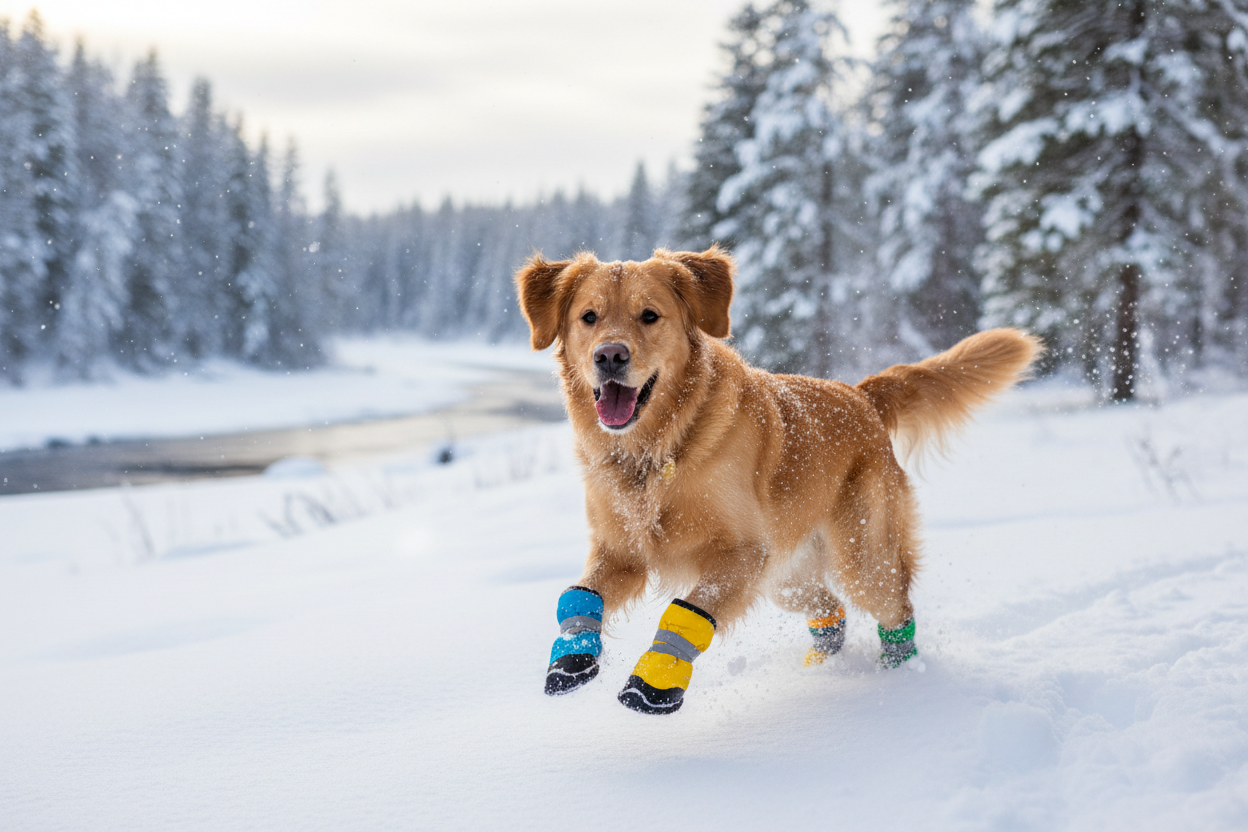
Image suggestion: Use a winter outdoor lifestyle photograph to introduce the product category and show how paw protection fits into everyday cold-weather activities.
1. Why Are Winter Dog Socks Important for Cold-Weather Paw Protection?
A dog's paws are in direct contact with the ground, which means the condition of the walking surface can significantly affect comfort. Cold pavement, packed snow, ice, and de-icing products may irritate sensitive paws. Snow can also collect between the toes, while wet conditions can leave paws damp after a walk.
Winter dog socks can help create a protective layer between the paw and the environment, but their performance depends on the materials and construction. Soft socks may be suitable for indoor warmth and traction, while outdoor snow products often need a more protective outer layer and a secure closure.
How Do Winter Socks Help Keep Paws Warm?
Insulating fabrics work by trapping air within or between fibers. Fleece, brushed polyester, wool blends, and thermal knit structures can help reduce heat loss while remaining relatively lightweight. The thickness of the fabric matters, but thickness alone does not determine warmth.
A sock that fits too tightly may compress its insulating layer and restrict comfortable movement. Conversely, a loose sock can bunch up around the toes, allowing cold air and snow to enter. For manufacturers, the challenge is to balance insulation, stretch, fit, and moisture management.
Buyers should also distinguish between keeping paws warm and protecting them against extreme cold. A soft winter sock is not automatically suitable for prolonged exposure to freezing temperatures, deep snow, or icy terrain.
Can Dog Snow Socks Help Protect Against Ice and Road Salt?
A well-designed product may reduce direct contact between the paw and rough or contaminated surfaces. An appropriately constructed outer layer can also help limit the accumulation of snow around the paw.
However, protection depends on coverage, fit, material resistance, and how securely the product stays in place. A sock with an exposed knitted surface may absorb moisture, while a more substantial boot-style design may offer better separation from wet ground.
For B2B buyers, these differences should be reflected in the product description. Claims about waterproofing, cold-weather protection, and resistance to road salt should be supported by appropriate product evaluation rather than inferred from appearance alone.
2. Which Materials Keep Snow Socks for Dogs Warm and Comfortable?
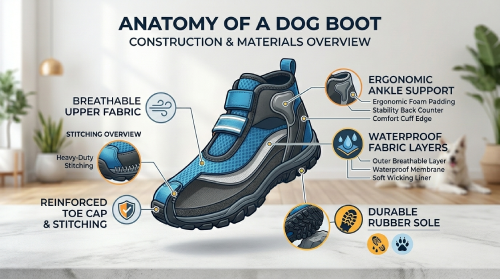
Material selection determines how a winter dog sock feels, how much insulation it provides, how quickly it dries, and how well it withstands repeated use. Buyers should evaluate the complete material system rather than focusing on the lining alone.
| Material | Main advantages | Potential limitations | Suitable applications |
|---|---|---|---|
| Polyester fleece | Soft, lightweight, good insulating potential | Can retain moisture if the construction becomes wet | Indoor warmth and cold-weather lining |
| Wool blends | Natural warmth and moisture-management potential | Cost, care requirements, and possible shrinkage | Premium winter socks |
| Thermal knit fabrics | Flexible, comfortable, adaptable to different fits | May provide limited protection from wet snow | Indoor use and light cold-weather wear |
| Brushed polyester | Soft inner surface and relatively easy care | Performance varies with fabric construction | Everyday winter socks |
| Nylon or polyester shell fabrics | Useful for creating a protective outer layer | May require additional treatment or seam protection | Snow-oriented designs |
| Neoprene | Flexible, cushioning, and useful in selected protective constructions | Can feel warm or bulky if poorly designed | Selected outdoor footwear designs |
Why Is a Layered Construction Often More Practical Than One Thick Fabric?
A layered design allows different materials to perform different jobs. The inner layer can focus on softness and thermal comfort, while the outer layer helps resist wind, moisture, abrasion, and snow accumulation. A separate grip component may improve traction on smooth floors.
This approach also gives product developers more flexibility. A lightweight indoor sock can prioritize stretch and comfort, whereas an outdoor snow sock can use a more protective shell and a reinforced underside.
The trade-off is that additional layers can increase bulk, cost, and drying time. The finished product should therefore be tested for flexibility and fit, especially around the toes and ankle opening.
3. What Is the Difference Between Warm, Water-Resistant, and Waterproof Dog Socks?
These terms describe different performance characteristics and should not be used interchangeably in product listings.
Warm describes the product's ability to provide insulation. Water-resistant means the construction can resist some moisture under defined conditions. Waterproof is a stronger claim that requires the complete product to prevent water penetration under specified test conditions.
| Product type | Primary purpose | Important design considerations |
|---|---|---|
| Warm indoor dog socks | Comfort on cold indoor floors | Soft lining, flexible fit, traction |
| Water-resistant snow socks | Protection in light moisture and slush | Outer fabric, water-repellent treatment, coverage |
| Waterproof winter dog boots | More substantial protection in wet outdoor conditions | Waterproof materials, seams, closure, sole construction |
| Insulated outdoor dog footwear | Thermal comfort in cold outdoor conditions | Insulation, secure fit, suitable outsole, moisture control |
A water-repellent coating can help droplets bead on the fabric surface, but it does not necessarily make seams or the entire shoe waterproof. Likewise, a waterproof outer material does not guarantee that snow cannot enter through an open cuff.
For wholesalers, these distinctions matter because inaccurate claims can lead to customer dissatisfaction and product returns. The product specification should state what has actually been tested and under what conditions.
4. Which Sole and Grip Designs Work Best for Dog Socks in Snow?
Traction is an important consideration for winter dog socks, but the best design depends on where the product will be used. A sock intended for indoor hardwood floors has different requirements from a boot intended for outdoor snow and icy sidewalks.
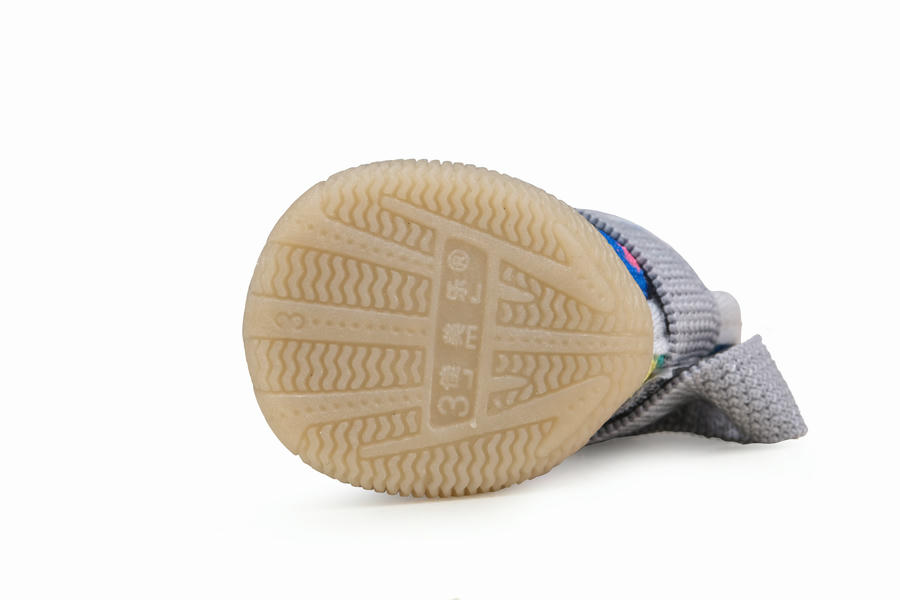
For indoor products, silicone grip dots or paw-shaped anti-slip patterns can increase contact with smooth flooring. Outdoor designs may require a more durable outsole with a tread pattern suited to the intended terrain.

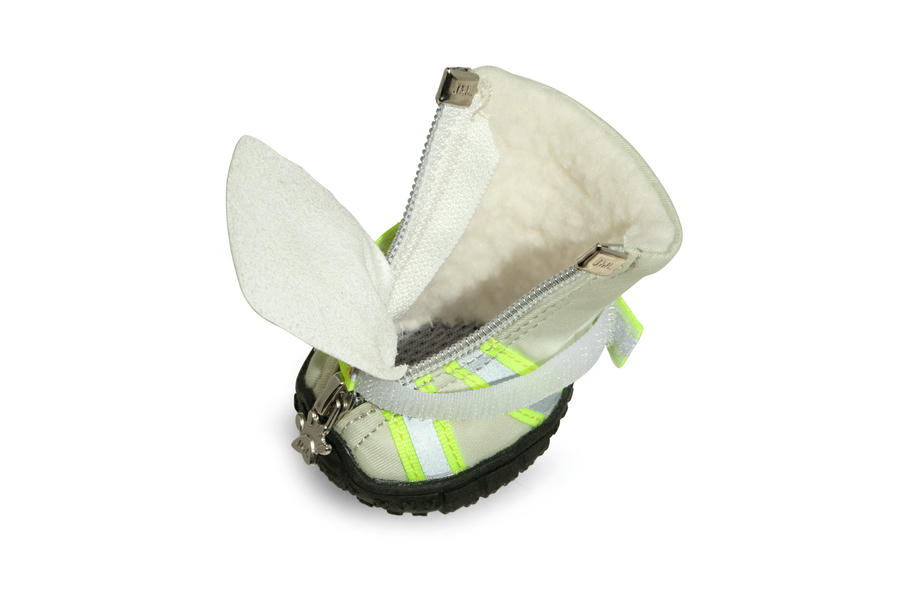
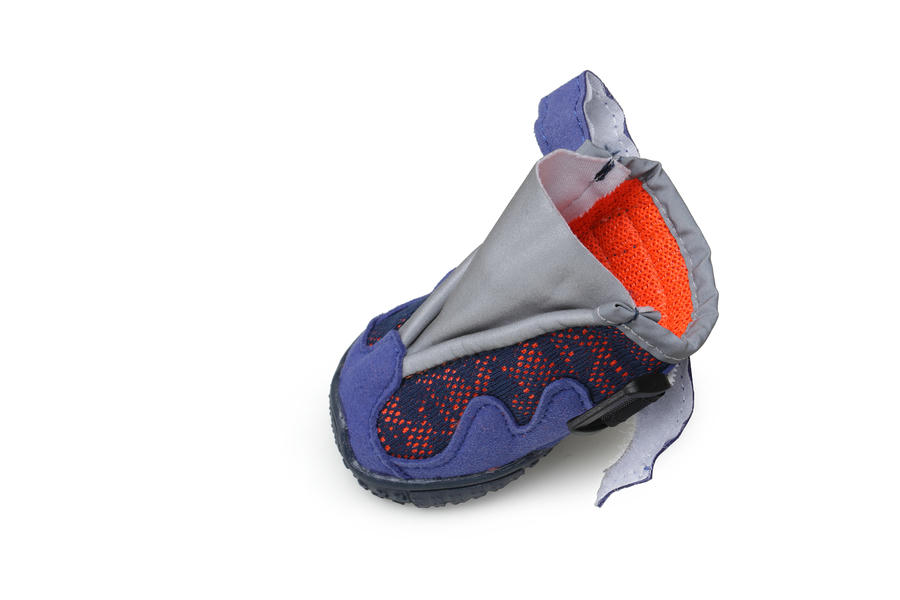
Image suggestion: Show a close-up of the lining, fastening system, and underside of a winter dog sock or boot. This helps B2B buyers compare material and construction details.
What Should Buyers Look for in Anti-Slip Patterns?
The pattern should provide useful contact with the intended surface without making the sock excessively stiff. A dense grip pattern may work well indoors, but it should not be assumed to provide reliable traction on ice. Ice performance depends on the material, tread geometry, surface conditions, and other design factors.
Buyers should also evaluate whether grip elements remain attached after repeated bending, washing, and abrasion. If the product is intended for regular winter use, durability testing should include the grip layer rather than assessing only the fabric.
How Does Sole Flexibility Affect Comfort?
Dogs need to move their paws naturally. A sole that is too rigid may change how the foot contacts the ground, while an excessively thin sole may provide insufficient protection from rough or cold surfaces.
The ideal balance depends on the product category. Indoor socks usually benefit from a soft, flexible construction, whereas outdoor boots may need a more substantial protective sole. Sample testing should assess both grip and ease of movement.
5. How Should Buyers Choose the Right Snow Socks for Small Dogs?
Small dogs have different sizing and fit considerations from larger breeds. Their paws may be narrow, their legs shorter, and their body weight lower, which can affect how a sock stays in place and how the sole interacts with the ground.
For this reason, snow socks for small dogs should not simply be scaled down from a large-dog pattern without checking the proportions. The opening, ankle length, toe shape, and closure position may all need adjustment.
Why Is Paw Measurement More Reliable Than Breed Labels?
Breed names are useful for guiding customers, but individual dogs within the same breed can have noticeably different paw dimensions. A more reliable sizing system records paw width and length, ideally with guidance on how to measure a weight-bearing paw.
For product development, the size chart should be based on actual measurements from representative dogs or appropriately designed sizing references. Buyers should confirm how the finished product accommodates paw shape, rather than relying on a single measurement alone.
How Can a Sock Stay Secure Without Restricting Movement?
A secure cuff, elastic opening, or adjustable strap can help prevent slipping. However, excessive compression can cause discomfort, and a fastening system placed too high or too low may interfere with movement.
Manufacturers should evaluate the relationship between cuff elasticity, strap length, opening circumference, and sock length. Fit trials should include walking, turning, and changes in direction, not just a stationary fitting.
6. How Can Manufacturers Improve the Fit and Retention of Winter Dog Socks?
A winter dog sock can have excellent materials but still perform poorly if it slips, twists, or bunches during movement. Retention is therefore a central design challenge.
Several construction features can help:
- Elastic cuffs that accommodate the intended size range.
- Adjustable hook-and-loop straps where appropriate.
- Anatomical shaping around the paw and ankle.
- Sufficient heel and toe space.
- A lining that does not bunch during repeated movement.
- Grip components that do not make the sock too stiff.
These features should be evaluated together. A tight cuff may improve retention but reduce comfort, while a longer sock may cover more of the leg but be more likely to twist if its shape is incorrect.
For B2B product development, the goal is not to maximize tightness. It is to achieve a stable, comfortable fit across the intended size range.
7. What Quality Tests Should Buyers Request for Winter Dog Socks?
Quality control should cover the finished product rather than relying solely on material certificates. A winter sock may fail because its lining separates, grip pattern peels off, stitching opens, or closure loses its holding power.
| Test or inspection | What it evaluates | Why it matters |
|---|---|---|
| Size and fit inspection | Dimensions, opening, and overall shape | Reduces slipping and sizing complaints |
| Seam-strength check | Resistance of stitched areas to pulling | Helps prevent seam opening |
| Grip adhesion test | Attachment of grip elements to the fabric | Identifies peeling or detachment |
| Flexing evaluation | Performance during repeated bending | Helps identify cracking or construction weakness |
| Washing test | Dimensional stability, color, seams, and grip retention | Supports washable-product claims |
| Water-resistance test | Resistance to moisture under defined conditions | Helps substantiate water-resistance claims |
| Wear simulation | Performance during repeated movement | Reveals product-level weaknesses |
| Fastener-cycle test | Repeated opening, closing, and retention | Checks whether closures remain functional |
Why Should Buyers Test the Finished Product After Washing?
Washing can affect dimensions, elastic recovery, grip adhesion, color, and the feel of the lining. A sock that fits well before washing may shrink or stretch after repeated care cycles.
If a product is marketed as washable, buyers should define the washing method, temperature, detergent where relevant, drying conditions, and number of cycles. The product should then be inspected against the original specification.
How Should Buyers Evaluate Water-Resistance Claims?
Testing should reflect the intended product claim. A water-resistant fabric test does not automatically prove that a complete sock is waterproof, particularly when seams, openings, and bonded components are present.
The test report should identify the sample, method, exposure conditions, and result. For products intended for prolonged outdoor use, buyers may also evaluate performance after flexing or washing to check whether the protective properties remain consistent.
8. How Can B2B Buyers Plan a Profitable Winter Dog Sock Collection?
Winter products can create a seasonal sales opportunity, particularly for retailers and distributors serving regions with cold winters, snow, and icy sidewalks. However, demand varies by climate, customer behavior, and the type of pet products a business already sells.
A balanced product collection can include more than one construction. Lightweight thermal socks may appeal to customers seeking indoor warmth and traction, while waterproof outdoor boots can serve customers who need more substantial protection for winter walks.
| Product tier | Target customer | Main selling point |
|---|---|---|
| Entry-level winter socks | Price-sensitive buyers | Basic warmth and simple traction |
| Mid-range thermal socks | Everyday pet owners | Comfort, fit, and practical design |
| Water-resistant snow footwear | Customers facing wet and slushy conditions | Additional moisture protection |
| Premium insulated boots | Outdoor-focused customers | More substantial construction and weather protection |
| Small-dog winter socks | Owners of small breeds | Proportional fit and lightweight comfort |
| Private-label winter collection | Retail brands and distributors | Custom branding, packaging, and product differentiation |
How Can Buyers Reduce Seasonal Inventory Risk?
Winter demand can be concentrated in a relatively short period, and weather conditions vary between markets. Buyers should avoid treating all regions as having the same seasonal sales pattern.
A practical approach is to review historical sales, local climate, customer feedback, and existing product performance. Initial orders can focus on a core range of sizes and styles, with additional variations introduced after demand becomes clearer.
For products with long development lead times, buyers should plan sample approval, production, shipping, and listing preparation well before the expected selling season.
9. Which Wholesale Options Should Buyers Consider for Winter Dog Socks?
Wholesale purchasing allows retailers and distributors to source products without developing every component from scratch. The right approach depends on the buyer's order volume, launch timeline, branding requirements, and willingness to hold inventory.
Ready-to-ship products can be suitable for businesses that want to respond quickly to seasonal demand. Customized products are often more appropriate when a brand needs a distinctive design, specific materials, or a coordinated product range.
Guangzhou Petsun provides a starting point for discussing available dog footwear and winter product options through its product catalog. Buyers should confirm current stock, available sizes, packaging, minimum order quantities, and lead times directly with the company before committing to a purchase.
What Should Buyers Compare When Requesting Wholesale Quotes?
A wholesale quote should be assessed beyond the unit price. Relevant factors include product construction, material specifications, size range, packaging, order quantity, sample cost, production lead time, shipping terms, and quality-control arrangements.
| Purchasing factor | Questions to ask |
|---|---|
| Product availability | Which models, sizes, and colors are currently available? |
| Minimum order quantity | Is the MOQ calculated per style, color, or size? |
| Price structure | How does the price change with order volume? |
| Packaging | Are standard packaging and private-label packaging available? |
| Quality assurance | What inspections or test records can be provided? |
| Lead time | How long will preparation, production, and shipment take? |
| Reordering | Can the same construction and specifications be maintained? |
For wholesale buyers, consistency between the approved sample and later orders is especially important. The specification should identify the materials, size chart, colors, grip pattern, and any other details that influence product performance.
10. How Can OEM and ODM Customization Help Differentiate a Winter Dog Sock Brand?
OEM and ODM projects give brands more control over product positioning than buying a standard product alone. Depending on the manufacturer's capabilities and the agreed project scope, customization may involve materials, colors, patterns, branding, packaging, sizing, and selected construction features.
Guangzhou Petsun's OEM/ODM custom services are a relevant starting point for discussing a customized dog-footwear project. Buyers should confirm which customization options are available for winter socks or boot-style products, along with development requirements, MOQ, sampling arrangements, and production lead time.
What Can Be Customized in a Winter Dog Sock?
Potential customization areas include:
- Thermal materials: Different lining weights or fabric combinations for different price points.
- Outer materials: Fabrics selected for the intended balance of flexibility, moisture resistance, and durability.
- Grip patterns: Custom shapes, colors, and layouts, subject to technical feasibility.
- Color and appearance: Brand colors, seasonal themes, and coordinated product collections.
- Sizing: Adjustments to the size range and proportions for the target customer.
- Branding: Labels, logos, tags, and packaging.
- Fastening systems: Suitable elastic or adjustable closure options.
Not every design can be changed without affecting cost, performance, or production complexity. For example, a new grip pattern may require tooling or additional development work, while a different outer fabric may require renewed testing.
What Should Buyers Confirm Before Approving an OEM/ODM Sample?
The sample should be evaluated against a written specification rather than appearance alone. The buyer should confirm materials, measurements, grip placement, closure behavior, washing instructions, packaging, and relevant quality requirements.
If the product will be sold as waterproof, insulated, or suitable for snow, the buyer should also agree on how those claims will be substantiated. This reduces the risk of discovering performance gaps after production has started.
11. How Should Brands Market Dog Socks for Snow Without Overpromising?
Product descriptions influence both customer expectations and returns. Terms such as “warm,” “water-resistant,” “waterproof,” and “non-slip” should reflect the construction and available evidence.
For example, a fleece-lined knitted sock with silicone grip dots may be suitable for indoor warmth and traction, but that does not establish that it can keep paws dry in deep snow. A waterproof outer layer may resist water penetration, but the opening can still allow snow or water to enter.
Which Product Details Should Appear on the Product Page?
Useful information includes the intended application, material composition, lining type, sole or grip design, available sizes, fit instructions, care guidance, and limitations of use. Buyers should also provide clear photographs of the underside, lining, closure, and product worn on a dog.
A good product page answers the questions customers are most likely to ask before purchasing. Clear limitations can be just as valuable as selling points because they help customers choose the product that fits their actual needs.
How Can Search Keywords Be Used Naturally?
The target phrases can be integrated into headings, descriptions, and product-category copy without making the writing awkward. For example, “snow socks for dogs” works well as the main category phrase, while “snow socks for small dogs” can support a dedicated size or fit discussion.
Related phrases such as “snow dog socks,” “dog snow socks,” “dog socks snow,” “dog socks for snow,” and “snow socks dogs” should appear only where they fit the context. Repeating every variation in the same paragraph can make the page feel unnatural and weaken the customer experience.
12. How Can Wholesale Buyers Prepare for the Winter Selling Season?
Seasonal planning should begin well before temperatures drop. Buyers need enough time to evaluate samples, confirm sizing, approve packaging, complete production, and arrange shipping. Delaying product decisions until the first snowfall may leave too little time to respond to demand.
A practical preparation schedule includes the following steps:
- Review the target market: Identify regions, customer types, and weather conditions relevant to the product.
- Choose the product range: Decide which styles, sizes, and price tiers are appropriate.
- Request samples: Evaluate fit, warmth, traction, and construction before making a large commitment.
- Confirm quality requirements: Document material specifications, testing, and acceptance criteria.
- Approve branding and packaging: Complete artwork and labeling early enough to avoid production delays.
- Plan inventory: Use historical sales and market conditions to set order quantities.
- Prepare product content: Photograph the product, write accurate descriptions, and publish size and care guidance.
For ready-to-ship sourcing, buyers can review Guangzhou Petsun's in-stock and wholesale services and confirm which relevant models are currently available. For products requiring a different design or branding, the OEM/ODM service page provides a starting point for discussing development requirements.
How Can Brands Choose the Right Winter Dog Socks for Their Customers?
Winter dog socks can fill several roles, from providing warmth and traction indoors to offering additional paw protection during cold-weather walks. The best product depends on the intended use, material construction, fit, sole design, and the level of moisture protection required.
For B2B buyers, a successful winter collection starts with clear product positioning. Thermal socks should be evaluated for comfort and fit; outdoor snow products need closer attention to moisture resistance, grip, retention, and durability. Buyers should also review sizing, packaging, wholesale terms, and the supplier's ability to maintain consistent specifications across orders.
Guangzhou Petsun's dog footwear product range can help buyers explore relevant styles, while its OEM/ODM custom services offer a starting point for discussing branded product development. Businesses looking to source available products for seasonal sales can also review the in-stock and wholesale services.
By matching the product to the right customer, validating its performance, and planning inventory early, retailers and distributors can build a winter dog-footwear collection that is practical, differentiated, and better aligned with seasonal demand.
Anatomy of a Dog Shoe: A Complete Guide to Components, Materials, and Construction
Which Dogs May Benefit From Wearing Socks During Winter
Related Article