How to Evaluate a Dog Shoe Supplier
Why Should B2B Buyers Evaluate a Dog Shoe Supplier Carefully?
Choosing the right manufacturing partner for pet footwear is one of the most critical decisions you will make for your brand. It is not simply about finding the lowest price per unit; it is about securing a reliable, transparent, and quality-driven alliance that will uphold your brand's reputation for years to come. For B2B buyers, brand owners, and distributors, a poor supplier choice can lead to catastrophic inventory delays, inconsistent product quality, and a flood of customer returns that erode your hard-earned brand equity.
At Guangzhou Petsun, we understand that trust is earned through transparency and performance. To help you navigate the complex landscape of global sourcing and avoid common procurement pitfalls, we have compiled this comprehensive, B2B-focused evaluation framework. By using this guide to evaluate dog shoe supplier capabilities rigorously, you can make data-driven decisions that protect your margins, ensure product excellence, and build a footwear line that your customers will trust implicitly.
Why Is a Comprehensive Dog Boot Supplier Checklist Essential for Risk Mitigation?
Before you even begin requesting quotes, you must establish a clear set of criteria. The pet footwear industry is rife with trading companies masquerading as direct manufacturers, and factories that cut corners on materials or labor. A comprehensive dog boot supplier checklist acts as your shield against these risks. It forces you to look beyond the glossy sales pitch and examine the operational reality of the factory. Are they financially stable? Do they have a history of ethical labor practices? Can they scale with you as your brand grows? Answering these questions upfront prevents costly mistakes down the line.
What Factory Qualifications and Certifications Should You Verify First?
The first step in any dog shoe manufacturer review is verifying the legal and operational legitimacy of the facility. Do not rely solely on a website or a brochure. You must request and verify specific documentation:
- Business License and Export Rights: Ensure the company is legally registered and authorized to export goods to your target markets.
- ISO Certifications: Look for ISO 9001 (Quality Management Systems) certification, which indicates a standardized approach to quality control.
- Social Compliance Audits: Certifications like BSCI (Business Social Compliance Initiative) or SA8000 demonstrate that the factory adheres to ethical labor standards, ensuring no child labor or unsafe working conditions. This is crucial for protecting your brand from reputational damage.
- Material Certifications: Request proof that their materials (rubber, fabrics, adhesives) are free from harmful substances like phthalates or heavy metals, complying with regulations like REACH (EU) or CPSIA (USA).
How Do You Assess a Manufacturer's True Production Capacity and Scalability?
A factory might be perfect for a small startup but completely overwhelmed by a large retail order. You need to understand their true capacity. Ask for their monthly production output specifically for pet footwear, not just general garments.
- Production Lines: How many dedicated sewing and assembly lines do they have? Are they automated or manual?
- Workforce Stability: What is their employee turnover rate? A stable, skilled workforce is essential for consistent quality.
- Scalability: If your brand suddenly goes viral and you need to double your order volume overnight, can they handle it? Do they have relationships with raw material suppliers that allow for rapid scaling?
A reliable partner like Guangzhou Petsun will be transparent about their capacity limits and work with you to plan production schedules that meet your growth trajectory without compromising quality.
What Quality Control Systems Should a Reliable Dog Shoe Supplier Have in Place?
Quality cannot be inspected into a product at the end of the line; it must be built into every step of the process. When you evaluate dog shoe supplier capabilities, their QC system should be the centerpiece of your review.
In-Line vs. Final Inspection Protocols
A robust QC system does not wait until the shoes are boxed to check them. It involves "In-Line" inspections where supervisors check the stitching, adhesive application, and material cutting during the assembly process. This catches errors when they are cheap to fix. "Final Random Inspection" (FRI) happens only after the goods are 100% packed, serving as a last line of defense. You need a supplier who prioritizes the former to prevent mass defects.
AQL Standards and Defect Tolerance
Ask the factory what Acceptable Quality Limit (AQL) they follow. The industry standard for consumer goods is usually AQL 2.5 for major defects (functional issues like sole separation) and AQL 4.0 for minor defects (cosmetic issues like loose threads). If a supplier cannot define their AQL standards clearly, it is a major red flag.
Third-Party Testing and Certifications
Does the factory have an in-house lab for basic testing (abrasion, flexing, peel strength)? Do they have a history of working with third-party testing agencies like SGS, Intertek, or Bureau Veritas? A supplier that welcomes and facilitates third-party testing is a supplier that has nothing to hide.
How Do You Evaluate Pricing Structures Without Compromising Quality?
Price is important, but the lowest price is often the most expensive mistake you can make. When reviewing quotes, look for transparency. A professional quote should be broken down by material cost, labor cost, overhead, and profit margin.
If one supplier is significantly cheaper than the others, ask why. Are they using inferior rubber that will crack in winter? Are they using low-density foam that will flatten after one walk? Are they skimping on the quality of the Velcro? At Guangzhou Petsun, we believe in value-based pricing. We explain why our materials cost what they do, ensuring you understand the direct correlation between the component quality and the longevity of the final product.
What MOQ Terms Are Reasonable for Different Business Stages?
Minimum Order Quantity (MOQ) is often the biggest barrier for emerging brands. However, MOQ is not a fixed number; it is a negotiation based on materials and complexity.
- Standard MOQ: For custom colors and sizes, 500-1000 pairs per style is typical.
- Flexible MOQ: Some factories, like Guangzhou Petsun, offer lower MOQs for first-time clients or for using "in-stock" base models with custom branding.
- Material MOQ: Remember that fabric mills and rubber sole factories have their own MOQs. If your order is smaller than the raw material MOQ, you will have to pay for the excess material, driving up your unit cost.
Always ask if the MOQ is per style, per color, or per size run. A quote of "500 pairs" sounds reasonable until you realize it means 500 pairs per color, forcing you to buy 2,000 pairs for a four-color launch.
How Do You Assess Customization and OEM/ODM Capabilities?
Not all customization is created equal. You need to distinguish between a factory that can simply print your logo on a generic shoe (Basic OEM) and one that can engineer a product from the ground up (ODM).
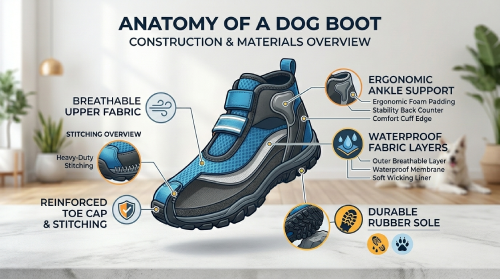
For brands looking to innovate, true ODM capabilities are essential. This involves designing custom ergonomic shoe lasts (molds) that fit specific dog breeds, engineering proprietary tread patterns for superior traction, and selecting specialized materials like hydrolysis-resistant rubber or ripstop nylon.
If you are looking for a partner who can turn your conceptual sketches into a functional, market-ready product, you should explore the deep engineering and design capabilities offered at OEM/ODM custom services. Here, you will find details on how a true partnership goes beyond simple assembly to include material research, prototype development, and fit testing, ensuring your product stands out in a crowded market.
What Delivery Timeframes and Lead Times Are Realistic for Pet Footwear?
Time is money. You need a supplier who respects your launch dates. When discussing lead times, break them down into phases:
- Sampling Time: 2-4 weeks for initial prototypes.
- Material Procurement: 2-4 weeks to source specific fabrics, rubber, and hardware.
- Mass Production: 30-60 days depending on order volume.
Always ask about their "on-time delivery rate." A good factory will have a track record of 95% or higher. Also, clarify the penalty clauses for late delivery in your contract. If a supplier hesitates to agree to reasonable penalties for delays caused by their own inefficiencies, proceed with caution.
How Do You Evaluate After-Sales Support and Warranty Terms?
Even with the best QC, defects can happen. How a supplier handles these issues defines the relationship. Do they offer a warranty on workmanship? What is their policy for "major defects" (e.g., sole separation, broken buckles)?
A professional supplier will have a clear remediation process. This usually involves a credit note for the defective units or free replacement in the next order. Avoid suppliers who say "all sales are final" or who blame the defect on "rough use" without investigating. You need a partner who stands behind their product as much as you do.
Can You Leverage In-Stock Wholesale Options for Faster Market Entry?
Sometimes, speed to market is more important than custom design. If you are a retailer looking to test a new category, or if you need to fill a gap in your inventory immediately, waiting 90 days for custom production is not feasible.
This is where wholesale and in-stock services become invaluable. By partnering with a supplier that maintains a robust inventory of high-quality, pre-manufactured footwear, you can bypass mold fees, sampling delays, and long lead times entirely.
For brands seeking agility and speed, Guangzhou Petsun offers a comprehensive range of ready-to-ship dog shoes that have already passed rigorous quality testing. You can explore our wholesale catalog and learn how to get premium products on your shelves in days, not months, at in-stock services. This option allows you to validate market demand with lower financial risk before committing to a large custom production run.
How Can a Supplier Evaluation Scorecard Help You Make an Objective Decision?
Emotions and sales pitches can cloud judgment. To make a truly objective decision, use a weighted scorecard. Rate each potential supplier on a scale of 1-10 for the following categories, multiply by the weight (importance), and sum the total.
Dog Shoe Supplier Evaluation Scorecard
|
Evaluation Criteria
|
Weight (%)
|
Supplier A Score (1-10)
|
Supplier B Score (1-10)
|
Supplier C Score (1-10)
|
|---|---|---|---|---|
|
Price Competitiveness
|
20%
|
|||
|
Product Quality & Materials
|
25%
|
|||
|
Production Capacity & Lead Time
|
15%
|
|||
|
MOQ Flexibility
|
10%
|
|||
|
Communication & Responsiveness
|
10%
|
|||
|
Certifications & Compliance
|
10%
|
|||
|
After-Sales Support/Warranty
|
10%
|
|||
|
TOTAL SCORE
|
100%
|
Why Is Building a Long-Term Partnership More Valuable Than Just Finding a Vendor?
In the end, you are not just looking for a factory to make shoes; you are looking for a partner to help build your brand. A transactional vendor will do exactly what you tell them to do, nothing more. A strategic partner, like Guangzhou Petsun, will challenge you, advise you, and innovate with you. They will tell you when a design is unmanufacturable, suggest a better material that saves you money, and work late nights to ensure your holiday inventory arrives on time.
When you find reliable dog shoe supplier partners who are invested in your success, the relationship transcends price per unit. It becomes about shared growth, mutual trust, and the confidence that comes from knowing your supply chain is in capable hands.
Ready to evaluate your next manufacturing partner with confidence? Stop guessing and start building with a team that values transparency, quality, and long-term success. Explore our full range of products and capabilities, and let's discuss how we can support your brand's journey at www.petshoe.com.
Which Dogs May Benefit From Wearing Socks During Winter
Dog Shoe Sole Adhesion Testing
Related Article