Custom Dog Sandals Private Label Options
Custom Dog Sandals: Wholesale & Private Label Options
When summer arrives, pet owners start looking for ways to keep their dogs comfortable outdoors. Hot pavement, rough trails, sharp surfaces, and long walks can all put extra stress on a dog's paws. For pet brands and retailers, this seasonal demand creates an opportunity to offer a product that is both practical and easy to differentiate: custom dog sandals.
Unlike traditional winter dog boots, sandals are designed with warm-weather comfort in mind. They can provide basic paw protection while allowing more airflow around the foot. For businesses, they also offer plenty of room for branding through materials, colors, patterns, packaging, and custom logos.
For wholesalers, retailers, and private-label pet brands, the real question is not simply whether dog sandals sell. It is how to develop the right product, control costs, meet minimum order quantities (MOQ), and create a design that customers will recognize.
This guide explores the major design options, wholesale considerations, OEM and ODM processes, and the potential business value of developing a custom line of dog sandals.
Why Are Dog Sandals Becoming More Interesting for Summer Pet Products?
Summer changes the way people use pet products.
During colder months, dog footwear is often associated with warmth, snow, ice, and protection from cold weather. In summer, the demand shifts toward protection from hot pavement, rough outdoor surfaces, dirt, and potentially irritating materials.
That creates a different product opportunity.
Dog sandals can be positioned as lightweight outdoor footwear for everyday walks, travel, hiking, camping, beach trips, and other warm-weather activities. Their open or semi-open construction can also make them visually different from conventional dog boots.
For B2B buyers, seasonality can be useful rather than problematic. A summer-focused product gives retailers another reason to refresh their pet footwear selection and create seasonal promotions.
The opportunity becomes even more attractive when the product is customized. Instead of selling a generic sandal that looks similar to products already available online, a retailer can create a recognizable product line around its own colors, logo, packaging, and brand identity.
That is where custom dog sandals become more than a simple footwear product. They become a branding opportunity.
What Design Options Are Available for Custom Dog Sandals?
Customization can happen at several levels, and businesses do not necessarily need to redesign every component.
The most common options include:
- Material selection
- Sole construction
- Strap design
- Color combinations
- Printed patterns
- Embossed or printed logos
- Buckles and fasteners
- Packaging
- Size ranges
- Product labels
- Retail-ready presentation
A small change in one component can significantly alter the appearance and positioning of a product.
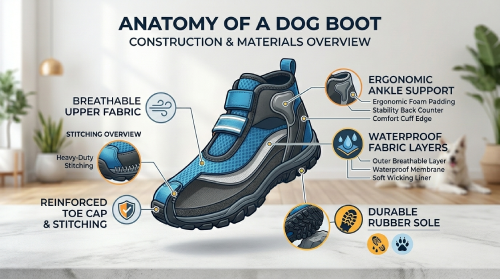
For example, a lightweight mesh upper may make a sandal feel more suitable for everyday summer walks, while a stronger synthetic material may be better suited to outdoor activities. A rubberized sole can provide a more performance-oriented appearance, while softer materials may support a more casual lifestyle positioning.
Businesses should think about customization from the customer's perspective rather than simply asking what can be customized.
The better question is: Which customization choices make the product easier to recognize, easier to market, and more relevant to the target customer?
Which Materials Work Best for Summer Dog Sandals?
Material selection is one of the most important decisions in the development process.
Dogs use their paws differently from humans. The footwear needs to remain secure while allowing natural movement. At the same time, summer products should not feel unnecessarily heavy or restrictive.
Common material choices include mesh, polyester fabric, synthetic leather, rubber, EVA, and other flexible synthetic materials.
Mesh is particularly attractive for summer designs because of its lightweight structure and breathable feel. Polyester and similar fabrics can also work well when a manufacturer needs a combination of durability, flexibility, and printability.
The sole deserves just as much attention as the upper.
A summer sandal may look attractive, but if the sole becomes slippery or separates easily, the product can quickly generate customer complaints. For this reason, B2B buyers should evaluate flexibility, traction, abrasion resistance, stitching, bonding, and overall construction rather than judging a product only by its appearance.
A supplier such as Petsun, which focuses specifically on pet footwear, can be useful during the product-development stage because material selection needs to be considered together with the sandal's construction and intended use.
How Can Colors and Patterns Make Dog Sandals More Marketable?
Color is one of the easiest ways to turn a generic pet product into a recognizable branded product.
For a private-label line, businesses can select colors based on an existing brand identity. A pet company with a strong visual identity may use the same primary and secondary colors across its dog sandals, packaging, website, and social media campaigns.
Other brands may choose seasonal colors.
Bright colors can create a playful summer look, while neutral colors may appeal to customers who prefer a more understated aesthetic. Two-tone designs can provide another way to make a product visually distinctive without dramatically changing its construction.
Patterns can be customized as well.
Depending on production capabilities and order volume, businesses may consider:
- Geometric patterns
- Paw prints
- Stripes
- Camouflage
- Tropical designs
- Brand-inspired graphics
- Seasonal prints
- Minimalist patterns
The important point is consistency.
If the sandal, packaging, and marketing materials all communicate the same visual identity, the product feels like part of a genuine brand rather than another generic item sourced from a factory.
How Can You Customize a Logo on Dog Sandals?
Logo customization is particularly important for private-label buyers.
Depending on the sandal's construction, a logo may be applied through printing, embroidery, embossing, woven labels, rubber badges, or other branding methods.
The best method depends on the material, logo complexity, expected production volume, and desired appearance.
For example, a simple one-color logo may be relatively straightforward to reproduce. A detailed multi-color graphic may require a different production method and potentially increase manufacturing costs.
Logo placement also matters.
Possible locations include the strap, upper section, label, sole area, packaging, or hangtag. A visible logo can strengthen brand recognition, but excessive branding can make a product look less premium.
For that reason, private-label buyers should ask for digital mockups or samples before approving mass production.
Petsun's product range can be reviewed through its pet footwear product catalog, which can help buyers understand the types of footwear and design directions available before discussing a custom project.
How Do Custom Dog Sandals Compare With Standard Dog Boots?
Not every customer needs the same type of dog footwear. From a retail perspective, understanding the differences can help determine where sandals should sit within a product portfolio.
| Feature | Dog Sandals | Standard Dog Boots | Winter Dog Boots |
|---|---|---|---|
| Main season | Spring & summer | Year-round | Fall & winter |
| Ventilation | Generally higher | Moderate | Lower |
| Warmth | Low | Moderate | High |
| Hot pavement protection | Suitable for many designs | Suitable | Usually excessive |
| Snow protection | Limited | Limited to moderate | Strong |
| Outdoor positioning | Walking, travel, casual outdoor use | General protection | Snow and cold-weather activities |
| Custom branding potential | High | High | High |
| Seasonal marketing | Strong | Moderate | Strong |
| Typical visual style | Lightweight, sporty, casual | Protective | Heavy-duty, insulated |
This does not mean one product is universally better than another.
Instead, they serve different customer needs. A retailer may benefit from carrying both summer sandals and more protective boots, allowing customers to choose according to season and activity.
For a brand, this can also create opportunities for product collections rather than one-off products.
Is There a Good Market Opportunity for Dog Sandals in Summer?
The summer market is particularly interesting because several consumer trends overlap.
Pet owners are increasingly treating dogs as companions in everyday activities rather than leaving them at home. Walking, hiking, traveling, camping, and outdoor recreation can all create situations where paw protection becomes relevant.
At the same time, consumers are increasingly willing to spend money on specialized pet products when those products solve a clear problem.
For retailers, this means the product does not necessarily need to compete solely on price.
A well-designed sandal can be marketed around several benefits:
Summer comfort: A lightweight design can be positioned as warm-weather footwear.
Outdoor protection: The product can be presented as an option for walks and outdoor adventures.
Lifestyle: Colorful or stylish sandals can appeal to customers who view pet accessories as part of their dog's overall look.
Convenience: A simple fastening system can make the product easier for owners to put on and remove.
Brand identity: Private-label customization allows retailers to offer something that is not visually identical to competing products.
The opportunity is strongest when the product is designed around a specific customer segment instead of being marketed as “a sandal for every dog.”
What Profit Margin Can Businesses Expect From Dog Sandals?
There is no universal profit margin for dog sandals wholesale, because the final economics depend on materials, construction, customization, order volume, freight, packaging, marketplace fees, retailer margins, and selling price.
However, customization can create an important advantage: the selling price does not have to be determined solely by factory cost.
A generic product is easy for customers to compare. If five stores sell nearly identical sandals, price becomes a major purchasing factor.
A branded product is different.
A retailer can potentially compete through design, brand recognition, packaging, customer experience, and product positioning.
For example, a business might develop:
- A budget-friendly everyday sandal
- A premium outdoor sandal
- A colorful fashion-oriented sandal
- A branded travel collection
- A multi-size family of sandals
The factory price is only one part of the calculation.
A B2B buyer should calculate the full landed cost:
Product Cost + Customization + Packaging + Freight + Duties/Taxes + Warehousing + Platform Fees = Landed Cost
Then compare that figure with the intended wholesale or retail price.
This approach provides a much more realistic picture of profitability than looking only at the supplier's unit quotation.
What Is the Difference Between OEM and ODM Dog Sandals?
OEM and ODM are often used interchangeably, but they represent different approaches.
OEM (Original Equipment Manufacturing) is generally more suitable when the buyer already has a specific product concept or design. The manufacturer produces the product according to the buyer's requirements.
ODM (Original Design Manufacturing) is more useful when the buyer wants to start from an existing manufacturer design and customize it for its own brand.
For example, a retailer may select an existing sandal construction and modify the colors, logo, packaging, and other details. This can reduce development time compared with creating a completely new product.
| Factor | OEM | ODM |
|---|---|---|
| Starting point | Customer's specifications | Manufacturer's existing design |
| Design freedom | Higher | Moderate to high |
| Development time | Usually longer | Usually shorter |
| Development cost | Potentially higher | Often more manageable |
| Suitable for | Established brands and unique concepts | New brands and faster launches |
| Custom logo | Yes | Yes |
| Custom colors | Yes | Usually |
| Custom packaging | Yes | Usually |
| Prototype development | Common | Common |
The right choice depends on how unique the product needs to be and how quickly the business wants to bring it to market.
What Does the OEM Process for Custom Dog Sandals Usually Look Like?
A professional OEM project normally involves several stages rather than simply sending a logo to a factory.
1. Define the product concept
The buyer identifies the target customer, intended use, price range, size range, and desired style.
2. Select or develop the design
The buyer can provide its own specifications or work from an existing manufacturer design.
3. Choose materials and components
This includes the upper material, sole, straps, fasteners, labels, and other components.
4. Confirm branding
Logo placement, printing method, colors, packaging, and labeling are discussed.
5. Develop a sample
A prototype allows the buyer to evaluate appearance, fit, construction, and functionality.
6. Make revisions
Changes may be necessary after testing the sample.
7. Confirm pricing and MOQ
Once the design is finalized, the manufacturer can provide more accurate production pricing and minimum order requirements.
8. Approve pre-production samples
The buyer confirms that the final production version matches the agreed specifications.
9. Begin mass production
The manufacturer moves into production after receiving final approval.
10. Conduct quality control
Finished products should be inspected before shipment according to the buyer's agreed quality requirements.
Working with an experienced pet footwear manufacturer such as Petsun can make this process more straightforward because the supplier is already familiar with the practical considerations involved in producing dog footwear.
What MOQ Should You Expect When Ordering Dog Sandals Wholesale?
MOQ, or Minimum Order Quantity, is one of the first questions B2B buyers should ask.
There is no single MOQ that applies to every dog sandals wholesale project. It can vary according to:
- Existing design vs. new design
- Number of colors
- Number of sizes
- Custom logo
- Custom packaging
- Material changes
- Printing requirements
- Special molds or components
- Production capacity
An existing design with a simple logo may have a lower barrier to entry than a completely new sandal requiring new tooling and packaging.
For new brands, this distinction is important.
Instead of asking only, “What is your MOQ?”, ask:
“What is the MOQ for your existing design with custom colors and logo?”
Then ask separately:
“What is the MOQ for a completely new design?”
These two numbers can be very different.
It is also worth asking whether MOQ applies per color, per size, per design, or to the entire order. A quoted MOQ of 1,000 pairs may sound reasonable until you discover that it means 1,000 pairs per color and per size.
How Should B2B Buyers Choose the Right Dog Sandal Supplier?
Price should not be the only criterion.
A supplier may offer an attractive unit price but become expensive once sampling, packaging, defects, shipping, and communication issues are included.
A better evaluation should consider at least six areas:
Product expertise Does the manufacturer specialize in pet footwear or produce many unrelated products?
Customization capability Can it support materials, colors, logos, packaging, and design changes?
Sampling process Can the supplier create and revise prototypes efficiently?
Quality control Are there defined inspection procedures before shipment?
Communication Does the sales team understand technical requirements and respond clearly?
Production capacity Can the supplier support both initial orders and future growth?
Petsun's focus on pet footwear makes it a supplier worth considering when evaluating manufacturers for a dedicated sandal project. However, buyers should still request samples, production specifications, MOQ details, lead times, and commercial terms before making a purchasing decision.
How Can Private Label Packaging Improve the Product's Retail Value?
A customized sandal is only one part of the customer experience.
Packaging can make a significant difference, particularly for products sold through pet boutiques, specialty retailers, online stores, and branded e-commerce channels.
Instead of receiving a generic product in plain packaging, customers can see:
- Brand logo
- Product name
- Size information
- Usage instructions
- Care instructions
- Brand colors
- Product photography
- Barcode or SKU
- Website or social media information
For private-label brands, packaging also creates additional space to communicate why the product is different.
A premium sandal with premium packaging feels like a complete product. A good product placed in generic packaging can feel like a commodity.
This is particularly relevant when the retailer wants to move away from competing purely on price.
What Should Buyers Test Before Placing a Large Wholesale Order?
Samples should be treated as a quality-control tool, not simply a formality.
Before committing to a large order, buyers should test the sandal under realistic conditions.
Check whether:
- The sandal stays securely on the dog's paw
- The fastening system is easy to use
- The sole has appropriate traction
- The materials feel comfortable
- Stitching and bonding are consistent
- The sole flexes appropriately
- There are sharp edges or uncomfortable components
- The sizes correspond reasonably with the manufacturer's size chart
- The logo remains clear after handling
- The packaging matches the approved artwork
It is also useful to test several sizes and, where possible, different dog breeds or paw shapes.
A sandal that works well for one dog may not perform equally well for another. That is why product development should consider fit and usability rather than focusing entirely on appearance.
How Can a Brand Build a Seasonal Dog Sandal Collection?
Instead of launching one product, brands can consider building a small collection.
For example, a summer range might include:
Everyday Series Lightweight sandals for routine walks.
Outdoor Series A more durable design for hiking and active use.
Fashion Series Colorful designs aimed at style-conscious pet owners.
Premium Series Higher-end materials, upgraded packaging, and stronger brand positioning.
This approach can increase the number of customer segments the retailer can target without requiring an entirely different product category.
It can also make seasonal marketing easier.
A brand can create a “Summer Walk Collection,” “Outdoor Adventure Collection,” or “Travel With Your Dog” campaign around the products.
For a manufacturer like Petsun, this type of collection can also be approached through ODM, where buyers start with existing footwear concepts and customize them into a coherent brand family.
How Can Businesses Make Custom Dog Sandals More Competitive?
The strongest products usually solve a clear customer problem while also giving the brand a reason to exist.
For custom dog sandals, that means thinking beyond the question of “What color should we use?”
Consider these questions:
Who is the customer?
An urban dog owner has different priorities from a hiking enthusiast.
Where will the product be used?
Sidewalks, parks, beaches, trails, and travel all create different requirements.
What price point are you targeting?
The target retail price influences material and construction choices from the beginning.
What makes the product recognizable?
A distinctive sole, strap, color combination, pattern, or logo placement can help.
How will it be packaged?
Packaging should support the same market positioning as the product.
What will make customers buy again?
A successful product line can expand into other colors, sizes, seasonal designs, or related footwear.
This product-first and customer-first approach is generally more effective than simply finding the lowest factory price.
What Should You Ask a Manufacturer Before Starting a Dog Sandal Project?
Before placing an order, B2B buyers should have a clear list of questions.
Ask the supplier:
- What dog sandal designs are currently available?
- What materials can be customized?
- Can colors be matched to a brand specification?
- What logo customization methods are available?
- Can the packaging be private labeled?
- What is the MOQ for an existing design?
- What is the MOQ for a new OEM design?
- Is the MOQ calculated per design, color, or size?
- What is the sample development time?
- How long does mass production take?
- Can the supplier provide size charts and product specifications?
- What quality-control procedures are used?
- What are the payment terms?
- What shipping terms are available?
- Can the supplier support repeat orders as demand grows?
A detailed conversation at the beginning can prevent expensive misunderstandings later.
For buyers researching different product options, Petsun provides a useful starting point for exploring pet footwear designs and discussing potential customization requirements.
Is Custom Dog Sandal Manufacturing Worth Considering for Your Brand?
For pet brands, wholesalers, and retailers, the answer depends on the target market and business model.
If you are simply looking for the cheapest generic summer pet product, customization may not provide enough additional value.
But if you want to build a recognizable pet accessory brand, custom dog sandals can offer several advantages.
They allow businesses to control the product's visual identity, develop a consistent product range, create private-label packaging, and differentiate themselves from retailers selling identical generic products.
The key is to approach the project as a complete product-development process.
Choose the right materials. Define the customer. Test the fit. Control the MOQ. Calculate the landed cost. Build a recognizable design. And make sure the manufacturer can support your quality and production requirements.
For businesses considering dog sandals wholesale, starting with an existing ODM design can often be a practical way to test the market. Once demand has been validated, a more extensive OEM program can provide greater product differentiation.
With the right strategy, summer dog sandals can become more than a seasonal accessory. They can become a profitable and recognizable part of a broader pet footwear collection.
Dog Shoe Manufacturing Process
Rubber Sole vs Soft Sole Dog Shoes
Related Article