Dog Shoe Sole Adhesion Testing
Why Is Dog Shoe Sole Adhesion Testing Critical for B2B Buyers?
A dog shoe can have a durable rubber outsole, a comfortable upper, and an attractive design, yet still fail because the bond between the sole and upper is too weak. During everyday use, the shoe repeatedly bends as the dog walks, while the outsole encounters friction, moisture, dirt, and changes in temperature. These forces place continuous stress on the bonded interface.
When adhesion is inadequate, the first defect may appear as a small gap around the toe or heel. As the dog continues walking, the gap can spread along the sole edge until part of the outsole separates. For importers, distributors, private-label brands, and retailers, this type of failure can lead to returns, negative reviews, warranty claims, and damage to brand reputation.
A systematic dog shoe sole adhesion test helps buyers identify bonding problems before mass production and shipment. It also helps manufacturers determine whether a failure comes from the adhesive, surface preparation, bonding temperature, pressing conditions, material compatibility, or insufficient curing time.
For B2B buyers, the objective is not simply to confirm that the sole sticks to the upper when a shoe is first assembled. The objective is to verify that the bond remains sufficiently strong under the conditions the finished product is expected to experience.
Guangzhou Petsun's dog footwear product range provides a starting point for buyers comparing dog shoe styles and constructions. When evaluating any model, buyers should confirm the sole attachment method and establish suitable adhesion requirements for the actual materials and intended use.
1. What Does Dog Shoe Sole Adhesion Actually Measure?
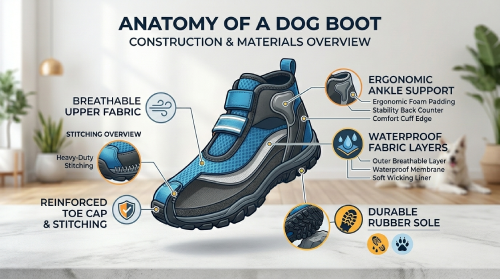
Dog shoe sole adhesion refers to the resistance of the bonded interface between the outsole and upper—or between different layers of a sole assembly—to separation. A dog shoe may use rubber, thermoplastic rubber (TPR), EVA, polyurethane (PU), molded compounds, textile uppers, synthetic leather, or combinations of these materials. Each combination presents different bonding challenges.
Adhesion testing evaluates the strength of the finished joint rather than the strength of the adhesive in isolation. Even a high-performance adhesive may produce a weak bond if the surfaces are contaminated, incompatible, inadequately prepared, or processed under unsuitable conditions.
A useful testing program distinguishes among three related questions:
- Is the bond initially strong enough? This is assessed through an initial peel or separation test.
- Does the bond remain strong after environmental exposure? Heat, moisture, washing, and aging can change the interface.
- Does the production process produce consistent results? Testing multiple samples and production batches helps reveal variation.
How Is Adhesion Different From the Strength of the Adhesive?
Adhesive strength is only one part of the bonding system. The finished joint also depends on the surface energy and condition of the materials, adhesive thickness, application uniformity, drying or activation conditions, pressure, and curing.
For example, a rubber outsole may have excellent wear resistance, but if its bonding surface is contaminated with mold-release residue or insufficiently prepared, the adhesive may not establish a reliable connection. The outsole material itself may be strong while the interface fails prematurely.
This is why a dog shoe sole bonding test should evaluate the complete joint and record where the failure occurs—not simply report that the shoe was pulled apart.
Which Areas of a Dog Shoe Should Be Tested?
The toe, forefoot, waist, and heel can experience different stresses. The toe is often vulnerable to peeling when the shoe repeatedly catches on the ground. The forefoot undergoes repeated bending, while the heel may experience localized pulling during movement.
For layered soles, the bond between the outsole and midsole may be just as important as the bond between the upper and sole. The test plan should identify these interfaces separately when the construction contains multiple bonded layers.
2. Which Factors Commonly Cause Dog Shoe Sole Bonding Failure?
Sole separation rarely has only one possible cause. A weak result may originate in the adhesive formulation, the materials being bonded, the factory process, or the conditions under which the shoe is stored and used.
| Potential cause | What happens | Recommended quality-control response |
|---|---|---|
| Inadequate surface preparation | Adhesive cannot establish sufficient contact with the substrate | Review cleaning, roughening, and surface treatment |
| Incompatible materials | Adhesive does not bond reliably to one or both materials | Verify adhesive-material compatibility |
| Incorrect adhesive application | Bonding areas contain gaps or inconsistent coverage | Inspect coating uniformity and application quantity |
| Incorrect drying or activation | Adhesive has not reached the required processing condition | Control time and temperature |
| Insufficient pressing | The surfaces do not make consistent contact | Check pressure, contact area, and pressing duration |
| Inadequate curing | The bond has not developed its intended properties | Define curing time before testing or packing |
| Contamination | Dust, oil, moisture, or release agents interfere with adhesion | Strengthen incoming-material and work-area controls |
| Excessive environmental stress | Heat, moisture, or repeated flexing weakens the joint | Test under relevant environmental conditions |
Why Can a Shoe Pass an Initial Inspection but Fail Later?
Some bonding defects are not obvious immediately after assembly. A shoe may remain intact during a quick hand pull, yet its bond may weaken after the adhesive continues to cure, the material experiences heat, or moisture penetrates vulnerable areas.
A simple manual check can be useful for identifying obvious defects, but it cannot replace a controlled dog boot glue test. Manual force varies from operator to operator, and the result is rarely measured in a repeatable way.
For a B2B quality program, the factory should combine visual inspection with instrumented tests and periodic checks of the manufacturing process.
3. How Does a Dog Shoe Peel Test Measure Bond Strength?
A dog shoe peel test measures the force required to separate a bonded interface under a defined test setup. In footwear testing, the outsole or a prepared section of the shoe is held in a fixture, and the machine pulls the bonded components apart at a controlled rate.
One important reference is ISO 17708:2018 — Footwear: Test methods for whole shoe, upper-sole adhesion. The standard addresses resistance to separation between the upper and outsole, separation between adjacent outsole layers, and cases in which the upper or sole itself tears. It also describes aging conditions that can be used for production control. The applicable procedure depends on the construction being evaluated.
Suggested image placement — instrumented shoe sole peel test:

Caption: A footwear peel test uses fixtures and controlled pulling force to assess resistance to sole separation. The selected method must match the footwear construction.
What Equipment Is Required for a Peel Test?
The central piece of equipment is a suitable tensile or universal testing machine configured with appropriate footwear fixtures. Depending on the method, the laboratory may also need a cutting tool, a specimen-width measuring device, a fixture for holding the upper or sole, and software capable of recording force during separation.
The test setup should provide controlled movement and reliable force measurement. If the specimen slips inside the clamps, the machine may record an invalid result. If the specimen is cut incorrectly, the test may evaluate a different bonding area from the one specified in the method.
How Is Peel Strength Calculated?
When the selected method requires force to be normalized by specimen width, the basic calculation is:

The resulting unit is N/mm.
For example, if the average force over the specified measurement range is 60 N and the effective specimen width is 10 mm, the calculated value is 6 N/mm. This is an arithmetic example, not a recommended acceptance threshold for dog shoes.
Some methods report force or separation load differently. Buyers should use the calculation and reporting requirements of the selected standard rather than comparing numbers produced by different methods without checking their definitions.
Why Should the Laboratory Record the Failure Mode?
The force value is important, but the failure pattern provides additional diagnostic information. During a peel test, the laboratory should record whether the adhesive separates from the upper, separates from the sole, splits within the adhesive layer, or causes tearing of the substrate.
A relatively high force followed by material tearing may indicate that the interface is stronger than the material that failed. Conversely, a clean separation along one bonding surface may suggest a surface-preparation or compatibility problem. These observations help the factory identify corrective actions rather than simply repeating the test.
4. How Should Buyers Interpret Peel Strength Results and Quality Thresholds?
One of the most common purchasing mistakes is asking for a universal peel-strength number that supposedly applies to every dog shoe. In practice, the acceptable result depends on the construction, bonding method, materials, intended use, test method, and customer specification.
A flexible indoor dog shoe may use a different construction from a rugged outdoor boot. A thin molded sole, a multilayer sole, and a fabric shoe with a narrow bonded edge should not automatically share the same numerical threshold.
Does ISO 17708 Set One Universal Minimum Value for Dog Shoes?
No. ISO 17708:2018 defines a footwear upper-to-sole adhesion test method; it should not be interpreted as a universal dog-footwear acceptance table. Buyers must establish or agree on an appropriate performance requirement for the product being tested.
A supplier should therefore be able to explain both the test method and the acceptance criterion. Saying that a shoe “passes ISO” is incomplete unless the supplier clarifies the specific procedure, measured result, and applicable product requirement.
How Can a Buyer Establish a Practical Acceptance Threshold?
A defensible approach is to begin with a documented baseline for the approved prototype, evaluate performance across multiple samples, and establish a minimum requirement based on intended use and risk. The buyer and manufacturer should then agree on the threshold before mass production.
A specification should define:
- The test method and standard edition.
- The tested location and specimen dimensions.
- The required unit of measurement.
- The minimum acceptable result, if applicable.
- The number of samples and how results are evaluated.
- The permitted failure modes.
- The actions required when a sample fails.
The table below illustrates how a buyer might structure an internal specification. It does not supply universal numerical limits.
| Quality requirement | What the specification should define |
|---|---|
| Initial adhesion | Minimum force or peel-strength requirement for each relevant interface |
| Bond consistency | Permitted variation among samples |
| Environmental durability | Required retention of performance after the specified exposure |
| Failure mode | Whether substrate tearing, adhesive failure, or separation is acceptable |
| Production control | Sampling frequency and batch acceptance rules |
| Corrective action | Retest, material review, process adjustment, or batch rejection |
If the buyer wants to set a numerical threshold, it should be supported by applicable footwear requirements, historical test data, prototype performance, intended-use testing, and agreement between the purchasing and manufacturing teams.
5. How Does Heat Peel Testing Reveal Weak Adhesive Bonds?
Heat-related testing helps determine whether the bonded construction remains reliable after exposure to elevated temperatures. This matters when dog shoes may be stored in hot warehouses, transported in warm containers, or used in hot environments.
Heat can affect adhesive stiffness, material dimensions, and the interface between different components. Depending on the adhesive system, exposure may lead to softening, embrittlement, reduced bonding performance, or dimensional changes in the joined materials.
It is important to distinguish between a peel test performed after heat conditioning and a test performed while the sample is hot. These procedures answer different questions and should not be treated as interchangeable.
What Is the Purpose of Heat Conditioning Before a Peel Test?
In a heat-conditioning approach, finished shoes or prepared specimens are exposed to a defined temperature for a specified period. After exposure, the samples may be conditioned under the selected test conditions and then evaluated using the chosen peel method.
This approach helps identify bonds that deteriorate after thermal exposure. The temperature, duration, recovery period, and test method must be documented so the result can be reproduced.
The conditions should reflect the product's expected storage or use risks. An excessively severe condition may be useful as a stress screen, but it should not be presented as a direct prediction of service life unless that relationship has been validated.
How Is a Hot Peel Test Different From a Heat-Aging Test?
A hot peel test measures separation behavior while the sample is at an elevated temperature. A heat-aging test exposes the sample to heat and then assesses its condition afterward. Some laboratories may use both approaches when developing a demanding product specification.
A hot peel test can help reveal whether the joint loses strength under thermal load. A post-aging test can reveal longer-term changes caused by the exposure.
The report should clearly state which procedure was performed. Buyers should not assume that a supplier has completed both simply because the report uses the phrase “heat resistance.”
What Should Buyers Check After Heat Exposure?
Inspect the toe and heel bond lines for opening or distortion, and look for adhesive residue, separation between sole layers, or visible changes in the upper. Then review the measured peel force and failure mode.
If a shoe performs well initially but fails after heat conditioning, the factory should investigate adhesive selection, surface treatment, application conditions, curing, and material compatibility. Merely increasing the amount of adhesive may not solve the underlying problem.
6. How Can Water Exposure and Washing Tests Evaluate Sole Bonding?
Dog shoes are frequently exposed to rain, wet grass, muddy surfaces, cleaning, and drying. Moisture can affect some adhesive systems and substrates, while repeated washing may create additional stress through temperature changes, agitation, and bending.
A post-wash adhesion test evaluates the bond after the shoe has undergone a defined cleaning procedure. A water-exposure test may use a different exposure process, depending on whether the product is designed for wet-weather use or routine washing.
What Should a Post-Wash Adhesion Test Include?
The protocol should begin with an approved shoe model and a documented baseline result. Samples are then subjected to the agreed washing procedure, dried according to the specified method, and tested again using the same relevant adhesion method.
The washing procedure should define the cleaning method, water temperature, detergent where applicable, number of cycles, and drying conditions. Hand washing and machine washing should not be treated as equivalent unless the protocol establishes that they are comparable.
After washing, the laboratory should check for:
- Separation at the toe, heel, or sole edge.
- Adhesive failure between the outsole and upper.
- Separation between layers of the sole.
- Swelling, distortion, or changes in flexibility.
- Changes in peel force compared with the baseline.
- New failure patterns that were not present before washing.
How Should Buyers Calculate Adhesion Retention After Washing?
A buyer can compare the post-wash result with the initial result using an agreed calculation:

For example, if the initial result is 8 N/mm and the post-wash result is 6 N/mm, the calculated retention is 75%. These values are illustrative only and do not define a pass/fail requirement.
Retention is useful for understanding how much performance changed, but it should not be used alone. A product with a low initial bond may retain a high percentage of an inadequate baseline. Buyers should therefore assess both the absolute post-exposure result and the percentage retained.
Why Is Drying Important Before Retesting?
The time and method used to dry the shoe can influence the measured result. Testing a wet shoe immediately after washing may produce a different result from testing it after a defined drying and conditioning period.
The test report should specify whether the shoe was tested wet, after drying, or after a defined recovery period. Without this information, comparisons between suppliers or production batches may be misleading.
7. Which Industry Standards Are Relevant to Dog Shoe Sole Adhesion Testing?
B2B buyers should select standards according to the product construction and the performance question they need to answer. A standard designed for whole-shoe adhesion may be suitable for evaluating the upper-to-sole interface, while other methods may be more appropriate for flat bonded materials or specific material combinations.
| Standard or method | Main application | What buyers should understand |
|---|---|---|
| ISO 17708:2018 | Upper-to-sole adhesion and separation between sole layers in finished footwear | A key reference for whole-shoe adhesion testing |
| GB/T 21396-2022 | Chinese footwear whole-shoe upper-to-sole adhesion testing | Relevant where the purchasing specification or factory QC system uses this standard |
| ASTM D413 | Adhesion between rubber and flexible substrates in defined applications | Its scope must be checked before applying it to a particular dog shoe construction |
| Relevant SATRA footwear methods | Specific footwear adhesion or toe-peel procedures | Confirm the exact method, edition, and suitability for the construction |
The official ISO description of ISO 17708 explains that it applies to footwear constructions where the upper is continuously assembled with the sole, including cemented, vulcanized, and injection-molded footwear. The method focuses on the resistance to separation near the edge of the assembly.
ASTM D413 addresses adhesion between rubber and flexible substrates in specified applications. It should not automatically be substituted for a whole-shoe method when the actual product geometry or bonded interface falls outside its scope.
How Should Buyers Verify a Supplier's Claim of Compliance?
Ask for the standard number and edition, the laboratory's test procedure, sample details, measured values, and the acceptance criteria used. If the supplier uses an internal method, request a written description of the specimen preparation, test equipment, loading conditions, and calculation.
A credible test report should make it possible to understand what was actually tested. The phrase “tested according to international standards” is not sufficient evidence on its own.
8. What Equipment Is Needed for a Reliable Dog Shoe Peel Test?
Testing equipment influences the reliability of the results. A machine with an unsuitable fixture, inaccurate force measurement, or inconsistent movement can produce results that are difficult to compare.
For many instrumented adhesion tests, a universal testing machine can be configured with suitable grips and fixtures. Some footwear laboratories also use dedicated sole-adhesion or toe-peel testers for particular shoe constructions.
Suggested image placement — footwear peel-strength testing equipment:

Caption: A footwear peel-strength tester holds the shoe and applies controlled force to evaluate the resistance of the bonded sole interface.
| Equipment or tool | Purpose | QC consideration |
|---|---|---|
| Universal testing machine | Applies controlled pulling force and records force data | Verify calibration, load range, and suitable fixtures |
| Dedicated footwear peel tester | Evaluates sole adhesion using a defined footwear fixture | Confirm the fixture suits the construction |
| Cutting tools | Prepare specimens or initiate a peel | Ensure specimen preparation follows the method |
| Width-measuring tool | Measures the effective specimen width | Record dimensions consistently |
| Temperature chamber or oven | Provides defined thermal exposure | Verify temperature control and uniformity |
| Washing equipment | Applies a controlled cleaning procedure | Record cycle, temperature, and drying conditions |
| Data-recording software | Stores force curves and calculated results | Retain raw data and traceable sample IDs |
A factory does not necessarily need to own every specialized test machine. It may use internal equipment for routine process checks and qualified external laboratories for specialized testing. What matters is that the method is appropriate, the equipment is maintained, and the results are traceable.
9. How Can a Factory Control Adhesion Quality During Production?
A strong adhesion test result is useful, but a mature quality system also prevents bonding defects from occurring in the first place. The factory should control the process variables that determine whether the adhesive forms a reliable joint.
For dog shoes, the control plan should cover incoming materials, surface preparation, adhesive application, drying or activation, pressing, curing, and final inspection. The exact parameters depend on the adhesive and materials being used; they should be defined by the approved manufacturing process rather than copied from a generic checklist.
Which Production Parameters Should Be Monitored?
The following variables are commonly important:
- Surface preparation: Check that the bonding surfaces are clean and treated as required.
- Adhesive application: Monitor coverage and consistency, including vulnerable toe and heel areas.
- Drying or activation: Control time and temperature according to the adhesive process.
- Pressing: Verify that the joint receives suitable and consistent contact pressure.
- Curing: Allow the bond to develop its required properties before final testing or packing.
- Material control: Confirm that production materials match the approved specifications.
- Operator training: Ensure that staff understand the process and recognize early warning signs.
A small process change can affect adhesion. For example, changing the outsole compound or switching to a different upper coating may alter how the adhesive interacts with the surface. Such changes should trigger a review of material compatibility and, where appropriate, repeat testing.
What Should Happen When a Sample Fails?
The factory should isolate the affected batch or production stage, document the failure location and pattern, and investigate the likely cause. Corrective actions may include improving surface preparation, changing the approved adhesive system, adjusting the processing conditions, or correcting material inconsistencies.
The revised process should then be verified through repeat testing. Simply retesting until a passing sample appears is not a reliable corrective-action process; the factory should establish why the failure occurred and confirm that the correction addresses the cause.
10. How Should Buyers Design an Incoming Quality-Control Plan for Sole Adhesion?
Incoming quality control helps buyers confirm that the delivered product matches the approved sample and agreed specification. It should be based on product risk, supplier history, order volume, and the consequences of a sole-bonding failure.
A practical plan can combine visual inspection, manual screening, instrumented adhesion tests, and periodic environmental testing. These checks serve different purposes and should not be treated as substitutes for one another.
| Inspection stage | Recommended activity | Objective |
|---|---|---|
| Sample approval | Instrumented peel test and failure-mode review | Establish a performance baseline |
| Pre-production | Verify materials and bonding process | Confirm that the intended construction can be produced |
| Production monitoring | Visual inspection and defined process checks | Detect inconsistent assembly |
| Final inspection | Check sole edges, toe and heel bonds, and visible separation | Identify obvious defects before shipment |
| Periodic verification | Repeat peel testing on representative samples | Monitor production consistency |
| Change control | Retest after material or process changes where needed | Confirm that changes do not compromise adhesion |
The sampling plan should specify the number of specimens, selection method, acceptance rules, and actions for a failed result. For large orders or products with a history of bonding problems, buyers may require more frequent testing than they would for a stable, low-risk product.
11. How Can OEM and ODM Projects Reduce Sole Adhesion Risks?
OEM and ODM development creates opportunities to improve bonding performance before a product reaches mass production. It also introduces risk if the design changes without a corresponding review of materials and process conditions.
For example, a private-label buyer may request a different outsole color, a softer rubber compound, a new coating on the upper, or a thinner sole profile. These changes may affect bonding compatibility even when the overall appearance remains similar.
Guangzhou Petsun's OEM/ODM custom services are a relevant starting point for buyers discussing customized dog footwear development. During a project, buyers should clarify which components can be customized, how material substitutions are approved, and what sample testing is available. Specific testing capabilities and acceptance requirements should be confirmed directly with the manufacturer.
What Should Be Agreed Before the Prototype Is Approved?
The buyer and manufacturer should agree on the material specifications, sole attachment construction, applicable test method, acceptance criteria, and sample approval procedure. The final approved sample should be linked to a controlled product specification so production staff can identify the correct materials and assembly details.
A prototype should not be approved solely because the sole looks secure or survives a quick hand pull. The acceptance process should include the relevant documented adhesion test and any environmental conditioning required by the product's intended use.
When Should a Design Change Trigger Retesting?
Retesting should be considered when changes affect the bonded interface. Examples include a new adhesive, a different outsole compound, a change in upper coating, a revised surface treatment, or a significant adjustment to the bonding process.
Not every cosmetic change requires a complete test program. However, the factory should evaluate whether the change could influence adhesion and document the reasoning behind its decision.
12. How Should Wholesale Buyers Evaluate Ready-to-Ship Dog Shoes?
Wholesale buyers often prioritize availability, unit cost, delivery time, and product variety. These commercial factors are important, but sole bonding should still be included in the purchasing review, particularly when the buyer intends to sell the products under an established retail brand.
Guangzhou Petsun's in-stock and wholesale services can help buyers begin discussions about available products and order arrangements. Before placing a large order, buyers should confirm the specific model, construction, available specifications, and whether test reports or sample evaluation can be provided for the selected product.
A ready-to-ship product should not be assumed to have the same adhesion performance as a customized model that has undergone a different material or construction process. If the buyer requires a particular peel-strength threshold or post-wash performance, that requirement should be communicated and agreed upon before ordering.
Which Documents Should Wholesale Buyers Request?
Depending on the product and purchasing agreement, useful records include:
- Product specifications and material descriptions.
- Available adhesion test reports.
- The test method and acceptance criteria.
- Sample approval records.
- Production-batch identification.
- Inspection records and documented corrective actions, where available.
These records help buyers evaluate supplier transparency and create a reference for future orders. They also make it easier to investigate complaints if sole separation appears after products reach the market.
13. What Should a Professional Dog Shoe Adhesion Test Report Contain?
A test report should communicate more than a final “pass” or “fail.” It should contain enough detail for a buyer to determine whether the result applies to the product being purchased.
| Report item | Why it matters |
|---|---|
| Product and model identification | Links the result to the correct dog shoe |
| Sample size and batch | Establishes what was tested |
| Bonding location | Distinguishes upper-to-sole from sole-layer adhesion |
| Test method and edition | Makes the procedure identifiable |
| Conditioning details | Explains any heat, washing, or aging exposure |
| Equipment and fixtures | Helps establish test suitability |
| Individual results | Shows variation among specimens |
| Average result and units | Supports comparison against the specification |
| Failure mode | Helps diagnose the source of weakness |
| Acceptance criteria | Explains the basis of the pass/fail decision |
| Photographs and raw data | Support traceability and technical review |
| Corrective action, if needed | Documents how a failure was addressed |
A useful report also identifies any deviation from the selected test method. If the factory used an internal procedure rather than a published standard, that fact should be stated clearly.
Buyers should be cautious about reports that lack specimen identification, numerical results, or a defined threshold. A certificate or report is valuable only when it provides relevant and verifiable evidence.
14. How Can Buyers Compare Suppliers Using Sole Adhesion Quality?
When comparing dog shoe manufacturers, the lowest unit price does not always produce the lowest total purchasing cost. A product with inconsistent bonding may generate returns, replacements, extra inspection costs, and customer-service work that outweighs the original savings.
A supplier comparison should consider both technical capability and process consistency.
| Evaluation criterion | Strong evidence | Warning sign |
|---|---|---|
| Test method | Clearly identified method and edition | Vague claims of “international testing” |
| Results | Traceable numerical data and sample identification | Only a pass statement |
| Acceptance criteria | Agreed threshold and defined failure conditions | No explanation of what constitutes failure |
| Process control | Documented preparation, application, and curing procedures | Reliance on visual inspection alone |
| Failure analysis | Root-cause investigation and verified corrective action | Repeated testing without investigating causes |
| Change control | Review of material and process changes | Unapproved substitutions |
| Production traceability | Batch and inspection records | No link between reports and delivered goods |
A supplier that can explain why a bond failed, demonstrate the corrective action, and provide repeatable results offers stronger evidence of process control than one that relies only on marketing claims.
For Guangzhou Petsun and any other supplier under evaluation, buyers should verify the exact scope of available testing and agree on project-specific acceptance criteria rather than assume that every model follows the same test plan.
How Can Buyers Build a Reliable Dog Shoe Sole Adhesion Testing Program?
Reliable dog shoe sole adhesion testing requires more than pulling at the outsole and checking whether it comes loose. A professional program combines an appropriate peel test, clearly defined acceptance criteria, environmental conditioning where relevant, failure-mode analysis, and production process control.
For B2B buyers, the most important principles are:
- Select a test method that matches the construction and bonded interface.
- Establish measurable acceptance criteria before approving mass production.
- Evaluate initial adhesion as well as performance after relevant heat or moisture exposure.
- Record numerical results, specimen details, and failure modes.
- Investigate failed samples and verify corrective actions.
- Reassess adhesion when materials or manufacturing processes change.
ISO 17708:2018 provides a recognized footwear method for evaluating upper-to-sole adhesion, but the product-specific acceptance threshold must still be established. Buyers should use test data alongside production records, sample approval, and incoming quality control to make informed purchasing decisions.
Guangzhou Petsun's dog footwear product range, OEM/ODM custom services, and in-stock and wholesale services are useful starting points for buyers exploring product options and discussing their purchasing requirements. For any order, the buyer should confirm the exact construction, test evidence, and agreed quality specifications before shipment.
How to Evaluate a Dog Shoe Supplier
How to Test Dog Shoe Durability
Related Article