How Custom Dog Shoes Are Developed
author: Gigi
2026-11-26
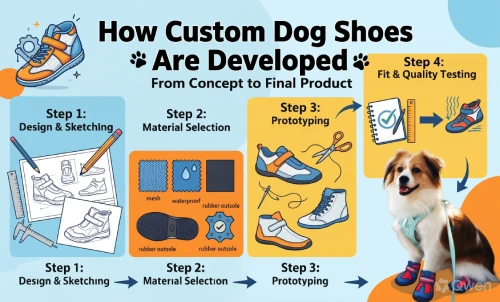
Developing custom dog shoes involves much more than choosing a fabric and adding a brand logo or private label. A structured custom dog shoe development process helps buyers transform an initial concept into a commercially viable product. Whether a business needs an exclusive custom dog boot design, improved functionality, or private label dog shoes footwear, understanding each custom dog shoe development stage can reduce sampling costs, prevent production errors, and shorten time to market.
1. How Does Custom Dog Shoe Development Start? Understanding OEM and ODM Requirements
The first stage of custom dog shoe development is defining what the product needs to achieve. Before discussing appearance or pricing, buyers and manufacturers should establish the target market, intended application, customer expectations, and expected order volume.
1.1 What Information Should Buyers Prepare Before Contacting a Manufacturer?
A clear product brief should cover several essential areas:
- Target application: Summer pavement protection, winter snow protection, indoor traction, or everyday outdoor walking.
- Target customers: Small-breed owners, large-dog owners, outdoor enthusiasts, or premium pet product consumers.
- Functional requirements: Waterproofing, breathability, abrasion resistance, flexibility, and anti-slip performance.
- Design preferences: Shoe height, closure system, color combinations, decorative elements, and overall appearance.
- Commercial requirements: Target unit cost, estimated order quantity, packaging, and expected delivery schedule.
These details provide the foundation for custom dog shoe development and help manufacturers evaluate whether the proposed custom dog boot design is technically and commercially feasible.
1.2 Should You Choose OEM or ODM for Custom Dog Boot Design?
OEM and ODM serve different business needs.
OEM is suitable for buyers who already have drawings, reference samples, technical specifications, or an established product concept. The manufacturer develops the product according to the buyer's requirements.
ODM is more appropriate for brands that need support with product concepts, structural improvements, pattern custom dog shoe development, and custom dog boot design optimization.
A professional custom dog boot design project may also combine both approaches. For example, a retailer might provide an existing custom dog boot design while asking the manufacturer ( Guangzhou Petsun ) to improve its sole structure, closure system, and material combination.
2. How Are Dog Shoe Designs, Sizes, and Materials Developed?
After the requirements are confirmed, the project moves into technical development. This stage is particularly important because dog shoes must accommodate different paw shapes while maintaining comfort, stability, and functional protection.
2.1 How Does Custom Dog Boot Design Address Different Paw Shapes?
Unlike conventional human footwear, dog shoes must account for the relationship between paw width, length, toe distribution, and movement.
A shoe that fits the paw length but is too narrow may create pressure around the toes. Excessive internal space, on the other hand, can cause rotation, slipping, and unstable walking.
A reliable custom dog boot design process should therefore consider:
- Paw length and width across different size categories.
- Internal shoe dimensions and toe-box allowance.
- Upper height and ankle coverage.
- Closure positioning and adjustable tension.
- Sole flexibility and ground-contact stability.
The manufacturer may develop patterns or adjust existing shoe structures according to the target breeds and applications.
Size grading also requires attention. Simply increasing every dimension proportionally may not produce a consistent fit because paw proportions can vary between small and large dogs.
2.2 Which Materials Should Be Selected for Custom Dog Shoes?
Material selection must balance protection, comfort, durability, and production cost.
| Component | Common Material Options | Main Development Considerations |
| Upper | Mesh, polyester, nylon, neoprene | Breathability, flexibility, abrasion resistance |
| Outsole | Rubber, TPR, PVC | Grip, wear resistance, flexibility |
| Lining | Polyester fabric, soft textile | Comfort, moisture management |
| Closure | Hook-and-loop, zipper, elastic | Adjustability, retention, ease of use |
| Reinforcement | Synthetic leather, reinforced fabric | Structural stability and durability |
The material combination should match the intended application rather than simply follow the lowest-cost option.
In the custom dog shoe development stage, buyers should also evaluate material thickness, seam strength, bonding compatibility, color consistency, and potential wear points.
2.3 How Does the OEM Dog Shoe Process Turn Designs into Physical Samples?
Once the design and materials are established, the factory prepares patterns, component specifications, and prototype samples.
The OEM dog shoe process typically includes upper cutting, stitching, component preparation, sole forming or attachment, and final assembly.
The first prototype is used to evaluate whether the proposed structure can be manufactured and whether its appearance matches the original concept.
For more complex projects, multiple sample rounds may be necessary. Adjustments can involve toe shape, sole thickness, stitching positions, opening dimensions, or closure placement.
3. What Happens During Sample Approval, Trial Production, and Mass Manufacturing?
A successful prototype does not automatically guarantee consistent bulk production. The factory must verify that the approved design can be reproduced using standardized materials, processes, and quality requirements.
3.1 How Many Sample Stages Are Needed Before Bulk Production?
The number of sample rounds depends on design complexity and the extent of customization.
A typical OEM dog shoe process may include:
1. Initial prototype: Evaluates the overall design, proportions, and construction.
2. Revised sample: Incorporates feedback on fit, materials, and functional details.
3. Confirmation sample: Establishes the final approved product standard.
4. Pre-production sample: Verifies that production materials and manufacturing methods match the approved specifications.
3.2 Why Is Trial Production Important for Custom Dog Shoe Development?
Trial production identifies problems that may not appear during individual sample making.
During the custom dog shoe development process, trial production should evaluate:
- Cutting accuracy and material utilization.
- Stitching consistency and seam strength.
- Sole attachment and structural stability.
- Size consistency and component alignment.
- Closure performance and finished-product appearance.
Once the trial results meet the agreed requirements, mass production can begin.
3.3 How Does Private Label Dog Shoes Manufacturing Ensure Consistency?
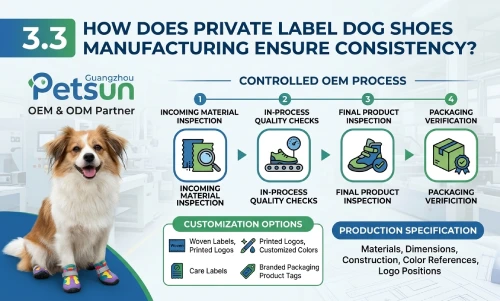
Typical customization options include woven labels, printed logos, customized colors, care labels, branded packaging, and product tags.
A standardized private label dog shoes production specification should document the approved materials, dimensions, construction methods, color references, logo positions, and packaging requirements.
For Guangzhou Petsun, its long standing focus on dog shoe design, manufacturing, and wholesale provides a business foundation for OEM and ODM cooperation. Its custom dog shoe development approach connects design requirements with sample production and subsequent manufacturing.
A controlled OEM dog shoe process should also include incoming material inspection, in-process quality checks, final product inspection, and packaging verification.
4. How Are Custom Dog Shoes Delivered, and What Should B2B Buyers Check?
The final stage involves finished-product inspection, packaging, shipment preparation, and delivery coordination.
Before shipment, buyers should confirm that the products match the approved sample in size, color, material, workmanship, branding, and quantity.
For private label dog shoes, packaging details deserve particular attention. Incorrect size labels, missing barcodes, inconsistent product descriptions, or damaged packaging can create additional costs for distributors and retailers.
A practical custom dog shoe development timeline should also account for sample revisions, material procurement, production scheduling, inspection, and international transportation. Buyers should confirm these milestones before committing to a launch date.
4.1 FAQ: Common Challenges in Custom Dog Shoe Development
Q1: Why do approved dog shoe samples sometimes fit differently in bulk production?
The main causes include material variations, inconsistent cutting dimensions, changes in stitching tension, and insufficient size grading control. Buyers should establish measurable specifications and retain an approved reference sample before production.
Q2: Can manufacturers customize dog shoes without developing new molds?
Yes. Existing shoe structures can often be modified through different upper fabrics, sole colors, sole hardness, logo applications, and closure components. New molds or custom tooling may be required when the outsole geometry or fundamental construction changes.
Q3: How can buyers reduce repeated sampling costs?
Prepare a detailed product brief, provide reference images or existing samples, define measurable requirements, and consolidate feedback from all decision-makers into one revision document. This reduces unnecessary development cycles.
Q4: What should buyers prioritize when evaluating an OEM dog shoe manufacturer?
Look beyond the sample appearance. Evaluate the manufacturer's pattern development capability, material sourcing, size range management, production consistency, quality inspection procedures, and ability to handle repeat orders.
Q5: How can brands protect their product designs during ODM cooperation?
Discuss ownership of original designs, mold ownership, artwork usage, confidentiality, and restrictions on reproducing exclusive products. Put these agreements into the commercial contract before development begins.
5. Start Developing Your Custom Dog Shoe Collection
Successful dog footwear development depends on the combination of product engineering, material knowledge, manufacturing experience, and effective buyer manufacturer communication.
Guangzhou Petsun has specialized in high quality pet shoes since 1999, whether you are improving an existing product or developing a new collection, start with a clear product brief and discuss your customization requirements with an experienced dog shoe manufacturer.
Related Article
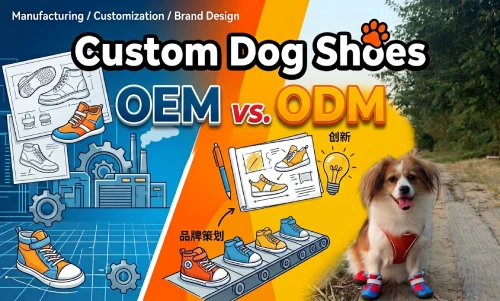
Compare custom dog shoes OEM vs. ODM, including design ownership, costs, MOQ, sampling, and private label options to choose the right manufacturing model. - Guangzhou Petsun
Custom Dog Shoes: OEM vs. ODM
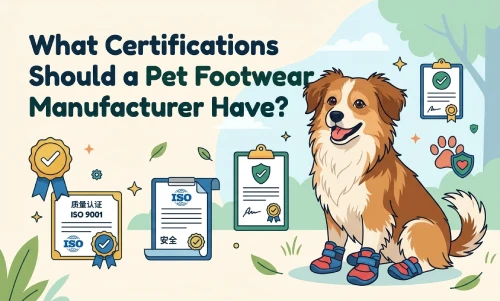
Learn which certifications pet footwear manufacturers need, including ISO, BSCI, Sedex, REACH, and CPSIA, to evaluate suppliers and manage compliance risks. - Guangzhou Petsun
What Certifications Should a Pet Footwear Manufacturer Have?