How Dog Shoe Size Grading Works
For a manufacturer, however, the process is much more complicated.
A professional dog footwear sizing system has to translate thousands of individual paw shapes into a manageable number of production sizes. The manufacturer must decide which measurements define each size, how much space should be added for movement, how the upper and sole should be adjusted, and how the pattern should change as the size moves from XXS to XL or beyond.
For B2B buyers, this distinction is important. A size chart is not simply a marketing table. It is the visible result of a much deeper production system involving measurement standards, pattern grading, materials, construction, tolerances, and sample testing.
This is why two brands can both offer “Small,” “Medium,” and “Large” dog boots while their actual dimensions are completely different.
For wholesalers, importers, private-label brands, and retailers, understanding dog shoe size grading makes it much easier to evaluate suppliers, create accurate product specifications, reduce size-related returns, and develop a consistent footwear collection.
Why Is Dog Shoe Sizing More Complicated Than Simply Choosing Small, Medium, or Large?
The first thing B2B buyers need to understand is that dog shoe size is not standardized in the same way as many human footwear systems.
A dog's weight or breed can provide a rough reference, but neither tells a manufacturer exactly how wide or long the paw is.
Two dogs with similar body weights may have very different paws. A compact terrier, for example, may have a relatively narrow paw, while a similarly weighted dog with a broader body structure may require a wider shoe.
Even within the same dog, the front and rear paws may not have identical dimensions.
That is why professional dog shoe sizing normally starts with actual paw measurements rather than breed or body weight alone.
For production purposes, the most useful measurements may include:
- Paw width
- Paw length
- Paw circumference
- Wrist or ankle circumference
- Foot opening circumference
- Upper height
- Sole length
- Sole width
Not every dog shoe requires every measurement.
A simple low-cut sandal may rely primarily on paw width and length. A high-cut protective boot may require additional circumference and opening measurements to make sure the boot stays secure without being too tight.
This is the first major difference between consumer sizing and manufacturing sizing:
The consumer sees a size label. The manufacturer sees a group of dimensional relationships.
Which Paw Measurements Should Be Used to Build a Dog Boot Size Chart?
A reliable dog boot size chart should be built from measurements that actually control fit.
Should paw width be the primary measurement?
For many dog boots, paw width is one of the most useful starting points.
The width should normally be measured at the widest part of the weight-bearing paw. When a dog stands, the paw spreads differently than when it is lifted, so measuring a non-weight-bearing paw can produce a smaller result.
This is why many established dog footwear brands use paw width as a central sizing reference. Ruffwear, for example, provides boot sizes based on paw width measured at the widest point while bearing weight, while other manufacturers combine width with additional measurements.
For production, width is particularly important because a boot that is too narrow may restrict the paw, while excessive width can make the shoe unstable or easier to lose.
Does paw length matter as much as width?
It depends on the construction.
Length becomes particularly important when the shoe has a shaped toe box, structured sole, or enclosed upper.
A manufacturer cannot simply increase width and assume the length will automatically remain appropriate. The relationship between length and width affects the overall last or pattern shape.
If the length is excessive, the dog's paw may move inside the shoe. If the length is insufficient, the toes may contact the front of the shoe.
When should circumference be included?
Circumference becomes more important for boots that extend higher around the foot or ankle.
A high-top boot, rehabilitation boot, waterproof boot, or tightly secured outdoor boot may require additional measurements around the paw or ankle.
For example, Thera-Paw's sizing system includes paw width, paw length, paw circumference, wrist/ankle circumference, and wrist/ankle height because its boot construction requires a more complete fit assessment.
This demonstrates an important manufacturing principle:
The correct measurement system depends on the construction of the product.
There is no single universal measurement formula that works equally well for every dog shoe design.
How Should a Manufacturer Build the Base Size Before Grading?
Before a manufacturer can perform dog shoe size grading, it first needs a reliable base size.
The base size is essentially the reference from which other sizes are developed.
For example, a manufacturer may decide that a particular medium size represents a core section of its target market. That size is then developed carefully through:
- Paw measurement analysis
- Pattern development
- Sole design
- Upper construction
- Closure placement
- Sample production
- Fit testing
- Pattern correction
The base size should not be selected simply because “Medium” sounds like the middle of the range.
It should be connected to real measurements and the intended customer market.
For example, a brand targeting small companion dogs may require a much more detailed size range at the smaller end. A manufacturer supplying outdoor boots for medium and large breeds may prioritize larger sizes and more robust construction.
The base size therefore becomes a technical reference point, not merely a label.
What Does Dog Shoe Size Grading Actually Mean in Manufacturing?
Dog shoe size grading is the process of systematically increasing or decreasing a footwear pattern so that one basic design can be produced in multiple sizes.
Imagine a manufacturer has developed a medium dog boot.
The manufacturer cannot simply enlarge the entire pattern by 10% and call it Large.
Different components need to change at different rates.
The sole may need to become longer and wider.
The upper may need additional volume.
The opening may need to increase.
The strap may need to become longer.
The position of the closure may need to move.
The toe shape may need to become wider or longer.
This is why professional grading is closer to a controlled engineering process than a simple scaling operation.
How does a manufacturer decide the grading increment?
A grading increment represents the dimensional change between adjacent sizes.
For example, a hypothetical size system might look like:
| Size | Paw Width | Paw Length | Approx. Width Increase |
|---|---|---|---|
| XS | 35 mm | 45 mm | — |
| S | 40 mm | 50 mm | +5 mm |
| M | 45 mm | 56 mm | +5 mm |
| L | 51 mm | 63 mm | +6 mm |
| XL | 58 mm | 71 mm | +7 mm |
These numbers are illustrative rather than a universal dog footwear standard.
The important point is that the increments need to be defined deliberately.
A manufacturer may use different increments at different parts of the size range because dog paw dimensions do not necessarily increase in a perfectly linear fashion.
Why can't every component use the same grading increment?
Because every component performs a different function.
Increasing the sole width by a certain amount does not automatically mean the upper height, strap length, opening circumference, and toe volume should increase by exactly the same amount.
For example:
Sole: primarily follows the paw's footprint.
Upper: needs additional volume and shaping.
Opening: must accommodate the leg or ankle.
Strap: must provide enough adjustment range.
Logo position: may need to move to remain visually centered.
This is why experienced footwear manufacturers grade patterns by component rather than blindly enlarging the entire product.
How Does Pattern Grading Change the Shape of the Dog Shoe?
Pattern grading is where sizing becomes a true manufacturing issue.
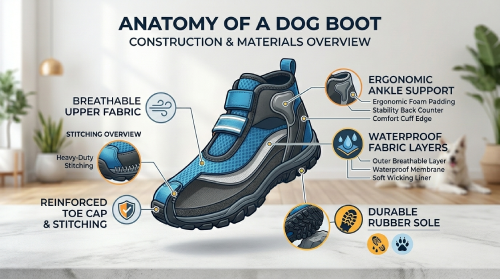
A dog shoe pattern may contain several individual pieces, such as:
- Toe upper
- Side panels
- Heel panel
- Tongue
- Collar
- Strap
- Lining
- Sole
- Reinforcement components
Each piece interacts with the others.
If the sole becomes wider but the upper does not change proportionally, assembly becomes difficult and the finished shoe may develop unwanted tension.
If the upper is increased too aggressively, the shoe may become loose.
If the opening is enlarged without adjusting the fastening system, the boot may be easier for the dog to pull off.
How should the toe area be graded?
The toe area should follow both length and width changes.
Simply stretching the toe forward may create excessive internal space. Increasing width without adjusting the toe curve may also produce an unnatural shape.
For enclosed boots, the toe box needs enough volume for the paw without creating unnecessary empty space.
How should the heel area be graded?
The heel needs to remain aligned with the dog's rear paw structure.
When a size becomes larger, the heel panel may need to increase in both width and height. However, the opening should still remain secure.
This is particularly important for products designed for active dogs because poor heel geometry can contribute to movement inside the shoe.
How should straps and closures be graded?
Straps should not simply be extended by the same amount as the sole.
The manufacturer needs to consider the circumference of the area where the strap sits.
A strap that is too short creates pressure and makes the product difficult to put on. A strap that is too long can leave excess material and reduce adjustment precision.
For B2B buyers, this is an important sample-review point that is often overlooked when evaluating a supplier's size chart.
How Should Manufacturers Turn Paw Measurements Into a Standardized Dog Footwear Sizing System?
A production sizing system normally needs several layers of information.
A useful structure is:
Raw Measurement → Target Fit Measurement → Size Range → Pattern Grade → Finished Product Tolerance
The first layer comes from actual dog paw data.
The second determines how much additional room the product requires.
The third groups measurements into commercially manageable sizes.
The fourth converts those dimensions into pattern changes.
The fifth defines acceptable production variation.
For example, suppose a manufacturer determines that a target paw width is 45 mm.
The finished shoe cannot necessarily have an internal width of exactly 45 mm.
Depending on the material and construction, the product may require additional internal allowance for:
- Lining thickness
- Seam construction
- Paw movement
- Closure design
- Sole stiffness
- Toe shape
Therefore, a professional size chart should distinguish between dog paw measurement and finished shoe dimensions.
This distinction is extremely important for private-label buyers because otherwise a supplier and buyer may both use the word “width” while referring to completely different measurements.
How Do U.S., European, and Asian Dog Shoe Sizes Differ?
There is an important misconception about international dog shoe sizing.
There is no single globally enforced dog-shoe equivalent system where a U.S. size can always be converted directly into a European or Asian size using one fixed formula.
Instead, many dog footwear brands create their own size labels based on paw measurements.
For example, one brand may call a 50 mm paw width “Medium,” while another may classify a similar dimension as “Large.”
Therefore, international B2B buyers should avoid treating:
US S = EU S = Asia S
as a technical sizing rule.
The letter or number is simply a label unless it is connected to a dimensional specification.
What does the U.S. market typically expect?
The U.S. market commonly uses inches alongside size labels.
For example, a U.S.-oriented dog boot chart may show:
- XS
- S
- M
- L
- XL
with paw width listed in inches.
Some brands provide exact measurements such as 1.5", 1.75", 2", 2.25", and so on.
What does the European market typically expect?
European buyers are generally more familiar with metric measurements, particularly centimeters and millimeters.
For B2B production, providing metric dimensions can therefore make technical communication easier.
However, a European retailer may still use its own product size labels such as S, M, L, or proprietary numbering.
What about Asian markets?
Asian markets are not one unified sizing system either.
Different countries, brands, and retailers can use different labeling conventions. For manufacturing, metric dimensions are often the most practical common technical language.
For export production, the safest approach is therefore:
Do not manufacture according to the word “S,” “M,” or “L.” Manufacture according to the agreed dimensional specification.
The size label can then be adapted to the target market.
How Should a Supplier Create a Dog Boot Size Chart for Multiple Markets?
For an international B2B product, the best practice is to separate technical measurements from consumer-facing labels.
A manufacturer can maintain a master technical chart in millimeters and then create localized versions.
For example:
| Technical Measurement | U.S. Presentation | European Presentation | Manufacturing Reference |
|---|---|---|---|
| Paw width | Inches | mm / cm | mm |
| Paw length | Inches | mm / cm | mm |
| Product size | XS–XL | XS–XL or local label | Internal size code |
| Tolerance | Manufacturing spec | Manufacturing spec | mm |
| Front/rear difference | Product-specific | Product-specific | Separate specification |
This approach makes international production much easier.
The factory maintains one controlled technical specification while marketing teams can present the information in the format expected by their customers.
It also reduces the risk of a common B2B problem: changing the size label without realizing that the underlying physical dimensions have changed.
Why Can the Same Dog Need Different Sizes for Front and Rear Paws?
This is one of the most important points for anyone developing a dog footwear sizing system.
Dogs do not necessarily have identical front and rear paws.
The front paws can be larger or shaped differently because they carry a significant proportion of the dog's body weight and have different anatomical functions.
As a result, some established dog boot brands specifically instruct customers to measure both front and rear paws.
This has direct production implications.
A manufacturer can produce four identical boots per package, but the buyer may need to determine whether the target market expects a single-size four-piece set or allows different front and rear sizing.
For a standard consumer product, using the larger paw size for all four boots may be operationally simpler.
For a specialized or premium product, however, a brand could potentially offer more precise front/rear sizing.
The choice affects:
- SKU count
- Inventory complexity
- Packaging
- Customer education
- Manufacturing cost
- Retail price
This is an excellent example of how a technical sizing decision eventually becomes a commercial decision.
How Should Manufacturers Handle Size Tolerance During Mass Production?
A size chart describes the target dimensions. It does not mean every finished shoe will be mathematically identical.
Textile, rubber, EVA, foam, stitching, bonding, and other materials can introduce small dimensional variations.
For this reason, a B2B specification should include acceptable tolerances.
For example, a technical specification might define a target dimension and an acceptable manufacturing range.
The exact tolerance should be determined by the product construction and production capability rather than copied from a generic number.
This is especially important for:
- Sole length
- Sole width
- Opening circumference
- Strap length
- Logo placement
- Pattern dimensions
- Component alignment
A buyer should agree on these specifications before mass production.
Otherwise, “the size is slightly different” becomes a subjective quality dispute rather than an objective manufacturing issue.
How Should Sample Testing Validate a New Dog Shoe Size Chart?
A size chart should never be considered finished simply because the spreadsheet looks correct.
It needs to be validated through physical samples.
A professional validation process can include:
Step 1: Check the base size
Confirm the fit, internal space, opening, sole dimensions, fastening position, and overall shape.
Step 2: Check the adjacent sizes
Test at least one smaller and one larger size to determine whether the grading behaves naturally.
Step 3: Check the size transition
Look for sudden changes in proportions.
For example, if Medium looks balanced but Large suddenly becomes unusually wide, the grading rule may need adjustment.
Step 4: Test different paw shapes
A dog shoe should not only fit one idealized paw shape.
Where possible, testing different breeds and paw structures can reveal issues that a single sample cannot.
Step 5: Test movement
The shoe should be checked while the dog stands, walks, turns, and moves naturally.
This can reveal problems that are invisible when the dog is stationary.
Step 6: Record feedback as production data
Instead of simply writing “Large is too loose,” the development team should identify where the issue occurs.
Is the sole too wide?
Is the opening too large?
Is the strap too long?
Is the upper too high?
This turns subjective feedback into an actionable pattern adjustment.
What Are the Most Common Dog Shoe Sizing Problems in Production?
Many sizing problems are not caused by the size chart itself.
They often come from the relationship between the chart and the physical product.
Problem 1: The shoe is correct in length but too narrow
This usually indicates that width grading or the basic last shape needs adjustment.
Problem 2: The shoe is wide enough but slips off
The issue may be the opening, closure, strap position, or heel construction rather than the sole size.
Problem 3: The front fits but the rear does not
This may indicate that the brand needs to consider different front and rear paw dimensions.
Problem 4: One size works for some breeds but not others
The size range may be too broad.
A single “Medium” size may cover too many different paw shapes.
Problem 5: The physical product differs from the approved sample
This is a production-control issue.
The buyer should compare the mass-production sample against the approved specification rather than relying only on visual inspection.
These problems explain why a good dog boot size chart is only one part of a successful footwear program.
The underlying pattern, materials, construction, and quality-control process must support it.
How Does Dog Shoe Size Grading Change With Different Shoe Constructions?
Not all dog shoes should use the same grading logic.
A lightweight sandal, a waterproof boot, a winter boot, and a heavy-duty outdoor shoe can have very different fit requirements.
A soft fabric sandal may tolerate more flexibility around the upper.
A rigid sole requires more careful dimensional control.
A thick winter boot may require additional internal volume because of insulation and lining.
A waterproof boot may need tighter control around the opening to reduce water entry.
Therefore, when a B2B buyer asks a manufacturer, “What is your standard dog shoe size chart?”, the next question should be:
“Which product construction does that chart apply to?”
This is an important distinction when developing a private-label range.
A manufacturer may have a standard size framework, but the final dimensions can still need adjustment for each product model.
How Can OEM and ODM Production Affect Dog Shoe Size Grading?
OEM and ODM projects give buyers different levels of control over the sizing system.
With ODM, a buyer may start with an existing Guangzhou Petsun design and adapt branding, colors, materials, packaging, and selected product specifications.
This can shorten development time because the basic construction and sizing architecture may already exist.
With OEM, the buyer can provide more detailed requirements and develop a product around its own technical specifications.
For example, a buyer may specify:
- Target paw-width range
- Number of sizes
- Size increments
- Front/rear sizing
- Sole dimensions
- Opening dimensions
- Strap position
- Materials
- Logo location
- Packaging requirements
For businesses interested in this route, Guangzhou Petsun's custom OEM and ODM services can be used as a starting point for discussing product customization, development, and private-label requirements.
The important point is that OEM/ODM customization should not stop at colors and logos.
For footwear, the sizing architecture itself can be part of the product design.
How Can Wholesale Buyers Use an Existing Size System to Reduce Development Risk?
Not every buyer needs a completely new sizing system.
For a retailer testing a new category, starting with an established product construction can be commercially practical.
Guangzhou Petsun's in-stock and wholesale services provide another route for buyers who want to evaluate existing pet footwear products rather than beginning with a completely new OEM project.
An existing product can allow the buyer to:
- Evaluate actual product dimensions
- Check material quality
- Test customer response
- Determine which sizes sell
- Identify the most popular colors
- Estimate reorder quantities
- Understand customer sizing questions
Once sales data is available, the buyer can make better decisions about whether a fully customized size system is justified.
This is particularly useful for smaller brands because every additional size increases SKU complexity.
How Should B2B Buyers Decide How Many Dog Shoe Sizes to Offer?
More sizes do not automatically mean a better product.
A larger size range improves coverage but also increases inventory complexity.
Suppose a brand offers:
5 sizes × 4 colors = 20 SKUs
If the brand offers:
8 sizes × 6 colors = 48 SKUs
That difference becomes much more significant when each SKU must be purchased at a minimum quantity.
The buyer therefore needs to balance:
Size Coverage vs. Inventory Efficiency
A practical starting point is to identify the target market first.
If the product is designed primarily for small companion dogs, the brand may need more precise grading at the smaller end.
If the product is aimed at active medium and large dogs, more attention may need to be given to wider soles, larger openings, stronger closures, and larger size increments.
Sales data can then be used to refine the range.
If one size consistently accounts for a large share of sales while another moves slowly, the buyer can adjust future purchasing rather than automatically giving every size equal inventory.
How Can a Standardized Sizing System Reduce Returns and Wholesale Problems?
For a B2B brand, sizing accuracy affects more than customer satisfaction.
Incorrect sizing can create:
- Higher return rates
- Replacement costs
- Negative product reviews
- Customer service workload
- Retailer complaints
- Overstock in unpopular sizes
- Lost repeat orders
A standardized sizing system reduces these problems by creating consistency between:
Product → Size Chart → Packaging → Website → Sales Team → Customer
Every part of the customer journey should use the same measurement definition.
For example, if the website says “paw width,” the manufacturer, packaging designer, and customer-service team should all understand exactly where that measurement is taken.
The same applies to whether the measurement includes nails, whether the paw is weight-bearing, whether the measurement refers to the dog or the finished shoe, and whether the chart uses inches or millimeters.
Consistency is one of the most overlooked parts of professional dog footwear sizing.
What Should B2B Buyers Ask a Dog Shoe Manufacturer About Sizing?
Before placing a production order, buyers should ask technical questions rather than simply requesting a PDF size chart.
A useful supplier questionnaire includes:
- What measurement determines each size?
- Is the chart based on paw width, length, or both?
- Should the paw be measured while weight-bearing?
- Are front and rear paws measured separately?
- Does the chart refer to dog measurements or finished shoe dimensions?
- What are the grading increments between sizes?
- Are grading increments identical across the full size range?
- What production tolerance applies to each dimension?
- Does the size chart change between different shoe models?
- How are straps and openings graded?
- Can the supplier customize the size range?
- Can the supplier provide physical samples for each size?
- What happens if the approved sample and mass production differ?
- Can the supplier support different size labels for different markets?
- Can the size chart be supplied in both inches and metric units?
These questions help a buyer distinguish between a supplier that simply sells finished products and a manufacturer that understands the technical side of pet footwear.
How Can Guangzhou Petsun Support a Standardized Dog Footwear Sizing Program?
For buyers developing a private-label dog footwear collection, Guangzhou Petsun can be introduced naturally at the product-development stage rather than treated as a separate company-profile section.
A manufacturer specializing in pet footwear can contribute to the process from product selection and sample development through customization and production.
For buyers starting from an existing product, Guangzhou Petsun's product range can be reviewed through its pet footwear product catalog.
For a new private-label product, the OEM/ODM route allows the buyer to discuss product specifications alongside branding and construction requirements.
This can be particularly useful when the buyer wants the dog shoe size grading to support a specific target market rather than simply adopting a generic XS–XL structure.
For wholesale buyers who want to start with existing products, Guangzhou Petsun's in-stock option provides another potential sourcing route, allowing businesses to evaluate product dimensions and customer demand before investing in a more extensive custom development program.
The key advantage of approaching sizing this way is that the size chart becomes part of the product specification instead of something added at the end of the marketing process.
What Does a Professional Dog Shoe Size Grading Workflow Look Like From Start to Finish?
A standardized B2B workflow can be summarized as follows:
1. Define the target market
Determine whether the product is intended for the U.S., Europe, Asia, or multiple regions.
2. Collect paw data
Identify the expected width, length, and other relevant measurements.
3. Select the base size
Choose a representative size for pattern development.
4. Build the base pattern
Develop the sole, upper, opening, straps, lining, and other components.
5. Define grading increments
Determine how each component changes between sizes.
6. Produce graded samples
Create multiple sizes rather than validating only the base size.
7. Test fit and movement
Evaluate the physical product on appropriate dogs.
8. Record dimensional problems
Turn subjective feedback into measurable corrections.
9. Finalize the master size chart
Document dog measurements, product dimensions, tolerances, and size labels.
10. Localize the chart
Create inch and metric versions as needed for different markets.
11. Approve the production specification
The buyer and manufacturer confirm the final technical requirements.
12. Control mass production
Production samples and finished products are checked against the approved specification.
This workflow turns sizing from a simple marketing exercise into a controlled manufacturing process.
Why Does Professional Dog Shoe Sizing Matter So Much for B2B Buyers?
For consumers, sizing determines whether a dog shoe fits.
For a B2B buyer, sizing affects the entire economics of the product.
It influences product development, sample approval, inventory planning, SKU count, packaging, website content, customer service, returns, and repeat orders.
A well-designed dog footwear sizing system therefore does more than tell customers which size to buy.
It creates a common technical language between the manufacturer and the buyer.
The buyer knows exactly what “Medium” means.
The factory knows exactly what dimensions need to be produced.
The packaging communicates the same information.
The website uses the same measurements.
The customer receives a product that corresponds to the size chart.
That consistency is what turns a collection of dog shoes into a scalable commercial product line.
For businesses sourcing dog shoe sizing solutions, the most important principle is simple: do not treat XS, S, M, L, and XL as universal standards. Treat them as labels attached to carefully defined measurements.
Once the measurements, grading rules, pattern adjustments, tolerances, and market-specific presentation are properly defined, a manufacturer can produce the same product concept consistently across different sizes and markets.
That is the real purpose of dog shoe size grading: not simply making a shoe larger or smaller, but creating a controlled sizing system that connects the dog's paw, the physical product, the manufacturing pattern, and the customer's buying decision.
How to Select Materials for Dog Shoes
Common Quality Problems in Dog Shoes
Related Article