How to Select Materials for Dog Shoes
For B2B buyers, therefore, dog shoe material selection is not simply a question of choosing the “best” fabric. It is a product-development decision involving performance, target market, cost, manufacturing compatibility, supply stability, and compliance.
A successful dog footwear product usually comes from a material system, rather than one premium material. The upper, sole, lining, reinforcement, fastener, thread, adhesive, logo and packaging all have to work together.
This dog boot materials guide explains how manufacturers and buyers can approach material selection systematically, from the first product brief to OEM/ODM production.
Why Does Dog Shoe Material Selection Matter So Much in Product Development?
Dog shoes experience a different combination of stresses from human footwear. The product must accommodate a paw that flexes, spreads under weight, and moves through dirt, moisture, heat, snow, pavement and uneven terrain.
That means material selection directly affects:
- Comfort and flexibility
- Abrasion resistance
- Water resistance
- Breathability
- Traction
- Weight
- Thermal protection
- Product lifespan
- Manufacturing cost
- Appearance and branding
- Quality consistency
- Regulatory and environmental requirements
For example, the American Kennel Club notes that dog boots intended for hiking require traction and durable construction, while hot-weather footwear benefits from lightweight and breathable materials. Waterproof materials such as PVC and natural rubber can be useful in wet conditions, but the overall design still needs to match the intended activity.
This is why a material should never be evaluated in isolation. The right question is not “Is rubber a good material?” but rather:
“Is this rubber compound appropriate for this sole, this dog, this environment, this price point and this manufacturing process?”
That mindset is the foundation of professional dog shoe material selection.
What Performance Requirements Should Be Defined Before Choosing Materials?
Before contacting a supplier, a B2B buyer should create a material specification based on the product's intended use.
A hiking boot, summer sandal, indoor traction sock and winter snow boot may all be called “dog shoes,” but their material requirements are fundamentally different.
Should the Product Be Designed for Summer, Winter, Rain or Outdoor Activities?
Start with the environment.
| Product Positioning | Primary Material Requirements | Typical Material Direction |
|---|---|---|
| Summer dog shoes | Breathability, lightweight construction, heat management | Mesh, polyester fabric, lightweight neoprene |
| Winter dog boots | Warmth, flexibility, water resistance | Neoprene, fleece, synthetic fabrics |
| Rain boots | Water resistance, easy cleaning, flexibility | Rubber, TPU, PVC, coated fabrics |
| Hiking boots | Abrasion resistance, traction, structural durability | Ripstop nylon, polyester, rubber/TPU outsole |
| Indoor dog shoes | Softness, flexibility, anti-slip performance | Knitted fabric, cotton blends, soft rubber/TPU |
| Medical/recovery footwear | Soft contact surfaces, controlled protection | Soft textile, neoprene, foam, flexible outsole |
There is no universal best material for dog shoes because the performance target changes with the product.
A common mistake in B2B development is asking a supplier to recommend a material before defining the application. That reverses the process. The product requirement should determine the material—not the other way around.
Which Materials Are Commonly Used for Dog Shoe Uppers?
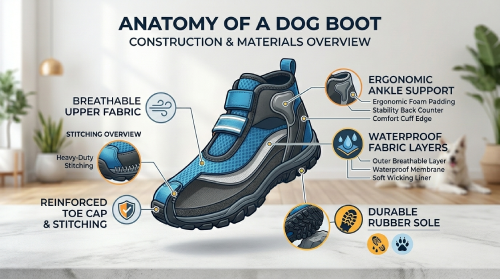
The upper is usually the most visible material in a dog shoe and has a major influence on comfort, appearance, flexibility and manufacturing cost.
Common dog shoe fabric choices include polyester, nylon, mesh, neoprene, canvas and synthetic leather.
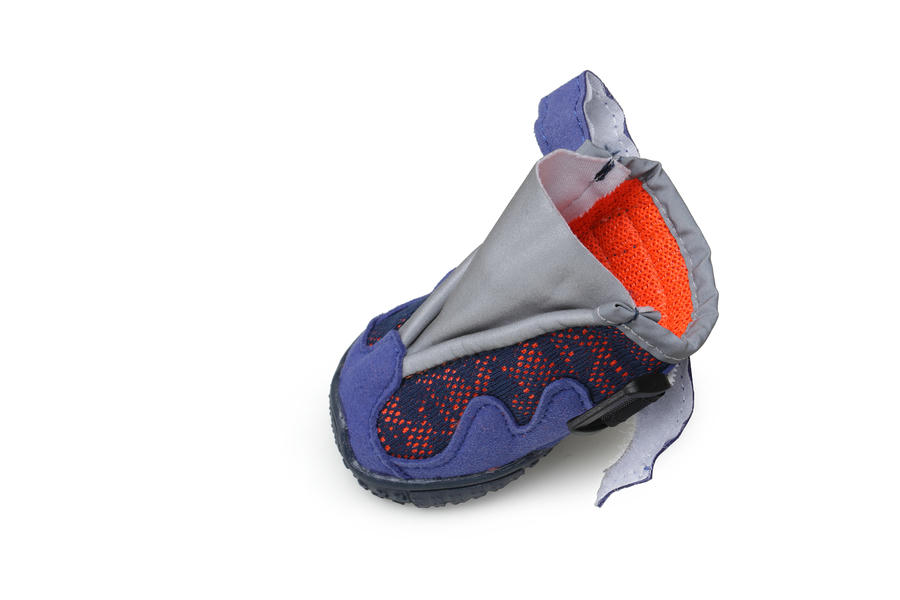
Why Is Polyester Mesh Popular for Lightweight Dog Shoes?
Polyester mesh is particularly useful when ventilation and low weight are priorities.
Its advantages include:
- Low weight
- Good breathability
- Flexible construction
- Relatively stable supply
- Easy dyeing and printing
- Compatibility with sewing and bonding
- Good suitability for sports-style products
For summer footwear, mesh can help create a more ventilated upper than dense waterproof materials.
However, mesh should not automatically be treated as waterproof. An open structure can allow water and mud to pass through easily.
For that reason, a summer walking shoe and a waterproof rain boot may use completely different upper constructions even if they share the same basic pattern.
When Does Nylon or Ripstop Fabric Make More Sense?
Nylon is often considered when abrasion resistance is more important than maximum softness.
For hiking or outdoor dog boots, tightly woven or ripstop nylon can provide a useful balance between durability and weight.
The key advantage is not simply the fiber itself. Fabric density, yarn construction, coating, thickness and finishing treatment all influence actual performance.
For a B2B buyer, asking only for “nylon fabric” is therefore not enough. A supplier should be given a clearer specification such as:
- Fiber composition
- Fabric weight
- Thickness
- Weave/construction
- Coating requirement
- Color standard
- Abrasion requirement
- Water-resistance requirement
That makes material sourcing much more controllable.
Where Does Neoprene Fit Into Dog Shoe Development?
Neoprene is useful when flexibility, cushioning and water resistance are needed together.
It is commonly associated with wet-weather and cold-weather products because its foam structure can provide insulation while remaining flexible.
However, neoprene is not automatically the best choice for warm-weather footwear. A thick neoprene upper can retain more heat than an open mesh construction.
This creates an important product-development principle:
Material performance must always be evaluated against the environment.
A material that performs well in winter can become a disadvantage in summer.
How Should Dog Shoe Sole Materials Be Selected?
The sole is one of the most technically important components because it directly contacts the ground.
For most B2B products, the outsole needs to balance:
- Grip
- Abrasion resistance
- Flexibility
- Weight
- Water resistance
- Temperature resistance
- Production cost
- Bonding compatibility
Common options include rubber, TPR, TPU, PVC and EVA-based constructions.
Why Is Rubber Often Used for High-Traction Dog Boots?
Rubber is valued for its grip and abrasion resistance.
A rugged rubber outsole can be appropriate for hiking, outdoor walking and surfaces where traction is critical. Ruffwear's Grip Trex product, for example, combines an air-mesh upper with a rugged Vibram outsole designed for varied terrain.
But rubber has trade-offs.
Depending on compound and thickness, it can increase product weight and may require more careful processing than lighter sole materials.
For a small-breed dog shoe, adding unnecessary sole weight can work against the original comfort objective.
When Is TPU a Useful Alternative?
TPU can be attractive when a product needs a combination of flexibility, durability and molded detail.
It can also be useful for:
- Anti-slip patterns
- Reinforced toe areas
- Decorative structures
- Flexible molded soles
- Logo details
TPU is especially interesting for private-label products because the material can support more distinctive visual and structural designs.
The final decision should depend on hardness, thickness, tread design and molding requirements rather than simply choosing “TPU” as a material category.
What About TPR and PVC?
TPR can provide a useful middle ground between rubber-like flexibility and thermoplastic processing.
PVC can be attractive for cost-sensitive waterproof products because it can be formed into relatively simple waterproof structures.
However, material selection should consider flexibility at the actual operating temperature, weight, odor, surface feel, durability and applicable chemical requirements.
The lowest material quotation does not necessarily produce the lowest total product cost if the material creates higher defect rates, poor durability or customer returns.
How Should the Inner Lining Be Chosen for Comfort?
The lining is often overlooked because consumers see the outside of the shoe first. From a product-development perspective, however, the lining can strongly affect how the dog experiences the product.
Common lining materials include:
- Polyester mesh
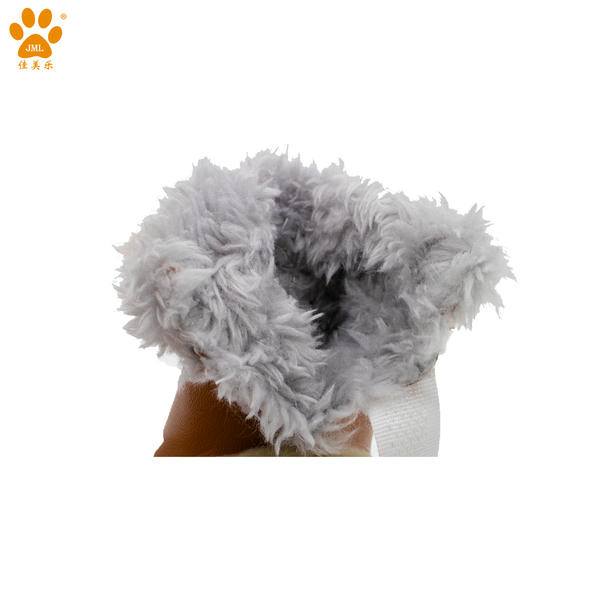
- Soft fleece
- Brushed fabric
- Neoprene
- Cotton blends
- Lightweight knitted materials
When Should a Mesh Lining Be Used?
Mesh lining works well when ventilation and low weight are priorities.
It can be appropriate for:
- Summer shoes
- Indoor footwear
- Lightweight walking boots
- Sport-style dog footwear
The main advantage is airflow and reduced bulk.
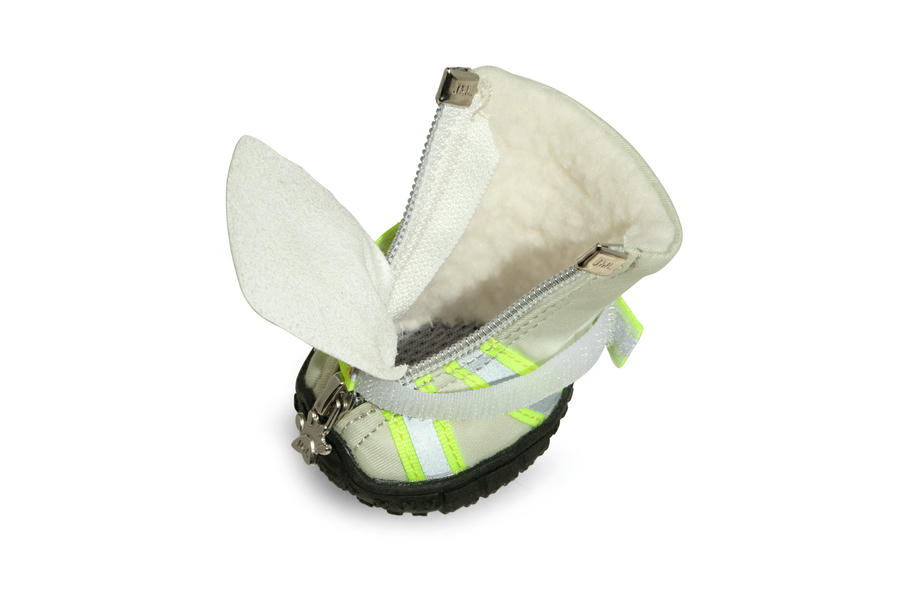
When Is Fleece the Better Choice?
Fleece is more appropriate when warmth and softness are major selling points.
Winter boots may combine a water-resistant outer material with fleece lining to create a warmer internal environment.
But this construction also adds thickness.
That matters because a thicker lining can reduce internal space and change the fit. A size that works with a thin mesh lining may become too tight after switching to thick fleece.
This is one reason material changes should trigger a fit review rather than being treated as a cosmetic modification.
Which Auxiliary Materials Are Easy to Overlook During Development?
A finished dog shoe contains much more than an upper, sole and lining.
Small components can determine whether the product feels premium or fails during use.
Important auxiliary materials include:
- Hook-and-loop fasteners
- Elastic bands
- Webbing
- Sewing thread
- Binding tape
- Reinforcement patches
- Reflective tape
- Woven labels
- Care labels
- Logo patches
- Adhesives
- Packaging materials
For example, a high-quality upper can still produce a poor product if the hook-and-loop fastener loses grip, the thread breaks under tension, or the adhesive fails at the sole joint.
A B2B specification should therefore define the complete bill of materials rather than approving only the main fabric.
How Should Materials Be Balanced Against the Product's Target Cost?
Material selection is also a financial decision.
A simple way to evaluate the product is to divide the target cost into major components:
Target Factory Cost = Upper + Sole + Lining + Trims + Labor + Packaging + Manufacturing Overhead
If the target factory cost is fixed, upgrading one component may require savings somewhere else.
For example, moving from a basic polyester upper to a high-abrasion nylon may increase material cost. That could be justified for a hiking boot but unnecessary for a lightweight indoor shoe.
The goal is not to maximize the cost of every component.
The goal is to allocate cost where the customer can actually perceive or benefit from the performance.
| Product Feature | Where to Spend More | Where to Control Cost |
|---|---|---|
| Hiking boot | Outsole, upper durability, reinforcement | Decorative trims |
| Summer boot | Breathable upper, lightweight sole | Heavy lining |
| Winter boot | Insulation, waterproof construction | Unnecessary ventilation mesh |
| Rain boot | Waterproof structure, outsole | Decorative reinforcement |
| Fashion dog shoe | Appearance, logo, surface materials | Extreme outdoor performance |
This is a much more practical approach to dog shoe material selection than simply choosing premium materials throughout the product.
How Does Material Choice Affect Manufacturing and Supply Chain Stability?
A material can look excellent on a sample and still become problematic during mass production.
Before approving a material, buyers should ask:
- Is the material consistently available?
- Does the supplier maintain the same specification between batches?
- Is the color stable?
- Can the material be cut efficiently?
- Can it be sewn without excessive needle damage?
- Does it bond reliably with the selected sole?
- Is the supplier dependent on a single raw-material source?
- Are there seasonal supply fluctuations?
- Can the same material be replenished six months later?
This is particularly important for private-label brands.
If a material is difficult to source consistently, the brand may face color differences, texture changes or unexpected redesigns during replenishment.
For B2B production, repeatability is often more valuable than novelty.
A slightly less exotic material with stable quality and supply can be a better long-term choice than a premium material that is difficult to reproduce.
How Should Environmental and Compliance Requirements Enter Material Selection?
Environmental requirements should be considered at the beginning of development, not after production has started.
Depending on the target market, buyers may need documentation covering restricted substances, chemical safety, material composition and other applicable requirements.
A professional material-development process should therefore include:
- Material specification
- Supplier documentation
- Restricted-substance requirements
- Test reports where applicable
- Adhesive specifications
- Dye/finish information
- Recycled-content claims where relevant
- Packaging requirements
The exact compliance requirements depend on the destination market and product configuration, so suppliers should not simply be told to provide a generic “eco-friendly” material.
The buyer should define what the environmental claim actually means.
For example, “recycled polyester,” “water-based adhesive,” “PVC-free” and “biodegradable” are different claims and should not be treated as interchangeable.
How Do Materials Influence Dog Shoe Construction and Durability?
Material selection cannot be separated from construction.
The same fabric can perform very differently depending on how it is cut, stitched, reinforced and attached to the sole.
For example:
Upper fabric + stitching + reinforcement + sole bonding = actual product durability
not:
Upper fabric = product durability
How Does Stitch Density Affect the Final Product?
Higher stitch density can improve structural stability in some areas, but excessive stitching can also create unnecessary perforation or stiffness.
The correct stitch specification depends on fabric thickness, thread type, seam position and expected load.
Why Does Sole Bonding Matter as Much as Sole Material?
Even a durable outsole can fail if the bonding interface is poorly designed.
The supplier needs to consider:
- Surface preparation
- Adhesive compatibility
- Curing conditions
- Bonding area
- Sole hardness
- Upper material
- Production temperature
- Application consistency
Petsun's in-stock service, for example, describes a three-stage sole adhesion process and dense stitching as part of its production approach, illustrating why construction quality needs to be considered alongside material selection.
How Should Buyers Compare Different Material Combinations?
Instead of comparing individual materials, B2B buyers should compare complete material packages.
| Material System | Upper | Lining | Sole | Strengths | Typical Positioning |
|---|---|---|---|---|---|
| Lightweight Summer | Mesh | Mesh | Flexible TPU/soft rubber | Breathable, light | Summer walking |
| Outdoor | Ripstop nylon | Mesh/neoprene | Rubber/TPU | Abrasion resistance, traction | Hiking |
| Winter | Polyester/neoprene | Fleece | Rubber/TPR | Warmth, grip | Snow/cold |
| Rain | Coated fabric/TPU/PVC | Lightweight textile | Rubber/TPR | Water resistance | Rainy conditions |
| Casual | Polyester/canvas | Soft textile | Flexible rubber/TPR | Comfort, appearance | Daily wear |
| Premium Outdoor | Technical textile | Neoprene/mesh | High-performance rubber | Durability and performance | Premium outdoor |
This type of comparison is much more useful during sourcing because it connects materials to product positioning.
How Does Material Selection Change in an OEM or ODM Project?
OEM/ODM development gives buyers much more control over materials, but that control needs to be managed systematically.
For an existing shoe model, a buyer may only need to change:
- Upper fabric
- Sole color
- Sole hardness
- Sole logo
- Labels
- Packaging
For a completely new product, the development process can go much deeper.
What Does OEM Material Customization Usually Involve?
OEM customization starts with an existing specification or product concept.
The buyer may provide:
- Target market
- Reference product
- Material preference
- Color standards
- Logo
- Size range
- Packaging requirements
- Target price
- Performance expectations
The manufacturer then translates these requirements into a production-ready material and construction specification.
What Makes ODM Development Different?
ODM development is more collaborative.
Instead of simply producing a buyer's existing design, the manufacturer can participate in:
- Product concept development
- Pattern development
- Material selection
- Sole selection
- Construction optimization
- Sampling
- Fit adjustment
- Packaging development
This is especially valuable when a brand knows the market opportunity but does not have an established dog-footwear engineering team.
For example, Guangzhou Petsun's current custom service describes solutions ranging from material, sole and construction customization to custom shoe lasts and new product development. Its published process includes requirement communication, sampling and quotation, production, packaging/shipping and post-delivery support.
For buyers exploring private-label footwear, the relevant Guangzhou Petsun custom OEM/ODM service can therefore be evaluated according to how much of the material and construction specification needs to be customized.
How Can Buyers Control MOQ When Developing New Materials?
MOQ is closely connected to material selection.
A factory may be able to change the upper fabric relatively easily, while a completely new sole compound, custom mold or specialized fabric may require additional development costs and minimum quantities.
Guangzhou Petsun currently publishes different customization levels: customization based on existing models can involve changes to fabric, sole color, sole hardness and logos, while new-product development can involve custom shoe lasts and new designs. Its published MOQ for some existing-model customization is 500 sets per color, while new-product projects are discussed according to project requirements.
For a new brand, this creates an important sourcing strategy:
Do not customize everything at once.
A more controlled development path can be:
Existing model → material/color customization → packaging/branding → market validation → deeper structural ODM development
This allows the buyer to test demand before committing heavily to tooling and complex material development.
When Is In-Stock Wholesale More Appropriate Than Custom Development?
Not every buyer needs a fully customized material system.
If the immediate objective is to test a market, replenish a proven product or launch a seasonal campaign quickly, an in-stock program may be more practical.
Guangzhou Petsun's current in-stock service lists a minimum order quantity of 10 sets and states that in-stock products can be shipped within 48 hours. The service also offers packaging enhancement options for orders of 50 sets or more.
This creates two different purchasing models:
| Requirement | In-Stock Wholesale | OEM/ODM Custom |
|---|---|---|
| Speed | Priority | Longer development cycle |
| MOQ | Lower | Usually higher |
| Material changes | Limited | Broad |
| Branding | Packaging/label options | Product + packaging |
| Product differentiation | Moderate | High |
| Development cost | Lower | Higher |
| Market testing | Suitable | Suitable for validated concepts |
| Best for | Distributors, retailers, testing | Private-label brands |
Buyers can review the Guangzhou Petsun in-stock wholesale service when speed and low initial commitment are more important than product exclusivity.
What Material Questions Should a B2B Buyer Ask a Dog Shoe Manufacturer?
A professional RFQ should go beyond “What materials do you use?”
A better material questionnaire includes:
What Is the Exact Material Composition?
Ask for fiber or polymer composition, thickness and construction.
What Performance Does the Material Provide?
Ask about abrasion resistance, flexibility, water resistance, breathability and temperature suitability where relevant.
Can the Material Be Supplied Consistently?
Confirm whether the same specification can be reproduced for future orders.
Can the Material Be Customized?
Clarify color, surface finish, printing, logo, hardness, thickness and texture options.
What Are the Material and Production MOQs?
A product MOQ and a raw-material MOQ are not always the same.
What Testing or Documentation Is Available?
Ask what documentation can be supplied for your target market and product claims.
What Happens If the Material Becomes Unavailable?
A backup material or approved alternative can prevent future supply disruption.
These questions turn material selection from a subjective design conversation into a measurable sourcing process.
How Should a Complete Dog Shoe Material Selection Workflow Be Built?
A practical B2B workflow can be divided into eight stages:
1. Define the application
Summer, winter, rain, hiking, indoor, casual or medical use.
2. Define performance requirements
Set priorities for grip, flexibility, durability, water resistance, breathability, warmth and weight.
3. Establish the target cost
Set a realistic factory-cost range before selecting premium materials.
4. Build the material system
Select upper, lining, sole and auxiliary components as one package.
5. Check manufacturing compatibility
Confirm sewing, cutting, molding, bonding and finishing processes.
6. Validate samples
Evaluate actual fit, flexibility, traction, comfort and durability rather than approving materials only by appearance.
7. Confirm supply and compliance
Check material availability, consistency, documentation and applicable market requirements.
8. Lock the specification for mass production
Create an approved material specification so future production does not rely on verbal descriptions.
This workflow is particularly important for brands planning repeated wholesale orders because the goal is not merely to produce one good sample. The goal is to reproduce the same product consistently.
What Does a Professional Dog Shoe Material Specification Look Like?
A useful specification sheet might contain:
| Component | Specification | Key Performance | Supplier Confirmation |
|---|---|---|---|
| Upper | Polyester mesh, defined GSM | Breathability, flexibility | Required |
| Lining | Soft polyester mesh | Comfort, moisture management | Required |
| Outsole | TPU/rubber, defined hardness | Grip, abrasion resistance | Required |
| Strap | Hook-and-loop | Secure fastening | Required |
| Thread | Polyester | Seam strength | Required |
| Adhesive | Approved formulation | Sole bonding | Required |
| Logo | Woven/printed/molded | Brand identification | Required |
| Packaging | Defined material | Protection and presentation | Required |
The important point is that the specification should describe measurable characteristics wherever possible.
“Soft fabric” is subjective.
“Polyester mesh, specified weight range, defined color standard and approved sample” is much easier to control.
How Can Guangzhou Petsun Help Turn Material Selection Into a Production-Ready Product?
For B2B buyers, the real value of a manufacturer is not simply access to materials. It is the ability to connect material selection with pattern development, construction, sampling and mass production.
Guangzhou Petsun's current product catalog includes summer, winter, rain and casual dog footwear, giving buyers multiple product directions to compare before developing a dedicated specification.
For a buyer starting from an existing product, the first step can be selecting a suitable model from the Guangzhou Petsun dog shoe product range, then determining which materials or construction elements need to change.
For a private-label project, Guangzhou Petsun can also work at a deeper development level, including material changes, sole modifications, pattern development and new product development through its OEM/ODM service.
This distinction matters because material selection should always match the development stage.
A distributor testing a new category may need a reliable ready-stock product.
An established pet brand launching an exclusive collection may need a completely different material package and development process.
What Is the Most Practical Way to Choose the Best Materials for Dog Shoes?
There is no single material that deserves to be called the “best” for every dog shoe.
The better approach is to define the product first and then select materials according to a hierarchy:
Application → Performance → Construction → Cost → Supply Chain → Compliance → Brand Positioning
If the product is designed for summer, prioritize ventilation and low weight.
If it is designed for hiking, prioritize abrasion resistance, flexibility and traction.
If it is designed for winter, consider insulation, water resistance and grip.
If it is designed for rain, prioritize waterproof construction and easy cleaning.
If it is a fashion-focused private-label product, appearance and branding may receive greater weight.
The strongest B2B products are usually not those with the most expensive materials. They are the products where every material has a clear job.
That is the real principle behind effective dog shoe material selection: choose the material system that delivers the required performance at a commercially sustainable cost, while remaining reproducible in mass production.
For buyers developing a new collection, this approach also makes communication with an OEM/ODM manufacturer much easier. Instead of saying “I want a premium dog boot,” the buyer can provide a specific product brief covering the upper, lining, sole, reinforcement, target environment, target cost and expected performance.
That gives the manufacturer something concrete to engineer—and gives the brand a much better chance of turning a promising sample into a repeatable product.
What is the Dog Shoe Quality Control Process
How Dog Shoe Size Grading Works
Related Article