How to Test Dog Shoe Durability
Why Is Dog Shoe Durability Testing Important for B2B Buyers?
Dog shoes are exposed to repeated friction, bending, stretching, moisture, dirt, and impact during everyday use. Unlike ordinary footwear, they must also accommodate paw movement, changing ground conditions, and the unique pressure points created by a dog's gait. A product may look well-made when it leaves the factory but still develop worn-out soles, loose stitching, broken fasteners, or damaged fabrics after relatively little use.
For wholesalers, retailers, private-label brands, and distributors, these problems can lead to customer complaints, product returns, negative reviews, and additional quality-control costs. A structured dog shoe durability test helps buyers identify weaknesses before mass production and shipment.
Durability testing should not be limited to checking whether a shoe survives one abrasion test. A reliable evaluation combines material performance, construction strength, fastening security, environmental resistance, and simulated use. Buyers should also understand that a laboratory result is only meaningful when the test method, sample preparation, conditioning, and acceptance criteria are clearly documented.
For companies developing private-label products, working with an experienced manufacturer such as Guangzhou Petsun can help connect product design, material selection, sample evaluation, and production quality control. Buyers can review the available dog footwear product range when comparing product constructions and identifying models for further testing.
1. What Are the Main Factors That Determine Dog Shoe Durability?
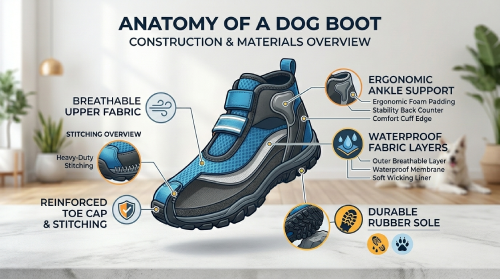
Dog shoe durability depends on the interaction between materials, construction, and the intended application. A thick outsole alone does not guarantee a long-lasting product if the upper tears easily or the fastening system loosens during movement.
| Component | Common durability risk | Recommended evaluation |
|---|---|---|
| Outsole | Abrasion, cracking, loss of traction | Abrasion testing, flexing, visual inspection |
| Upper fabric | Tearing, thinning, surface damage | Tensile, tear, and abrasion tests |
| Stitching | Broken threads, seam opening | Seam-strength testing and repeated-use inspection |
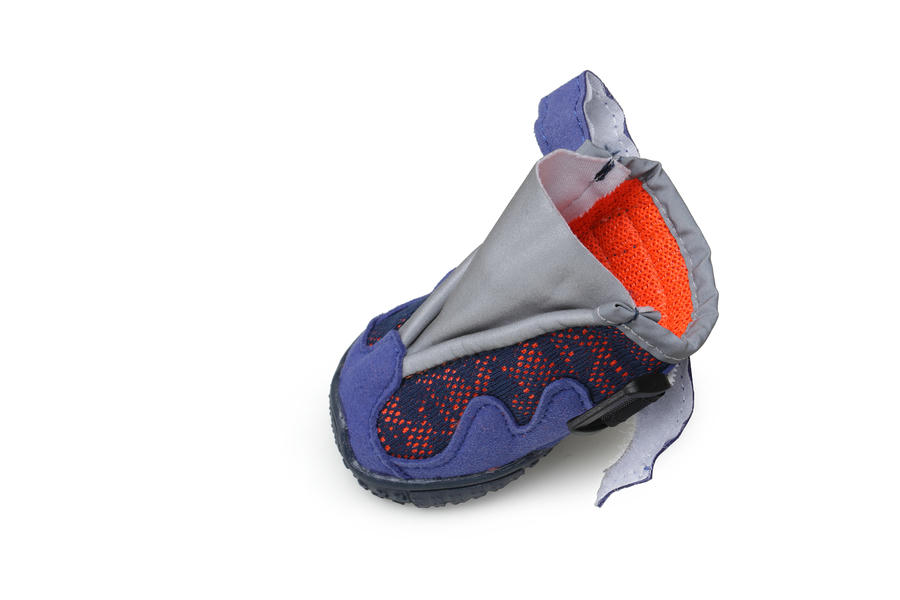
| Hook-and-loop straps | Reduced fastening strength | Repeated fastening cycles and retention testing |
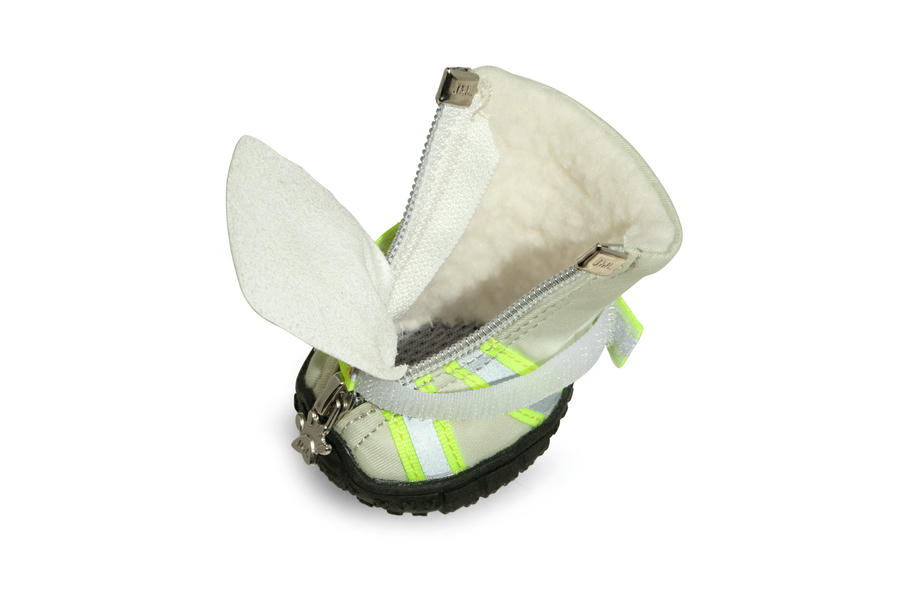
| Zippers and buckles | Breakage, deformation, loosening | Repeated operation and load testing |
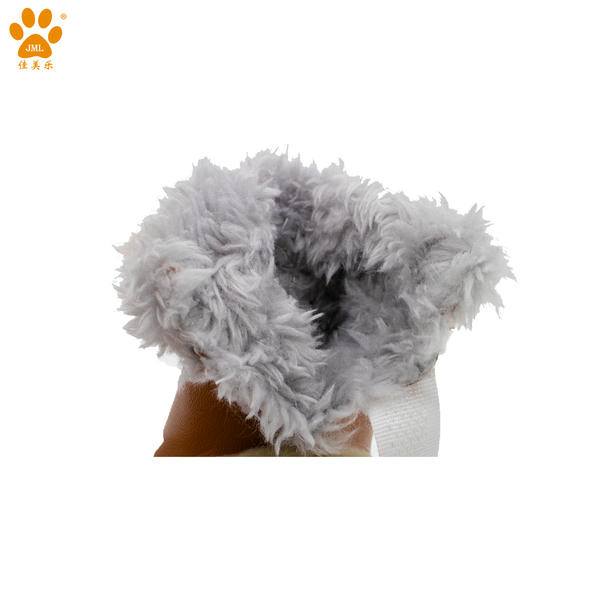
| Lining | Wear, pilling, separation | Abrasion and internal inspection |
| Adhesive joints | Delamination or edge lifting | Bond-strength evaluation and flex testing |
| Waterproof layers | Leakage or coating deterioration | Water-resistance testing before and after flexing |
The testing plan should reflect the product's intended use. Lightweight indoor dog socks, waterproof winter boots, and heavy-duty outdoor dog shoes have different performance requirements. Applying the same acceptance criteria to every product can either overlook important risks or impose unnecessary costs.
How Does the Intended Use Affect Test Selection?
For everyday walking shoes, outsole abrasion and fastening security are usually high-priority tests. For hiking or rugged outdoor boots, buyers should pay greater attention to sole separation, puncture-related risks, seam strength, and repeated flexing. Waterproof models also need water-resistance checks after mechanical stress, because a shoe that initially resists water may leak after its seams or coating have been repeatedly bent.
2. How Should Buyers Prepare Samples for a Dog Shoe Durability Test?
Testing is only useful when the samples represent the actual product being purchased. A prototype made with different materials, adhesives, stitching, or sole thickness may perform differently from the final production version.
Before testing, buyers should document:
- Product model and size.
- Upper, lining, outsole, and reinforcement materials.
- Sole thickness and construction method.
- Stitch type, stitch density, and seam locations.
- Adhesive type and bonding process, where applicable.
- Strap, buckle, zipper, or hook-and-loop specifications.
- Production batch and sample identification.
- Intended use and expected performance requirements.
Where possible, samples should be taken from a representative production batch rather than selected only by the supplier. Buyers should also test multiple samples, since one successful specimen cannot establish consistent quality across a production run.
Why Is Conditioning Important Before Testing?
Temperature, humidity, storage conditions, and moisture can influence the behavior of rubber, textiles, adhesives, and synthetic materials. Samples should be conditioned according to the selected test method when required. The laboratory should record these conditions so results can be compared fairly between suppliers or production batches.
3. How Does a Dog Shoe Abrasion Test Measure Outsole Wear?
A dog shoe abrasion test evaluates how quickly an outsole or other exposed material loses material when rubbed against an abrasive surface under controlled conditions. It is especially relevant for products designed for frequent outdoor walking, rough pavement, or mixed terrain.
A laboratory abrasion machine typically moves a test specimen against an abrasive surface under a defined load and movement pattern. The test may measure mass loss, volume loss, or another method-specific indicator of wear.
A commonly referenced footwear standard is ISO 20871:2018 — Footwear: Test methods for outsoles, abrasion resistance. Rubber materials may also be assessed using ASTM D1630-16(2021), which addresses abrasion resistance of vulcanized rubber compounds used in footwear. These methods are not interchangeable in every situation, and neither automatically establishes a universal pass/fail threshold for dog shoes.
What Equipment Is Used for Outsole Abrasion Testing?
Typical equipment includes an abrasion-testing machine, an appropriate abrasive medium, a specimen holder, a balance where mass loss is measured, and tools for measuring specimen dimensions. The exact equipment and procedure depend on the chosen standard and material.
| Test element | What buyers should confirm |
|---|---|
| Test method | Standard and edition used |
| Specimen | Material, thickness, and preparation |
| Load | Specified force applied during testing |
| Abrasive medium | Type and condition of the abrasive surface |
| Measurement | Mass loss, volume loss, or another defined result |
| Replicates | Number of specimens tested |
| Report | Raw data, average, variation, and observations |
How Should Buyers Interpret Abrasion Results?
Lower material loss generally indicates better abrasion resistance within the same valid test method and comparable material conditions. However, a low abrasion-loss result does not automatically mean a sole offers better grip, greater flexibility, or longer real-world service life.
ASTM specifically cautions that laboratory abrasion results may not correlate directly with actual service performance. Buyers should therefore combine laboratory data with product-level wear simulation and field feedback.
4. How Can a Dog Boot Wear Test Simulate Real-World Use?
A dog boot wear test evaluates the complete shoe rather than an isolated material sample. The objective is to identify failures that emerge when the outsole, upper, seams, lining, and fastening system work together.
A controlled wear simulation may use a mechanical fixture, a suitable articulated test setup, or a defined field-trial protocol. The method should reproduce relevant stresses as consistently as possible without claiming to reproduce every aspect of a dog's natural gait.
A practical test plan can include:
- Record the shoe's initial appearance, dimensions, and component condition.
- Fit the shoe to a suitable test fixture or use a controlled wear protocol.
- Apply a defined number of movement or loading cycles.
- Inspect the sole, upper, seams, and closures at predetermined intervals.
- Record deformation, wear, loosening, cracking, and separation.
- Compare the final condition with predefined acceptance criteria.
The report should distinguish between machine-cycle tests and actual animal wear trials. A specified number of mechanical cycles cannot automatically be translated into a particular number of days or kilometers of use.
What Should Be Inspected After a Wear Simulation?
Inspect the outsole for uneven wear, cracks, and loss of material. Check whether the upper has thinned or torn around flex points. Examine seams near the toe and heel, where movement and friction can concentrate stress. Also check whether the shoe rotates, slips, or loses its fastening tension during the protocol.
Where animal wear trials are conducted, the process should prioritize animal welfare, appropriate supervision, correct fit, and immediate removal if the footwear causes discomfort or interferes with normal movement.
5. How Does Flex Testing Identify Cracks and Structural Weaknesses?
Dog shoes bend repeatedly as paws move. The forefoot area is particularly important because the shoe must accommodate movement without developing cracks, separating at bonded joints, or restricting the paw.
A flex test repeatedly bends a specimen or finished shoe under defined conditions. Depending on the test setup, the laboratory may assess the outsole, complete footwear, upper material, or bonded interface.
ISO 24266:2020 — Footwear: Test methods for the whole shoe, flexing durability describes whole-shoe flexing durability methods. Its procedures should be followed as specified, and results from different methods should not automatically be treated as equivalent.
What Equipment Is Required for Flex Testing?
A flexing machine typically uses a fixture that repeatedly bends the sample through a controlled movement. The test protocol defines relevant factors such as specimen preparation, movement, and inspection intervals.
| Evaluation point | Potential failure |
|---|---|
| Forefoot bending zone | Sole cracking or upper creasing |
| Outsole-upper interface | Bond separation |
| Stitching near flex points | Broken threads or opened seams |
| Coatings and laminates | Cracking, peeling, or delamination |
| Waterproof construction | Leakage after repeated bending |
How Many Flex Cycles Should a Dog Shoe Pass?
There is no single cycle count suitable for every dog shoe. The target should be determined by the product category, material system, intended service conditions, and buyer's risk tolerance. A buyer may set an internal requirement for a defined number of cycles with no critical cracks or separation, but that requirement should be identified as a product specification rather than a universal industry standard.
6. How Can Tensile and Tear Tests Evaluate Dog Shoe Materials?
Tensile testing measures the force required to stretch or break a material or assembly. Tear testing evaluates how a cut, notch, or existing damage may propagate under load. Both are useful for assessing textile uppers, reinforcement panels, straps, and selected flexible components.
These tests are particularly important when a shoe uses lightweight mesh, thin coated fabrics, elastic panels, or narrow straps. A material may feel soft and comfortable but still have insufficient strength for its intended application.
What Is the Difference Between Tensile Strength and Tear Strength?
Tensile strength describes a material's resistance to being pulled apart under a defined test. Tear strength focuses on the force needed to extend a tear. A fabric may perform reasonably well in tensile testing yet remain vulnerable to tearing at a sharp edge, stitch hole, or damaged section.
Buyers should therefore select methods that match the failure mode they are trying to prevent.
Should the Complete Shoe or Individual Materials Be Tested?
Both can be necessary. Material-level tests help compare raw materials before production, while assembly-level tests reveal whether stitching, bonding, reinforcement, and component geometry create weak points.
For example, a strap fabric may have sufficient tensile strength, but the finished strap can still fail if the stitching is too close to the edge or the reinforcement is inadequate. A complete evaluation should consider the material and the way it is assembled.
7. How Should Buyers Test Stitching, Straps, and Fasteners?
Fastening systems determine whether the shoe stays securely in place during movement. Even a durable outsole cannot compensate for a strap that breaks or a hook-and-loop closure that loses its holding power.
A practical fastening test should examine initial strength, repeated operation, and performance after exposure to dirt or moisture when relevant.
| Component | Suggested evaluation | Common warning signs |
|---|---|---|
| Stitching | Seam-strength or pull testing | Thread breakage, seam opening |
| Hook-and-loop closure | Repeated opening and closing | Reduced holding force, fraying |
| Buckles | Repeated fastening and loading | Cracks, deformation, accidental release |
| Zippers | Repeated opening and closing | Jammed teeth, slider failure |
| Elastic straps | Repeated stretching and recovery | Permanent elongation, loss of tension |
The buyer and manufacturer should define the required number of operation cycles and acceptable failure conditions before testing. Those values should reflect the design and application rather than being presented as universal dog-footwear standards.
8. How Can Washing and Water Exposure Tests Reveal Weaknesses?
Some dog shoes are designed for wet-weather use, while others are intended mainly for dry conditions. Testing should match the product claim. A shoe described as washable should be checked after the recommended washing process; a waterproof model should be evaluated for water penetration using an appropriate method.
Water and cleaning can affect adhesives, coatings, textiles, labels, and fastening components. Repeated washing may also change dimensions or stiffness.
What Should a Washing Test Include?
The protocol should specify the washing method, water temperature, detergent if applicable, cycle count, drying procedure, and inspection criteria. Hand washing and machine washing should not be treated as equivalent unless the product instructions and test method explicitly support that comparison.
After washing, inspect for:
- Shrinkage or distortion.
- Color transfer or fading.
- Adhesive failure.
- Loose stitching.
- Cracked or peeling coatings.
- Strap deformation or reduced fastening performance.
- Changes in flexibility and overall fit.
How Should Waterproof Dog Shoes Be Tested?
A water-resistance protocol should define the exposure conditions, duration, and method used to detect penetration. Depending on the construction, testing may need to examine seams, material panels, and the outsole-upper interface.
It is also useful to repeat water-resistance testing after flexing or wear simulation. A product that passes an initial water test may fail after mechanical stress damages its coating, seam, or bonded joint. Claims should be limited to the conditions actually tested.
9. How Do Aging Tests Help Predict Long-Term Durability?
Materials can change over time even when they are not being used continuously. Heat, ultraviolet exposure, humidity, oxidation, and storage conditions may affect rubber, plastics, adhesives, elastic components, and surface coatings.
Accelerated aging tests expose specimens to controlled environmental conditions to identify possible degradation. The method must be selected according to the materials and risks involved.
Which Aging Conditions Matter Most?
Heat exposure may reveal hardening, softening, deformation, or adhesive changes. UV exposure may be relevant to materials exposed to sunlight. Humidity or moisture conditioning can help identify problems in susceptible materials or bonded constructions.
After aging, buyers should compare the sample's condition with its initial state and, where appropriate, repeat relevant mechanical tests such as flexing, tensile, or bond-strength evaluations.
Can Accelerated Aging Prove a Product's Exact Shelf Life?
No. Accelerated aging can reveal vulnerabilities and support comparative evaluation, but it does not automatically translate into a precise number of months or years in real-world use. Any shelf-life claim needs a justified relationship between the laboratory protocol and the expected storage or service conditions.
10. Which Standards Are Relevant to Dog Footwear Testing?
There is no single universal test standard that covers every durability risk in dog shoes. Buyers commonly adapt relevant footwear and material-testing methods, then establish product-specific acceptance criteria.
| Standard or method | Main focus | Important limitation |
|---|---|---|
| ISO 20871:2018 | Abrasion resistance of footwear outsoles | Does not establish overall shoe durability |
| ASTM D1630-16(2021) | Abrasion resistance of vulcanized rubber materials used in footwear | Results may not directly predict service performance |
| ISO 24266:2020 | Flexing durability of whole footwear | Different methods may produce non-comparable results |
| Relevant textile or polymer methods | Tensile, tear, coating, or material performance | Method must match the material and failure mode |
Before accepting a report, confirm the exact standard number, edition, test method, sample preparation, and result units. If a supplier says a product is “tested to international standards,” ask which standards were used and request the corresponding reports.
Passing one material test should never be presented as proof that the complete dog shoe is durable under every use condition.
11. What Testing Equipment Should a Dog Shoe Manufacturer Have Access To?
The required equipment depends on the product range and whether tests are performed in-house or by an external laboratory. Some routine inspections can be completed during production, while specialized abrasion, flexing, or environmental tests may require dedicated laboratory equipment.
| Equipment | Purpose | Typical use |
|---|---|---|
| Abrasion tester | Measures material wear under defined conditions | Outsole and surface materials |
| Flexing tester | Repeats controlled bending | Soles, bonded joints, complete shoes |
| Tensile tester | Measures force under tension | Fabrics, straps, seams, selected assemblies |
| Thickness gauge | Measures material thickness | Soles, fabrics, coatings |
| Precision balance | Measures mass changes | Abrasion or material-loss evaluation |
| Environmental chamber | Controls temperature and, where supported, humidity | Aging and conditioning |
| Water-resistance setup | Evaluates water penetration under defined conditions | Waterproof footwear |
| Visual inspection tools | Identifies visible defects | Incoming materials, samples, production lots |
Buyers should not judge a factory's quality system solely by the number of machines it owns. More important questions include whether the equipment is suitable for the test, properly maintained, calibrated where necessary, operated by trained personnel, and supported by traceable records.
For specialized testing, an independent laboratory may be appropriate. The report should identify the laboratory, test method, sample description, and actual results.
12. How Should Buyers Establish Pass/Fail Criteria for Durability Tests?
A test without an acceptance criterion produces data but does not necessarily support a purchasing decision. Buyers should define critical failure conditions before samples are tested.
A practical specification may distinguish between critical failures, major defects, and minor cosmetic changes.
| Evaluation category | Example of a failure condition | Possible purchasing response |
|---|---|---|
| Structural integrity | Sole separation, major cracking, broken strap | Reject or require redesign |
| Functional performance | Closure no longer secures the shoe | Reject or require corrective action |
| Material durability | Excessive wear against the agreed threshold | Review material or construction |
| Water resistance | Leakage under the specified test conditions | Reject if waterproof performance is required |
| Appearance | Minor cosmetic change without functional impact | Assess against agreed appearance limits |
The examples above are decision-making categories, not universal pass/fail requirements. Numerical thresholds, sample quantities, and allowable defect rates should be agreed upon for the specific product.
A useful specification states the test method, number of specimens, acceptance threshold, inspection interval, and action required if the test fails.
13. How Can Buyers Integrate Durability Testing Into OEM and ODM Development?
Durability should be evaluated during product development rather than only after bulk production. This is especially important for OEM and ODM projects, where changes in sole compounds, fabric suppliers, fastening systems, or construction methods can affect performance.
A structured development process can follow five stages:
- Define the application: Establish the intended terrain, climate, expected use, and product claims.
- Select materials: Compare candidate materials for abrasion, flexibility, strength, comfort, and cost.
- Test prototypes: Identify weaknesses in the sole, upper, seams, and closure system.
- Refine the construction: Adjust materials, thickness, reinforcement, pattern, or bonding process.
- Approve the production specification: Record the final materials, construction details, test requirements, and inspection criteria.
For private-label projects, Guangzhou Petsun's OEM/ODM custom services provide a relevant starting point for discussing customization requirements and product development. Buyers should confirm the available development and testing arrangements directly with the manufacturer and specify any independent laboratory requirements in the project agreement.
After approval, the tested sample should be linked to a controlled specification. Material substitutions and construction changes should trigger a review of whether additional testing is needed.
14. How Should Durability Be Checked During Mass Production?
Prototype approval does not guarantee that every production batch will perform identically. Variations in material lots, stitching tension, adhesive application, curing conditions, or assembly accuracy can affect durability.
A production quality-control plan should identify which characteristics are checked on every batch and which tests are performed periodically or when a material or process changes.
| Production stage | Recommended checks | Purpose |
|---|---|---|
| Incoming materials | Material identity, thickness, appearance, supplier records | Prevent unsuitable inputs |
| In-process production | Stitching, bonding, component alignment | Detect construction problems early |
| Finished-product inspection | Size, appearance, closure operation, visible defects | Confirm product conformity |
| Periodic durability testing | Selected abrasion, flexing, or strength tests | Monitor performance consistency |
| Change control | Review after material or process changes | Prevent unapproved substitutions |
Buyers should agree on inspection frequency and batch acceptance rules in advance. High-risk components may require more frequent checks than cosmetic details.
For wholesale buyers comparing ready-to-ship products, Guangzhou Petsun's in-stock and wholesale services are a useful place to begin discussions about available models, order requirements, and product specifications. Buyers should still confirm the exact model and batch details before placing a large order.
15. What Should a Professional Dog Shoe Durability Test Report Include?
A useful report should allow the buyer to understand what was tested, how it was tested, and whether the result meets the agreed requirement.
At minimum, request:
- Manufacturer and product identification.
- Model, size, material, and batch information.
- Sample quantity and sampling method.
- Test date and testing organization.
- Standard number and edition, where applicable.
- Equipment and test conditions.
- Specimen preparation and conditioning details.
- Individual results and calculated averages, where relevant.
- Photographs of failures or unusual changes.
- Acceptance criteria and pass/fail conclusion.
- Corrective action and retest results, if applicable.
Be cautious of reports that show only a “PASS” statement without identifying the method or threshold. A report should provide enough information to evaluate whether the result is relevant to the product being purchased.
16. Which Questions Should Buyers Ask a Dog Shoe Supplier Before Ordering?
A supplier assessment should cover both technical performance and production consistency. The following checklist can help importers, distributors, and private-label brands compare manufacturers more objectively.
| Question | Why it matters |
|---|---|
| Which materials are used for the outsole, upper, and lining? | Helps evaluate suitability for the intended application |
| Which durability tests have been completed? | Identifies available evidence of product performance |
| Can the supplier provide complete test reports? | Allows verification of test methods and results |
| What acceptance criteria are used? | Clarifies how pass/fail decisions are made |
| Are tests performed in-house or by an external laboratory? | Helps assess testing arrangements and independence |
| What happens if a sample fails? | Reveals the corrective-action process |
| Are production materials controlled against the approved sample? | Reduces the risk of unapproved substitutions |
| How are changes to materials or construction handled? | Ensures changes trigger appropriate review |
| What quality inspections occur during mass production? | Shows how consistency is monitored |
| Can the supplier support customized designs and specifications? | Helps assess suitability for private-label development |
A supplier that explains test limitations, provides traceable results, and documents corrective actions may offer more useful quality assurance than one that relies on broad claims such as “premium quality” or “high durability.”
17. How Can Buyers Balance Durability, Comfort, and Cost?
Maximum durability is not always the best design target. A very thick or stiff outsole may resist wear but make the shoe heavy or restrict natural paw movement. Heavy reinforcement may increase strength while also increasing cost and reducing flexibility.
The objective is to match the construction to the intended use and price position.
| Product positioning | Main design priority | Testing emphasis |
|---|---|---|
| Entry-level indoor footwear | Cost control and basic function | Seam integrity, closure function, basic wear |
| Everyday walking shoes | Balanced wear and flexibility | Abrasion, flexing, fastening retention |
| Outdoor and hiking footwear | Greater resistance to demanding use | Abrasion, flexing, seam strength, bond integrity |
| Waterproof footwear | Water resistance and construction integrity | Water exposure before and after flexing |
| Customized premium products | Performance consistency and differentiated features | Risk-based combination of relevant tests |
Material selection should therefore be based on more than unit price. Buyers should consider the cost of defects, returns, replacement shipments, customer dissatisfaction, and potential damage to their brand.
A well-designed testing plan helps determine where a more expensive material provides measurable value and where additional reinforcement may be unnecessary.
How Can Buyers Build a Reliable Dog Shoe Durability Testing Process?
A reliable dog shoe durability test program combines abrasion testing, wear simulation, flexing, tensile and tear evaluation, fastening checks, washing or water exposure, and aging where relevant. The exact combination depends on the shoe's construction, intended application, and performance claims.
B2B buyers should define the test plan before sample approval, use methods appropriate to the material and failure mode, establish measurable acceptance criteria, and retain reports that can be traced to the approved product specification. Laboratory testing should support—not replace—production quality control and real-world feedback.
For buyers developing a new product, Guangzhou Petsun's dog footwear product range can help identify relevant constructions, while its OEM/ODM custom services provide a starting point for discussing customized development requirements. Buyers seeking available products for wholesale can also review the in-stock services.
Ultimately, the strongest purchasing decision comes from combining documented test results, clear product specifications, consistent manufacturing controls, and realistic expectations about how the dog shoes will be used.
Dog Shoe Sole Adhesion Testing
Best Dog Paw Protection: Keep Paws Safe in All Weather
Related Article