Stitching vs Bonded Construction for Dog Shoes
Stitching vs Bonded Construction for Dog Shoes
If you have ever held a torn dog boot in your hands, examining the frayed threads or the peeling sole, you already know that not all pet footwear is built the same. For the end consumer, a failed boot means a frustrated dog, a ruined hike, and a wasted purchase. For pet brands, wholesalers, and distributors, the consequences are far more severe: skyrocketing return rates, damaging customer reviews, and a rapid erosion of hard-earned brand equity.
At PetSun, we see this dynamic every day. We understand that the secret to a successful, long-lasting pet footwear line lies beneath the surface, in the foundational engineering of the product. The debate between stitching and bonding is not just a technical footnote; it is the absolute core of dog shoe construction methods. To help you make informed, strategic decisions for your product line, let’s pull back the curtain and deeply explore how these techniques impact quality, cost, and performance. You can explore how we apply these advanced engineering techniques across our diverse, rigorously tested catalog at www.petshoe.com.
What Is the Fundamental Mechanical Difference Between Stitching and Bonding in Dog Footwear?
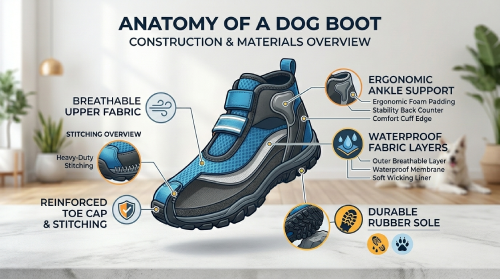
At its core, the difference lies in the physics of how the upper material is connected to the outsole. Stitching is a mechanical interlocking process. It utilizes heavy-duty, high-tenacity thread and industrial sewing machines to physically pierce the upper material and a midsole (often a Strobel board), tying the components together through friction and tension.
Bonding, on the other hand, is a chemical and thermal fusion process. It relies on specialized adhesives (such as advanced cold cement systems) or direct injection molding to create a molecular-level bond between the upper and the outsole. Instead of piercing the materials, bonding treats the surfaces chemically and thermally to merge them into a seamless, unified structure without introducing physical perforations.
How Do Stitched Dog Shoes Perform Under Dynamic Stress, and Where Do They Excel?
When executed with high-quality materials and precision machinery, stitched dog shoes offer remarkable biomechanical benefits, particularly in flexibility and breathability. Because the materials are not fused together with rigid adhesives, stitched boots retain a highly pliable, natural feel that closely mimics a dog’s bare paw movement.
This makes them exceptionally well-suited for warm-weather activities, casual neighborhood walks, or indoor use on slick floors. Furthermore, stitching allows manufacturers to utilize highly breathable, lightweight mesh uppers without the risk of heat-sensitive adhesives melting, degrading, or off-gassing onto the fabric. From a consumer perspective, this translates to a lightweight, "barely-there" comfort that dogs are psychologically more willing to accept and keep on their paws.
What Are the Hidden, Long-Term Vulnerabilities of Traditional Stitched Dog Boots?
Despite their superior flexibility, traditional stitching introduces a critical, inherent weakness: the needle hole. Every single stitch creates a microscopic puncture through the upper, the waterproof membrane (if present), and the sole. In dry, controlled conditions, this is irrelevant. However, when a dog steps into a puddle, deep mud, or snow, those needle holes act as capillaries. Through capillary action, moisture is actively drawn up the thread and into the interior of the boot.
Additionally, the thread itself is a vulnerable component. Constant abrasion against rough terrain, combined with prolonged exposure to UV rays, moisture, and dirt, can cause synthetic threads to fray, rot, or snap over time. When evaluating stitched vs glued dog shoes, this inherent vulnerability to moisture infiltration and seam blowout (particularly at high-stress areas like the dewclaw) is the primary engineering trade-off.
How Does Advanced Bonded Construction Revolutionize Modern Dog Boot Manufacturing Techniques?
Advanced bonding has completely transformed dog boot manufacturing techniques, shifting the industry toward higher performance, consistency, and reliability. Modern cold cement processes are far from the simple "superglue" of the past. This is why, at PetSun, our engineering team insists on a meticulous, multi-step procedure: the bonding surfaces are mechanically roughed (buffed) to increase surface area, specialized chemical primers are applied, the adhesive is heat-activated, and the components are joined using high-pressure pressing machines to forge an unbreakable, uniform bond.
Even more advanced is direct injection molding. In this process, liquid polyurethane (PU) or rubber is injected directly into a steel mold that already contains the pre-formed upper. The material cures and fuses with the upper, creating a single, seamless piece. This completely eliminates the "weakest link" of thread, resulting in a structurally superior product.
Why Are Bonded Dog Shoes the Undisputed Champion for Waterproof and Winter Applications?
For winter snow boots, heavy-duty hiking footwear, or rain boots, bonded dog shoes are overwhelmingly the superior, and often the only viable, choice. Because there are no needle holes piercing the waterproof membrane or the upper material, the boot maintains a continuous, impenetrable barrier against the elements.
This seamless construction prevents snow, slush, and corrosive road salts from seeping into the boot and degrading the interior lining or the dog’s paw. For the end consumer, this means the product actually delivers on its core "waterproof" marketing promise, keeping the dog’s paws genuinely dry and warm. For the B2B buyer, it means drastically fewer warranty claims related to water damage and material degradation.
What Are the Real, Total Cost Implications of Stitched vs Glued Dog Shoes for B2B Buyers?
Understanding the cost dynamics is crucial for strategic procurement. On the surface, basic stitching might appear cheaper due to lower initial tooling costs (no expensive steel molds are required). However, this is often a short-term illusion. Stitched boots require more manual labor for complex assemblies and carry a higher risk of quality inconsistency, such as skipped stitches, uneven tension, or human error.
Conversely, while bonded construction (especially injection molding) requires a higher upfront investment in mold development and specialized machinery, the per-unit marginal cost drops significantly at scale due to automation, speed, and material efficiency. At PetSun, we always advise our B2B clients to calculate the Total Cost of Ownership (TCO). When you factor in the "hidden costs" of manufacturing—such as return shipping, replacement units, and the intangible cost of brand damage—high-quality bonded construction often yields a much healthier long-term profit margin and stronger brand reputation.
How Do These Dog Shoe Construction Methods Directly Impact the End Consumer’s Daily Experience?
The construction method directly dictates how the product feels, functions, and survives in the real world. A poorly stitched boot might feel light initially, but once water wicks through the seams, it becomes waterlogged, heavy, and cold, causing the dog to limp or refuse to walk. A poorly bonded boot might feel stiff, or worse, experience catastrophic delamination (peeling) at the toe after just a few weeks of use.
However, a well-executed bonded boot provides robust, confident traction and protection, allowing the owner to hike in any weather with absolute peace of mind. A well-executed stitched boot provides a barely-there, breathable feel perfect for protecting sensitive paws from hot summer pavement. The key is aligning the construction method with the intended user experience and environmental demands.
Which Construction Method Is Best Suited for Specific Pet Footwear Scenarios and Market Niches?
There is no single "best" method; there is only the best method for a specific use case and target market.
- Choose Stitching For: Summer booties, lightweight casual shoes, breathable mesh designs, and products where maximum flexibility, low weight, and cost-effective entry-level pricing are the primary selling points.
- Choose Bonding For: Winter snow boots, heavy-duty all-terrain hiking boots, waterproof rain boots, and premium products marketed for rugged, long-lasting durability.
Forward-thinking brands often utilize a sophisticated hybrid approach: using stitched construction for the upper ankle collar (to maximize flexibility and comfort) while utilizing bonded or injection-molded construction for the toe cap and sole (to guarantee durability and waterproofing where it matters most).
How Can B2B Buyers Rigorously Evaluate Stitching and Bonding Quality During Sample Approval?
Never approve a manufacturing sample based on aesthetics alone. You must stress-test the construction to verify the factory’s capabilities.
- For Stitching: Check the Stitches Per Inch (SPI). It should be dense, uniform, and tight. Look for bartack reinforcement at high-stress points (like strap anchors and the toe box). Perform a manual "pull test" on the seams to ensure the thread doesn’t easily snap, stretch, or unravel.
- For Bonding: Perform a rigorous peel test. Try to separate the sole from the upper at the toe and heel using firm, steady pressure. There should be zero give or separation. Inspect the perimeter for "glue bleed" (messy adhesive overflow), which is a hallmark of sloppy, low-quality manufacturing. Finally, flex the shoe aggressively 50 times; if the bond cracks, whitens, or separates, the adhesive or molding process is fundamentally flawed.
How Does a Strategic Manufacturing Partner Like PetSun Optimize These Methods for Global Brands?
Navigating these technical nuances requires deep, hands-on manufacturing expertise. This is exactly why partnering with an experienced leader like PetSun provides immense, tangible value to global buyers. We don’t just blindly follow a tech pack; we actively consult with our clients to determine the optimal construction method for their specific target market, price point, and performance requirements.
Whether your brand’s vision requires the intricate, breathable precision of advanced stitching or the rugged, seamless durability of injection-molded bonding, our engineering and quality control teams ensure the execution is flawless, scalable, and rigorously tested before it ever reaches your customers. By making informed, science-backed decisions about dog shoe construction methods, you are not just manufacturing a product; you are building a legacy of trust and reliability with your end consumers.
Comprehensive Comparison: Stitching vs Bonded Construction for Dog Shoes
To help you visualize the key differences and make an informed decision for your product line, here is a detailed comparison table:
| Feature | Stitched Construction | Bonded Construction |
|---|---|---|
| Primary Connection Method | Mechanical (thread & needle) | Chemical/Thermal (adhesive or injection molding) |
| Waterproof Capability | Low to Moderate (needle holes allow moisture wicking) | Excellent (seamless barrier, no perforations) |
| Flexibility & Natural Feel | Excellent (highly pliable, mimics bare paw movement) | Good to Moderate (can be stiffer, depends on adhesive/mold) |
| Breathability | Excellent (ideal for mesh uppers) | Moderate (depends on upper material, not the bond) |
| Durability in Rough Terrain | Moderate (thread can fray, seams can blow out) | Excellent (superior resistance to abrasion and delamination) |
| Resistance to Moisture/Salts | Low (thread rots, moisture wicks through holes) | High (impervious to water, salts, and mud intrusion) |
| Initial Tooling Cost | Low (no expensive molds required) | High (steel molds and specialized machinery required) |
| Per-Unit Cost at Scale | Higher (more manual labor, slower production) | Lower (highly automated, faster production cycles) |
| Production Speed | Slower (labor-intensive assembly) | Faster (automated molding/pressing) |
| Quality Consistency | Variable (dependent on operator skill) | High (machine-controlled precision) |
| Repairability | Moderate (can be re-stitched by a cobbler) | Low (difficult to re-bond once separated) |
| Best Use Cases | Summer booties, casual shoes, breathable mesh designs | Winter boots, hiking boots, waterproof rain boots |
| Weight | Lightweight | Moderate to Heavy (depends on sole thickness) |
| Risk of Failure | Seam blowout, thread rot, water wicking | Delamination (if poor adhesive process), sole cracking |
| Environmental Impact | Moderate (thread waste, energy for sewing) | Variable (chemical adhesives vs. recyclable TPU/Rubber) |
| Minimum Order Quantity (MOQ) | Lower (flexible for small batches) | Higher (due to mold amortization costs) |
| Customization Flexibility | High (easy to change patterns/materials) | Low (mold changes are expensive and time-consuming) |
Key Takeaways for B2B Buyers:
-
Choose Stitching If: You are launching a lightweight, breathable summer line, testing a new market with low MOQs, or targeting a budget-conscious consumer segment where flexibility is prioritized over rugged durability.
-
Choose Bonding If: You are building a premium, all-weather brand, require strict waterproof guarantees, plan to scale to high volumes (1,000+ units), and want to minimize long-term warranty claims and returns.
-
The Hybrid Approach: As mentioned earlier, the most sophisticated products often combine both. A bonded sole guarantees waterproofing and traction, while a stitched upper collar ensures comfort and flexibility. This is the route PetSun often recommends for brands aiming for the high-end performance market.
By carefully weighing these factors against your brand's specific goals, price points, and target audience, you can select the construction method that not only builds a better shoe but also builds a stronger, more profitable business.
What Materials Are Best for Dog Shoes
What Makes a Durable Dog Shoe
Related Article