What is the Dog Shoe Quality Control Process
This is exactly why a rigorous dog shoe quality control system is not just an operational checkbox; it is the absolute backbone of a profitable, sustainable business. At Guangzhou Petsun, we understand that true quality is engineered into the product from the ground up and fiercely protected at every stage of manufacturing. Let’s walk through the factory floor and pull back the curtain on a world-class dog shoe QC process that guarantees your inventory is always retail-ready.
Why Is a Rigorous Dog Shoe Quality Control Process the Backbone of Brand Reputation?
In the B2B landscape, your customers are not just buying a pair of shoes for their dog; they are buying protection, safety, and peace of mind. If a winter boot leaks or a hiking shoe delaminates on a rocky trail, the end consumer blames your brand, not the factory. A comprehensive dog footwear quality check ensures that every single unit leaving the facility meets exact performance specifications. It shifts the manufacturing paradigm from reactive damage control to proactive defect prevention, safeguarding your profit margins and ensuring long-term brand loyalty.
How Does Incoming Quality Control (IQC) Prevent Flawed Materials from Entering the Production Line?
The journey of a flawless dog shoe begins long before assembly starts. Incoming Quality Control (IQC) is the first line of defense. If substandard raw materials—such as low-grade adhesives, weak nylon, or brittle rubber—are allowed into the warehouse, no amount of skilled craftsmanship can save the final product. At Guangzhou Petsun, our IQC team rigorously inspects every batch of raw materials against strict engineering tolerances before they are ever moved to the cutting room.
The 4-Point System for Fabric Inspection and Rubber Hardness Testing
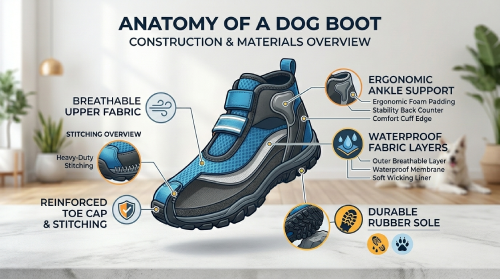
To guarantee material integrity, we utilize highly specialized testing protocols. For dog shoe upper materials like ballistic nylon or Cordura®, we employ the textile 4-Point System. Inspectors run the fabric rolls over lighted inspection machines, assigning penalty points for any holes, yarn slubs, or dye lot inconsistencies. A roll exceeding the acceptable penalty threshold is immediately rejected.
Simultaneously, for outsole materials, we use a calibrated Shore A Durometer to test rubber hardness. If a batch of Thermoplastic Rubber (TPR) is too hard, it will lack traction and crack in the cold; if it is too soft, it will wear down rapidly on asphalt. By strictly enforcing a Shore A tolerance (typically between 60A and 70A), we ensure the sole provides the perfect balance of grip and longevity.
What Happens During In-Process Quality Control (IPQC) on the Factory Floor?
Once materials are approved, production begins. In-Process Quality Control (IPQC) involves continuous, roaming inspections by dedicated QC specialists right on the assembly line. The goal of IPQC is to catch micro-errors in real-time, preventing a small machine calibration issue from ruining thousands of units. This phase of the dog shoe QC process focuses heavily on stitching tension, adhesive application, and component alignment.
Stitching Tension Monitoring and Adhesive Bonding Verification
During the sewing phase, IPQC inspectors randomly pull units off the line to measure the Stitches Per Inch (SPI). Too few stitches compromise structural integrity, while too many can perforate and weaken the fabric. They also verify that high-stress areas, like strap anchors, feature proper bartack reinforcement.
In the bonding and lasting rooms, the focus shifts to chemistry and thermodynamics. For cold-cement bonded boots, inspectors use infrared thermometers to verify that the heat-activation tunnels are maintaining the exact temperature required to properly cure the primer and adhesive. If the temperature drops even a few degrees, the molecular bond will fail, leading to sole separation in the field.
How Is Final Random Inspection (FRI) Conducted Before Packaging?
Once the shoes are fully assembled, cleaned, and prepared for packaging, they undergo Final Random Inspection (FRI). This is the ultimate gatekeeper before the goods are boxed and palletized. FRI is not a 100% check of every single shoe, which would be cost-prohibitive and slow; rather, it is a statistically significant sampling method designed to evaluate the overall health of the entire production batch.
AQL 2.5 Standards and Real-World Simulated Wear Testing
Guangzhou Petsun strictly adheres to the international AQL (Acceptable Quality Limit) 2.5 standard for major defects and AQL 4.0 for minor defects. Using standard statistical sampling tables (like ISO 2859-1), our inspectors randomly pull a specific number of cartons and pairs based on the total order quantity.
During this dog boot inspection, inspectors conduct destructive and non-destructive tests. They perform manual peel tests on the soles, aggressively flex the shoes to check for cracking, and verify that left and right shoes are perfectly symmetrical. Furthermore, we conduct real-world simulated wear tests, such as dragging the toe caps across abrasive surfaces to ensure the reinforced rubber guards will not scuff or tear during a dog's normal gait.
Which Advanced Testing Equipment Is Used for Dog Boot Inspection?
While the trained human eye is invaluable, modern dog shoe quality control relies heavily on precision laboratory equipment to validate performance claims. In our testing lab, we utilize:
- Martindale Abrasion Testers: To simulate thousands of rubbing cycles on upper fabrics, ensuring they won't fray from a dog's claws or rough terrain.
- Dynamic Flexing Machines: Which bend the shoe sole 50,000+ times at specific angles to guarantee the rubber compound and bonding will not suffer from flex-fatigue cracking.
- Electronic Tensile Testing Machines: To measure the exact Newton force required to rip a seam apart or peel the sole from the upper, providing hard data on structural integrity.
What Are the Industry-Standard Metrics for a Comprehensive Dog Footwear Quality Check?
A holistic dog footwear quality check goes far beyond just structural durability. It encompasses aesthetics, safety, and compliance. Key metrics include:
- Dimensional Tolerances: Verifying that the internal volume and strap lengths perfectly match the graded size chart (from XS to XL).
- Color Fastness & Delta E: Using spectrophotometers to ensure the dye won't bleed when wet and that the color perfectly matches the approved Pantone swatch.
- Chemical & Odor Compliance: Ensuring all adhesives, plastics, and fabrics are free from toxic phthalates, heavy metals, and harsh chemical odors, meeting global safety standards like REACH or California Prop 65.
How Does Guangzhou Petsun Handle Non-Conforming Products and Defect Rectification?
Finding a defect is only half the battle; how a manufacturer responds to it defines their reliability. When a batch fails the dog shoe QC process, Guangzhou Petsun initiates a strict Non-Conforming Product (NCP) protocol. The defective batch is immediately quarantined in a designated red zone to prevent accidental shipping.
Our engineering team then conducts a Root Cause Analysis (RCA) using methodologies like the "5 Whys" or Fishbone diagrams. Was it a bad batch of glue? A dull cutting die? Operator fatigue? Once the root cause is identified and corrected, the batch is either entirely reworked under strict supervision or completely scrapped and remanufactured. We then issue an 8D (Eight Disciplines) report to the client, ensuring total transparency and preventing the issue from ever recurring.
How Does the Dog Shoe QC Process Differ for OEM/ODM vs. Wholesale Orders?
While the core standards remain uncompromising, the QC workflow adapts to the specific nature of your order.
For brands developing entirely new concepts, our OEM and ODM Custom Services involve a rigorous First Article Inspection (FAI). Before mass production begins, we produce a "Golden Sample" that undergoes exhaustive lab testing and field testing on actual dogs. Every material, stitch pattern, and mold dimension is locked in and signed off by the client. Mass production QC then strictly measures every unit against this Golden Sample.
Conversely, for buyers looking for rapid inventory replenishment, our Wholesale In-Stock Services focus heavily on batch consistency and rapid turnaround. Because the molds and material supply chains for these proven, best-selling models are already dialed in, our QC team focuses intensely on FRI and packaging accuracy, ensuring your ready-to-ship inventory is flawless and dispatched without delay.
Why Should B2B Buyers Demand Full Transparency in the Dog Shoe QC Process?
In global manufacturing, distance breeds anxiety. You should never have to guess whether your manufacturer is cutting corners. A top-tier partner will proactively provide detailed, photo-documented QC reports after every major inspection milestone. At Guangzhou Petsun, we encourage our B2B clients to hire independent third-party inspection agencies (like SGS, Intertek, or Bureau Veritas) to audit our facilities and verify our dog shoe quality control data. We welcome this scrutiny because our internal standards are designed to exceed external expectations.
How Can You Partner with a Manufacturer That Prioritizes Dog Shoe Quality Control?
Choosing a manufacturing partner is one of the most critical decisions you will make for your pet brand. You need a team that views quality control not as a bottleneck to rush through, but as a sacred promise to the end consumer and the dog wearing the product.
By partnering with Guangzhou Petsun, you are aligning your brand with decades of specialized footwear engineering, uncompromising material science, and a relentless dedication to defect prevention. We invite you to explore our meticulously crafted, rigorously tested catalog and see the difference that a true quality-first mindset makes. Discover our full range of performance pet footwear solutions at www.petshoe.com and let’s build a product line that your customers will trust for years to come.
Dog Shoe Supplier Checklist
How to Select Materials for Dog Shoes
Related Article